
QIE Blockchain's Breakout Potential in 2025: The Asymmetric Upside of Utility-Driven Enterprise Adoption
The Technical Edge: Speed, Scalability, and Deflationary Design
QIE's architecture is engineered for enterprise-grade utility. It combines EthereumETH-- Virtual Machine (EVM) compatibility with Cosmos-based infrastructure, enabling seamless integration with Ethereum-based apps while facilitating cross-chain communication. This "multilingual" design allows enterprises to deploy solutions without sacrificing interoperability. For instance, QIE's 3-second finality and 25,000+ transactions per second (TPS) outperform legacy systems like BitcoinBTC-- and Ethereum, which struggle with scalability and high fees.
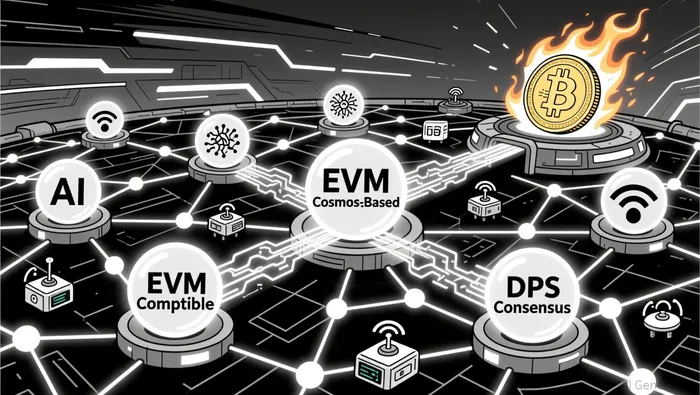
The network's deflationary model further enhances its appeal. By burning 80% of gas fees and capping supply at 150 million coins, QIE creates scarcity and aligns incentives for long-term adoption. This contrasts with inflationary models like Bitcoin, where supply growth dilutes value. As of 2025, QIE's validator model-built on Delegated Proof-of-Stake (DPoS)- offers predictable rewards and lower entry barriers than Bitcoin mining, attracting a broader base of participants.
Enterprise Adoption: From Pilot Projects to Production-Grade Solutions
Enterprises are no longer testing blockchain in silos; they are scaling it into production environments. For example, Walmart's IBM Food Trust system reduced food safety incident response times to 2.2 seconds, while JPMorgan's JPM Coin cut cross-border payment costs by 25%. QIE's partnerships and use cases mirror this shift.
A standout collaboration is with KrypToon, a Web3 gaming platform leveraging QIE's EVM compatibility and low fees to develop decentralized applications (dApps) with minimal technical barriers. This partnership highlights QIE's role in powering Web3 gaming, where 3-second finality and negligible fees enable real-time interactions. Beyond gaming, QIE's infrastructure supports DeFi, identity verification, and AI modules, positioning it as a "global decentralized operating system".
QIE's developer ecosystem further accelerates adoption. With tools like QIEDex (a decentralized exchange), QIE Wallet (a non-custodial smart wallet), and free oracles, the network has attracted over 1,300 developers in its first hackathon, funding 50+ dApps annually. This developer-first approach mirrors the success of Ethereum in the early 2020s, where community-driven innovation fueled ecosystem growth.
Market Dynamics: Regulatory Clarity and Integration with AI/IoT
Regulatory frameworks like the EU's MiCA and U.S. guidance have provided enterprises with clear compliance pathways, reducing the risk of adoption. QIE's design inherently aligns with these regulations, offering privacy-preserving features like zero-knowledge proofs and permissioned modules for sensitive data.
Moreover, QIE's integration with AI and IoT amplifies its utility. For example, IoT devices generate vast data streams that require secure, tamper-proof storage-a challenge QIE addresses with its fast settlement and MEV protection. In healthcare, blockchain is securing patient records and drug traceability, as seen in Estonia's e-Health system. QIE's free oracles and cross-chain bridges enable similar use cases, making it a versatile platform for industries like finance, logistics, and healthcare.
Asymmetric Upside: Solving Enterprise Pain Points
Enterprises adopt blockchain to solve specific pain points: reducing operational costs, improving transparency, and enhancing security. QIE's asymmetric upside lies in its ability to address these challenges while avoiding the pitfalls of legacy systems. For instance, its DPoS validator model reduces energy consumption by 99% compared to Bitcoin mining, appealing to sustainability-focused enterprises.
In finance, QIE's Orion-like platforms (e.g., HSBC's asset tokenization) could reduce post-trade reconciliation efforts by 60%, mirroring the success of permissioned DLT systems. In supply chain, its traceability features could replicate Walmart's 25% inventory shrinkage reduction. These use cases demonstrate QIE's potential to become a backbone for enterprise blockchain, outpacing competitors focused on speculative metrics like total value locked (TVL).
Challenges and QIE's Counterstrategies
Despite its strengths, QIE faces challenges like integration complexity and the need for skilled developers. However, its partnerships with platforms like Alchemy PayACH-- and NOWPayments simplify adoption, while hackathons and grants attract talent. Additionally, QIE's deflationary model and strategic focus on real-world utility mitigate risks associated with market volatility, offering a more stable value proposition than speculative L1s.
Conclusion: A Breakout Candidate in 2025
QIE Blockchain is not just another blockchain-it's a purpose-built infrastructure for enterprise adoption. Its technical advantages, strategic partnerships, and alignment with regulatory and technological trends position it to capture a significant share of the $393.42 billion blockchain market by 2032. As enterprises move beyond pilots and into production-grade systems, QIE's utility-driven approach offers an asymmetric upside: solving real-world problems while creating long-term value for stakeholders. For investors, this represents a rare opportunity to back a network that is not only undervalued but also fundamentally reshaping the enterprise blockchain landscape.







Comentarios
Aún no hay comentarios