
Qiagen's Strategic Position in the Evolving MedTech Landscape
Qiagen (QGEN) has emerged as a pivotal player in the MedTech sector, leveraging its innovative diagnostics portfolio and disciplined capital allocation to navigate a complex market environment. Following its presentation at the Morgan StanleyMS-- Healthcare Conference in 2025, the company's strategic initiatives and financial resilience have drawn significant investor attention. This analysis evaluates Qiagen's valuation resilience and long-term growth potential, contextualizing its recent performance against broader industry trends and institutional sentiment.
Financial Resilience and Strategic Execution
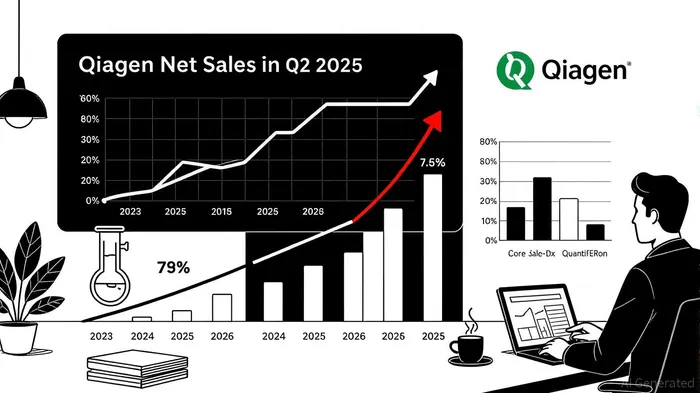
Qiagen's Q2 2025 results underscored its ability to deliver consistent growth amid macroeconomic headwinds. Net sales rose 7% year-over-year to $534 million, with core sales increasing 6% at constant exchange rates (CER) [1]. This outperformance was driven by robust demand for its QIAstat-Dx and QuantiFERON platforms, which grew 41% and 11% at CER, respectively [2]. The company also raised its full-year 2025 sales guidance to 4–5% CER growth, reaffirming an adjusted EPS target of $2.35 at CER [3]. Such guidance reflects confidence in its ability to scale high-margin products while managing operational efficiency, as evidenced by a 29.9% operating income margin in Q2 2025 [4].
A critical catalyst for long-term growth is Qiagen's product innovation pipeline. The recent FDA clearance of QIAstat-Dx Rise—a higher-throughput syndromic testing system—positions the company to capture a larger share of the U.S. diagnostics market, where automation and rapid testing demand are accelerating [5]. With over 4,600 QIAstat-Dx instruments already deployed globally, the new platform's scalability could further amplify revenue synergies [6].
Valuation Resilience and Institutional Sentiment
Despite a 5.49% post-earnings stock dip, Qiagen's valuation remains anchored by strong institutional backing. As of Q2 2025, 316 hedge funds and institutions held $7.23 billion in QiagenQGEN-- shares, with 64 funds initiating new positions and 121 increasing stakes [7]. Analyst price targets also suggest resilience: the average 12-month target of $51.86 implies a 9.1% upside from its post-earnings closing price of $47.49 [8]. Morgan Stanley's Aisyah Noor, who presented at the conference, maintained a “Hold” rating but raised her target to $50.63, citing Horizon Europe funding prospects and the company's disciplined capital allocation [9].
Qiagen's commitment to shareholder returns further bolsters its valuation case. The company announced a $500 million share repurchase authorization and pledged to return at least $1 billion to shareholders by 2028 [10]. These measures, combined with a strong balance sheet, signal a strategic focus on balancing growth investments with capital efficiency—a critical differentiator in a sector marked by R&D intensity.
Challenges and Risks
Qiagen's trajectory is not without risks. Persistent challenges in China, where regulatory shifts and economic slowdowns have dampened demand, remain a near-term concern [11]. Additionally, the research and academia sectors—key markets for Qiagen's consumables—have shown sluggish growth, potentially limiting diversification benefits [12]. Tariff uncertainties and NIH budget volatility could also impact U.S. operations, though the company's global footprint and product diversification mitigate some of these risks.
Conclusion: A Balanced Outlook for Long-Term Investors
Qiagen's strategic pillars—innovation in syndromic testing, disciplined capital allocation, and a focus on high-growth markets—position it to outperform in the evolving MedTech landscape. While near-term headwinds exist, the company's ability to raise guidance, secure product approvals, and attract institutional capital suggests valuation resilience. For investors, the key question is whether Qiagen can sustain its 40%+ growth rates in QIAstat-Dx and similar platforms while navigating macroeconomic pressures. If the company executes on its 2025 roadmap, its long-term growth potential appears well-supported by both financial fundamentals and market dynamics.





Comentarios
Aún no hay comentarios