
Qatar's Energy Ambitions: A Strategic Nexus for Global Markets and Investment Opportunities
Qatar's Energy Ambitions: A Strategic Nexus for Global Markets and Investment Opportunities
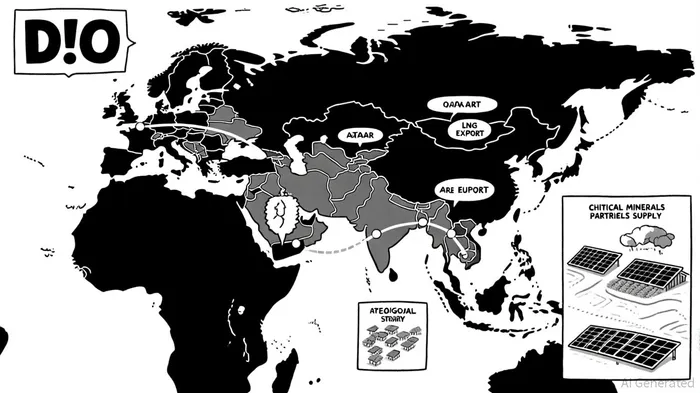
Qatar's strategic positioning at the crossroads of global energy markets and geopolitical dynamics has transformed it into a pivotal player in the 21st-century energy transition. By 2025, the country is not only expanding its liquefied natural gas (LNG) dominance but also accelerating investments in renewable energy and critical minerals, all while navigating a complex web of international alliances. For investors, this confluence of factors presents a unique opportunity to engage with a nation that is redefining its energy legacy.
Geopolitical Leverage and LNG Supremacy
Qatar's geopolitical strategy is anchored in its control over global LNG markets. By 2030, the country aims to increase its LNG production capacity from 77 million metric tons per year (MTPA) to 142 MTPA, a surge that will position it to supply nearly 25% of the world's LNG demand, a Columbia Energy Policy report. This expansion, driven by the North Field East and North Field South projects, is underpinned by partnerships with global energy giants like ShellSHEL--, TotalEnergiesTTE--, and ExxonMobil, the U.S. State Department notes. Such projects are not merely about scale; they reflect Qatar's calculated approach to securing long-term market influence.
The Columbia Energy Policy report further notes Qatar's preference for long-term contracts with fixed destination clauses, which allows it to manage supply volatility and pricing dynamics. However, as of mid-2025, 75% of its new LNG capacity remains uncontracted, creating a strategic dilemma: will Qatar flood the market to suppress prices or withhold volumes to maintain premium pricing? This uncertainty underscores the need for investors to monitor Qatar's market decisions, which could reshape global gas economics.
Renewable Energy and the Energy Transition
While LNG remains central to Qatar's energy strategy, the country is also pivoting toward sustainability. By 2025, QatarEnergy has commissioned two solar photovoltaic (PV) projects with a combined capacity of 875 MW, part of a broader target to achieve 4 GW of centralized and 1.2 GW of distributed renewable energy by 2030, The Peninsula reports. The Al Kharsaah Solar Power Plant, a joint venture with TotalEnergies and Marubeni, exemplifies this shift, with its 800 MW capacity projected to reduce emissions by 26 million metric tons over its lifetime, the ME Council report.
Qatar's investments extend beyond its borders. A partnership with TotalEnergies to develop a 1.25 GW solar project in Iraq highlights its regional leadership in the energy transition. These initiatives align with the country's National Vision 2030, which seeks to diversify its economy while maintaining energy leadership. For investors, Qatar's dual focus on LNG and renewables offers a balanced portfolio of high-yield and long-term sustainable assets.
Critical Minerals and Supply Chain Security
A less-discussed but equally vital aspect of Qatar's energy strategy is its foray into critical minerals. The Qatar Investment Authority (QIA) has invested in companies like TechMet and Rainbow Rare Earths, securing supply chains for rare earth elements essential to renewable technologies, as reported by regional coverage of Qatar's expanding energy strategy. This move positions Qatar as a key player in the global energy transition, where mineral scarcity is a growing concern. Investors in this sector can capitalize on Qatar's strategic foresight, which mirrors the U.S. and China's own mineral security initiatives.
Foreign Investment Opportunities and Policy Framework
Qatar's government has implemented a robust policy framework to attract foreign capital. The third National Development Strategy (2024–2030) targets $100 billion in inward foreign direct investment (FDI) by 2030, supported by full foreign ownership laws, tax incentives, and streamlined regulatory processes, Reuters reports. The North Field expansion alone is expected to unlock $100 billion in upstream and downstream investments, with opportunities in marine infrastructure, processing complexes, and green hydrogen projects, according to the U.S. State Department.
Legislative reforms, including a new bankruptcy law and public-private partnership (PPP) framework, are set to finalize by March 2025, further enhancing the business environment; Reuters has covered the draft laws and the timing of these reforms. These reforms, coupled with a $1 billion incentive program offering up to 40% support for setup costs, make Qatar an attractive destination for energy infrastructure investments, per U.S. State Department reporting.
Regional Stability and Strategic Alliances
Qatar's geopolitical balancing act-deepening ties with the U.S. through projects like the Golden Pass LNG terminal while expanding economic partnerships with China-ensures its relevance in a multipolar world. This strategy not only diversifies its export markets but also insulates it from regional conflicts. For instance, Qatar's mediation efforts in the Middle East, alongside Egypt and Oman, have been critical in maintaining energy flow stability, a point highlighted by Columbia Energy Policy. Such diplomatic agility reduces risks for investors, who can rely on a stable operating environment.
Conclusion: A Strategic Investment Horizon
Qatar's energy infrastructure offers a rare combination of traditional and emerging opportunities. From LNG megaprojects to solar farms and critical minerals, the country's strategic vision aligns with global energy transition goals while maintaining its role as a geopolitical stabilizer. For investors, the key lies in leveraging Qatar's policy reforms and geopolitical positioning to access high-growth sectors. As the world transitions to a low-carbon future, Qatar's dual focus on energy security and sustainability will likely cement its status as a linchpin of global energy markets.





Comentarios
Aún no hay comentarios