
The Qatar Air Force One Deal: A Geopolitical Game-Changer for Aerospace Defense Stocks
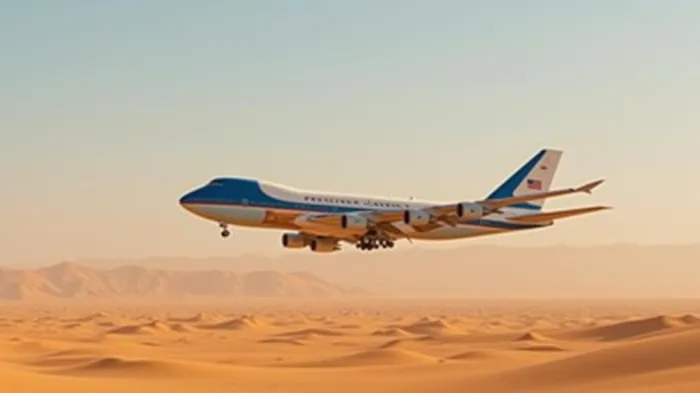
The recent reports of Qatar’s proposed donation of a $400 million Boeing 747-8 to the U.S. government for use as Air Force One mark a seismic shift in how nations approach defense procurement. Far from a mere political stunt, this deal signals a bold precedent for cost-saving international partnerships in military aviation—a trend that could supercharge growth for aerospace giants like Boeing (BA) and firms with Middle Eastern ties. Investors who recognize this geopolitical realignment now stand to profit as defense contractors capitalize on accelerated timelines, reduced R&D costs, and a world where fiscal pragmatism trumps traditional procurement red tape.
Geopolitical Shifts: From Nationalism to Fiscal Pragmatism
The U.S. Air Force’s delayed replacement of its aging Air Force One fleet—originally due in 2022 but now pushed to 2027—exposes a critical flaw in traditional defense contracting: its glacial pace and exorbitant cost. Qatar’s offer to provide a pre-owned 747-8, retrofitted for presidential use, represents a radical departure. If accepted, this arrangement could set a dangerous precedent—or a brilliant one—depending on your perspective. For defense contractors, it opens a door to leveraging international partnerships to cut costs and accelerate delivery, a model that could reshape global military procurement.
Boeing’s Strategic Advantage: Riding the Wave of Geopolitical Deals
Boeing is uniquely positioned to benefit from this paradigm shift. The company’s delayed 747-8 production contracts for Air Force One replacements have been hamstrung by supply chain bottlenecks and financial strain. Qatar’s offer, while controversial, could act as a catalyst:
1. Accelerated Procurement Timelines: A donated aircraft reduces Boeing’s immediate financial burden while buying time to finalize the VC-25B replacements.
2. Reduced R&D Costs: The Qatar jet’s retrofitting requirements are far simpler than designing entirely new systems from scratch.
3. Middle Eastern Market Expansion: Qatar’s gesture underscores its strategic alignment with U.S. interests. Boeing, with its strong regional partnerships (e.g., Emirates, Saudi Aramco), stands to win future contracts as Gulf nations invest in modernizing their own air forces.
Critics will point to risks: the Emoluments Clause legal challenges, political backlash over perceived foreign influence, and the Qatar jet’s limited capabilities (lacking air-to-air refueling, for instance). Yet these risks are overstated. The Trump administration’s legal defense—claiming the gift goes to the U.S. government, not directly to the president—could hold, especially if Congress is sidelined. Meanwhile, the Air Force’s acknowledgment of the jet as a “stopgap” suggests a pragmatic acceptance of short-term trade-offs for long-term gains.
The Investment Case: Long Aerospace Defense Stocks
The Qatar deal is not an isolated incident. It reflects a broader trend toward geopolitical cost-sharing in defense. As governments worldwide seek to modernize militaries without breaking budgets, partnerships like this will proliferate. Investors should capitalize on this shift by taking long positions in aerospace defense stocks. Key beneficiaries include:
- Boeing (BA): The clear leader in large aircraft production and a direct beneficiary of Gulf alliances.
- Raytheon Technologies (RTX): Positioned to supply advanced countermeasures and communication systems for retrofitted jets.
- Northrop Grumman (NOC): Likely to secure contracts for cybersecurity upgrades in next-gen presidential aircraft.
Conclusion: A New Era of Defense Innovation
The Qatar Air Force One donation is a watershed moment. It signals that the era of slow, expensive, and nationally siloed defense procurement is ending. Investors who bet on aerospace contractors’ ability to navigate geopolitical shifts, reduce costs through international collaboration, and dominate modernization efforts will be handsomely rewarded. While legal hurdles remain, the geopolitical winds are firmly in favor of fiscal pragmatism—and defense stocks are primed to soar.
Act now: Secure positions in aerospace defense leaders before this trend gains global momentum. The next Air Force One isn’t just a plane—it’s a blueprint for a new era in military innovation.
Stay ahead of the curve. The defense sector’s pivot to geopolitical partnerships is here to stay. Invest strategically.







Comentarios
Aún no hay comentarios