
Q3 2025 Asset Allocation Shifts: Tech Sector Dominance and Energy Transition Challenges
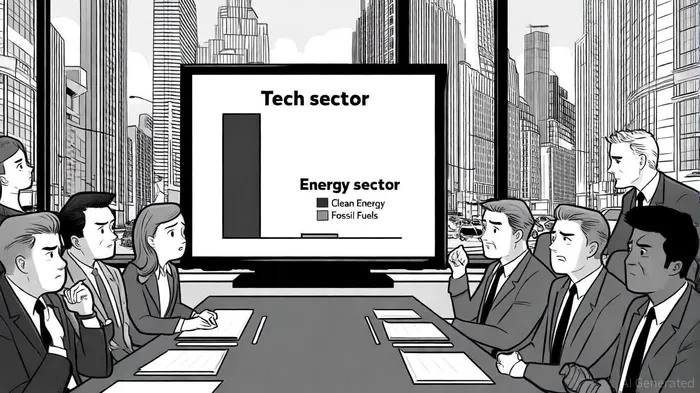
The third quarter of 2025 has witnessed a seismic shift in global asset allocations, with the technology sector capturing investor enthusiasm while the energy sector grapples with the dual pressures of decarbonization and evolving demand dynamics. This divergence reflects broader macroeconomic and technological trends, from the AI revolution to the accelerating energy transition.
Tech Sector: AI-Driven Inflows and Structural Momentum
The technology sector has emerged as the dominant force in Q3 2025, fueled by surging demand for artificial intelligence infrastructure and robust corporate earnings. According to iShares, the ETF/ETP market saw a record $377 billion in inflows during the quarter, with large-cap technology stocks alone attracting nearly $94 billion (see iShares flow report). This momentum was further amplified by strategic pivots from tech giants like MicrosoftMSFT--, whose Azure cloud services reported a 33% revenue increase, with AI services contributing 16 percentage points to that growth - detailed in Microsoft's Q3 2025 results.
The APAC region, in particular, became a hotspot for tech investment, with over $100 billion flowing into AI and GenAI initiatives. The AI-dedicated server market alone reached $23.9 billion, while companies such as Samsung, SK Hynix, and TSMCTSM-- drove semiconductor demand for cloud computing and autonomous systems, as noted in the GartnerIT-- AI spending forecast. Gartner forecasts that global AI spending will total $1.5 trillion in 2025, underscoring the sector's structural growth.
Meanwhile, established tech firms like AMD, Oracle, and Apple reported double-digit revenue growth, with AMD leading at 27.2% year-over-year (as observed in the Futurum momentum report). Strategic partnerships, such as Oracle's landmark deal to host OpenAI's Stargate project, further signaled the sector's resilience and innovation (Futurum's analysis).
Historically, a strategy of buying AMD after earnings beats has yielded a 93.8% cumulative gain over 30 days, outperforming Microsoft's 68.6%, though with significantly higher volatility (max drawdown of -63% vs. -32% for Microsoft). However, AMD's fewer events (4) compared to Microsoft's 15 suggest Microsoft's results are more statistically robust, albeit with lower per-event upside.
Energy Sector: Outflows and the Clean Energy Transition
In contrast, the energy sector faced a more complex landscape. Global energy investment reached a record $3.3 trillion in Q3 2025, but the composition of this capital revealed a stark shift. Clean technologies captured two-thirds of the total ($2.2 trillion), while traditional oil, gas, and coal investments remained at $1.1 trillion, according to the IMA Energy Markets report. This trend, driven by decarbonization goals and the Inflation Reduction Act (IRA), saw U.S. clean manufacturing investments triple to $14.0 billion in Q1 2025 (Futurum's analysis).
However, the energy sector's challenges are multifaceted. While the U.S. upstream sector demonstrated resilience-with crude oil production rising 2% year-to-date to 13.5 mb/d-downstream energy stocks lagged due to falling oil prices and shifting capital flows (per the IMA Energy Markets report). Fossil fuel investment in upstream oil projects declined by 6% in 2025, marking the first annual drop since the 2020 pandemic, as highlighted in an IEA report.
The sector's dual challenge lies in balancing traditional energy infrastructure with the demands of electrification and AI-driven data centers. For instance, Meta's Hyperion data center in Louisiana will require up to 5 gigawatts of electricity, prompting energy providers to invest in natural gas plants and transmission lines (IMA Energy Markets report). Yet, grid constraints and permitting delays continue to hinder clean energy deployment, particularly in advanced economies (Futurum's analysis).
Implications for Investors
The Q3 2025 trends highlight a clear bifurcation in asset allocations. For tech investors, the AI and cloud infrastructure boom offers long-term growth potential, though valuations may face pressure as momentum slows. Energy investors, meanwhile, must navigate the transition to renewables while managing the risks of stranded assets in fossil fuels.
The Federal Reserve's anticipated rate cuts and dovish monetary policy have further amplified these dynamics, with fixed income ETFs seeing $100 billion in inflows as investors anticipate lower borrowing costs (iShares flow report). However, the energy sector's 6.2% quarterly gain noted in the IMA Energy Markets report suggests that, despite outflows, traditional energy remains a critical component of diversified portfolios.
Conclusion
Q3 2025 has underscored the transformative power of technology and the urgency of the energy transition. As AI reshapes global demand for computing power and clean energy investment outpaces fossil fuels, investors must weigh the opportunities and risks in both sectors. The coming quarters will likely test the resilience of energy markets and the scalability of tech-driven growth, making strategic asset allocation more critical than ever.





Comentarios
Aún no hay comentarios