
Q2 Holdings' Strategic Ascendancy in the Small-Cap Tech Sector: A Deep Dive into S&P 600 Index Inclusion
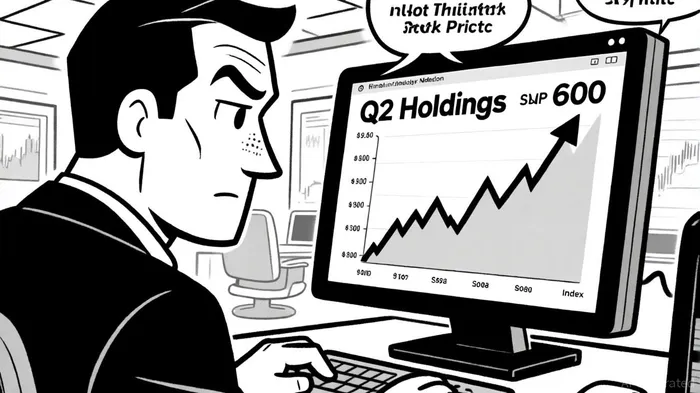
The recent inclusion of Q2 HoldingsQTWO-- (QTWO) in the S&P 600 Information Technology Index marks a pivotal moment for the fintech innovator, signaling its emergence as a key player in the small-cap technology landscape. This strategic milestone, effective September 22, 2025, underscores Q2's alignment with the index's rigorous criteria while amplifying its visibility to institutional investors and ETFs.
Index Inclusion: A Validation of Q2's Tech-Driven Model
The S&P 600 Information Technology Index, part of the broader S&P SmallCap 600, benchmarks U.S. small-cap companies engaged in IT-related products and services, including software, hardware, and communication technologies[1]. To qualify, firms must demonstrate profitability, liquidity, and market capitalization within the $850 million to $3.7 billion range[2]. Q2's inclusion reflects its classification under the Information Technology sector—specifically the Software & Services industry group and Application Software sub-industry[3]. This classification, governed by the Global Industry Classification Standard (GICS), aligns with Q2's core offering: a cloud-based digital banking platform that empowers regional financial institutionsFISI-- with retail, small business, and commercial banking solutions[4].
While earlier reports classified Q2 under the Financial Services sector[5], its recent reclassification highlights the tech-centric nature of its value proposition. The company's platform, which integrates AI-driven risk management and real-time fraud detection, operates as a software-as-a-service (SaaS) solution, blurring traditional sector boundaries. This dual identity—as both a fintech enabler and a software innovator—positions Q2 uniquely at the intersection of two high-growth industries.
Financial Performance: A Catalyst for Index Eligibility
Q2's inclusion is underpinned by robust financial metrics. In Q2 2025, the company reported $195.1 million in revenue, a 13% year-over-year increase[6]. More strikingly, it transitioned from a $13.1 million net loss to a $11.8 million net income, while Adjusted EBITDA surged 53% to $45.8 million[6]. These figures not only satisfy the index's profitability requirements but also demonstrate operational efficiency and scalable margins.
The company's $1.2 billion market capitalization (as of September 2025) falls squarely within the S&P 600's target range[7]. Additionally, Q2's liquidity profile—bolstered by a 12-month public trading history and a 15% investible weight factor (IWF)—ensures sufficient market participation for index-tracking funds[8]. The resulting influx of capital from ETFs and passive investors has already driven a 7.19% stock price decline post-announcement, reflecting short-term volatility typical of index additions[9].
Strategic Implications for Investors
Q2's inclusion in the S&P 600 Information Technology Index offers dual benefits: enhanced liquidity and broader institutional exposure. Index-tracking funds are obligated to purchase QTWO shares, creating a self-reinforcing cycle of demand. For long-term investors, the move validates Q2's role in the digital transformation of financial services—a $12.8 billion market projected to grow at 14% annually[10].
However, risks persist. The company's reliance on a narrow client base (primarily regional banks) and macroeconomic headwinds in the fintech sector could temper growth. Investors must weigh these factors against Q2's durable cash generation and its ability to leverage index inclusion for further market penetration.
Conclusion: A Tech-Enabled Fintech Story
Q2 Holdings' inclusion in the S&P 600 Information Technology Index is more than a technicality—it is a testament to the company's successful pivot toward software-driven financial services. By meeting the index's stringent criteria, Q2 has cemented its status as a small-cap tech innovator, offering investors a compelling play on the convergence of fintech and SaaS. As the digital banking landscape evolves, Q2's strategic positioning could yield outsized returns for those willing to navigate its volatility.





Comentarios
Aún no hay comentarios