
U.S. Q2 2025 Current Account Deficit Narrows: Implications for Dollar Strength and Emerging Market Debt Risk
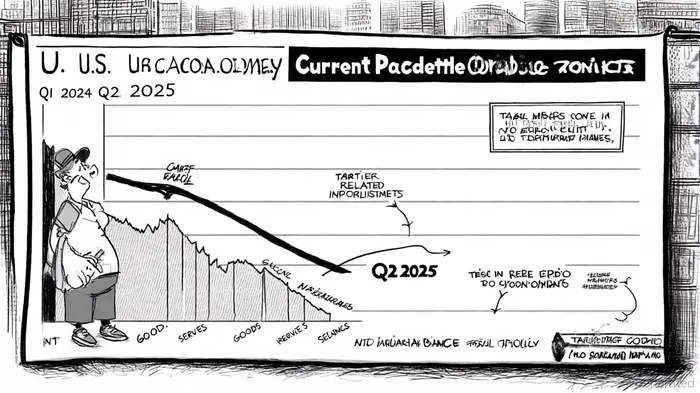
The U.S. current-account deficit narrowed by 42.9% in Q2 2025, shrinking to $251.3 billion (3.3% of GDP) from $439.8 billion in the prior quarter[1]. This dramatic contraction was driven by a 1.8% decline in goods imports, as companies front-loaded purchases to avoid U.S. tariff hikes[1]. While this reduction might initially seem bullish for the dollar, the broader economic context suggests the U.S. currency remains under pressure.
Dollar Weakness: A Tale of Tariffs, Fiscal Deficits, and Fed Policy
The narrowing deficit does not guarantee dollar strength. According to a report by Morningstar, the dollar has weakened throughout 2025 due to three key factors: uncertainty around U.S. tariff policy, rising fiscal deficits, and the Federal Reserve's anticipated rate cuts[2]. Deloitte's Q2 2025 economic forecast underscores that elevated tariffs and fiscal expansion are slowing business investment and increasing public debt, further eroding confidence in the dollar[3].
Meanwhile, the International Monetary Fund (IMF) has raised alarms about global imbalances, noting that large U.S. public deficits and the dollar's depreciation threaten long-term stability[4]. These dynamics create a paradox: while a smaller current account deficit typically signals stronger external demand for U.S. assets, the dollar's performance is increasingly tied to domestic policy risks and global capital flows.
Emerging Market Debt: A Double-Edged Sword
For emerging markets, a weaker dollar introduces both opportunities and risks. On one hand, lower U.S. interest rates could ease borrowing costs for EM governments. On the other, dollar depreciation amplifies currency risk for countries with dollar-denominated debt. As Cambridge Currencies notes, capital is shifting out of the dollar and into alternatives like gold, EM bonds, and local currencies[5]. This trend heightens vulnerability for EM borrowers, particularly those with high debt-to-GDP ratios or weak foreign exchange reserves.
The shift in capital flows is already evident. The U.S. primary account deficit widened to $7.7 billion in Q2 2025, reflecting reduced net income from abroad[1]. This signals a potential rebalancing of global capital, with emerging markets likely to bear the brunt of volatility.
Strategic Implications for Investors
Investors must navigate these crosscurrents carefully. A weaker dollar may boost EM equities and commodities but could also trigger debt crises in overleveraged markets. Hedging strategies, such as diversifying into non-dollar assets or using currency derivatives, may become essential. For U.S. investors, the narrowing current account deficit offers a temporary reprieve but does not offset the long-term risks posed by fiscal expansion and geopolitical tensions.
In conclusion, the Q2 2025 current account data reveals a complex interplay of short-term relief and structural vulnerabilities. While the deficit contraction is a positive sign, the dollar's trajectory and EM debt risks remain contingent on policy decisions and global market sentiment.







Comentarios
Aún no hay comentarios