
Pyxis Oncology's MICVO: A Breakthrough ADC with First-in-Class Mechanism and Strong Early Clinical Readouts in HNSCC
The oncology landscape is witnessing a paradigm shift toward targeted therapies that address unmet needs in hard-to-treat cancers. Among the most promising candidates is Pyxis Oncology's micvotabart pelidotin (MICVO), a first-in-concept antibody-drug conjugate (ADC) targeting extradomain-B of fibronectin (EDB+FN), a structural component of the tumor extracellular matrix. With recent clinical data demonstrating robust efficacy and a favorable safety profile in recurrent/metastatic head and neck squamous cell carcinoma (R/M HNSCC), MICVO has emerged as a compelling investment opportunity in the next-generation oncology space.
A Novel Mechanism with Strategic Differentiation
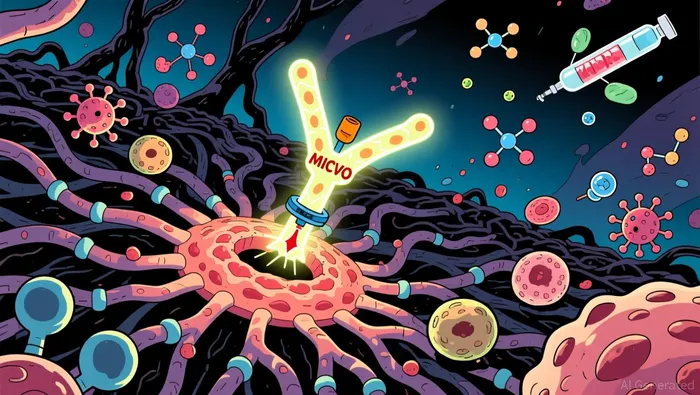
MICVO's unique mechanism of action sets it apart from conventional ADCs, which typically target tumor cells directly. Instead, MICVO binds to EDB+FN, a protein overexpressed in the extracellular matrix of solid tumors, including HNSCC. This approach avoids direct cytotoxicity to healthy cells and mitigates common ADC-related toxicities such as ocular, pulmonary, or neurological side effects. By targeting the tumor microenvironment rather than tumor cells, MICVO addresses a critical gap in therapies for R/M HNSCC, where resistance to immune checkpoint inhibitors (ICIs) and limited treatment options post-second-line therapy persist according to research.
Robust Efficacy in Monotherapy and Combination Settings
Early-phase clinical trials have underscored MICVO's therapeutic potential. In monotherapy trials for second-line and later (2L+) R/M HNSCC patients, MICVO at 5.4 mg/kg achieved a confirmed objective response rate of 46% and a disease control rate (DCR) of 92%. These results are particularly significant given the historical challenges in achieving durable responses in this patient population. When combined with pembrolizumab (KEYTRUDA®), a PD-1 inhibitor, the ORR surged to 71%, with a 100% DCR at doses of 3.6 mg/kg and 4.4 mg/kg. This synergy suggests that MICVO could enhance the efficacy of ICIs by modulating the tumor microenvironment, potentially overcoming resistance mechanisms that limit ICI monotherapy according to research.
The combination therapy's safety profile further strengthens its investment case. While 89% of monotherapy patients experienced treatment-related adverse events (TRAEs), including 56% with Grade ≥3 events, the combination arm showed no TRAE-related discontinuations and no overlapping toxicities with pembrolizumab according to data. This favorable tolerability profile positions MICVO as a viable option for combination regimens, a growing trend in oncology where multi-modal approaches are increasingly favored according to analysis.
Fast-Track Designation: A Regulatory Tailwind
The U.S. Food and Drug Administration (FDA) has recognized MICVO's potential by granting it Fast Track Designation for R/M HNSCC patients who have progressed after platinum-based chemotherapy and anti-PD-(L)1 therapy. This designation accelerates development timelines, facilitates more frequent regulatory interactions, and may qualify MICVO for priority review or accelerated approval pathways. For investors, Fast Track status is a critical indicator of regulatory confidence and a catalyst for reducing time-to-market, which is essential in competitive therapeutic areas like HNSCC according to market analysis.
Market Positioning and Investment Rationale
The HNSCC market remains underserved, particularly in later-line settings where ICIs face resistance rates of 60%-70% according to research. MICVO's dual potential as a monotherapy and combination agent, coupled with its novel mechanism, positions it to capture a significant share of this market. With updated monotherapy data expected in mid-2026 and combination therapy results anticipated by late 2026, Pyxis OncologyPYXS-- is poised to advance MICVO into pivotal trials, potentially securing a differentiated position in the HNSCC treatment algorithm.
From an investment perspective, MICVO's progress aligns with broader trends in oncology: the shift toward precision therapies, the growing importance of combination strategies, and the regulatory incentives for addressing high-unmet-need indications. Its Fast Track designation and early clinical success reduce development risks while amplifying upside potential, particularly if Phase 2 trials replicate or exceed Phase 1 outcomes.
Conclusion
Pyxis Oncology's MICVO represents a rare convergence of innovation, clinical promise, and regulatory support. Its first-in-class mechanism, robust efficacy in monotherapy and combination settings, and favorable safety profile address critical gaps in R/M HNSCC treatment. With Fast Track Designation providing a clear regulatory pathway and upcoming data readouts offering near-term catalysts, MICVO is well-positioned to become a cornerstone of next-gen oncology. For investors seeking exposure to high-impact, targeted therapies, MICVO exemplifies the kind of innovation that can redefine therapeutic paradigms and deliver substantial returns.





Comentarios
Aún no hay comentarios