
Pure Cycle's Diversified Growth Strategy: Leveraging Energy Royalties and Real Estate Synergies to Navigate Market Headwinds
Energy Royalties: A High-Conviction Catalyst
Pure Cycle's energy royalty segment has emerged as a standout driver of profitability. For the year ended August 31, 2025, oil and gas royalty income surged 738% year-over-year to $6.7 million, fueled by six new wells at the Sky Ranch project. This exponential growth underscores the company's ability to capitalize on energy infrastructure, even as broader energy markets face cyclical pressures. The Sky Ranch wells, in particular, highlight a strategic focus on high-margin, low-operational-risk assets-royalties that generate cash flow without the capital intensity of direct production.
This segment's performance is further amplified by its alignment with real estate development. The same land that hosts residential and commercial infrastructure also supports energy production, creating a symbiotic relationship. As Sky Ranch's population grows, so does the demand for water and energy, reinforcing the company's dual revenue streams.
Real Estate Synergies: Phased Development and Tap Fee Resilience
Pure Cycle's real estate strategy is built on phased development, ensuring steady cash flow and minimizing exposure to market downturns. In FY2025, the company sold 182 water and wastewater taps, generating $7.3 million in revenue, with an additional $19.1 million projected over the next three years from Phase 2 of Sky Ranch. This model leverages partnerships with national homebuilders, which has insulated tap fee sales from broader housing market slowdowns.
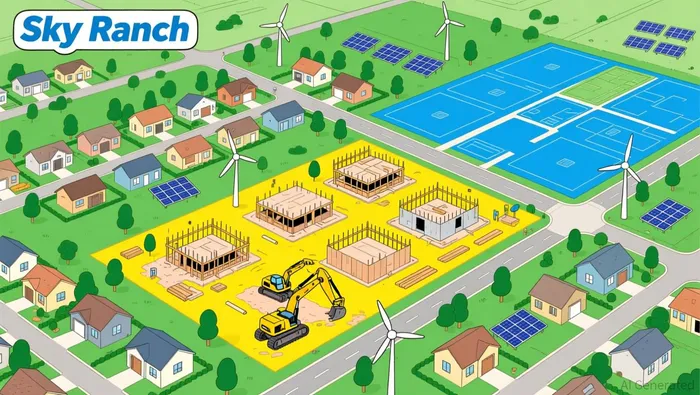
The development timeline itself is a testament to disciplined execution. As of Q3 2025, Phase 2B of Sky Ranch is 97% complete, Phase 2C at 82%, and Phase 2D expected to reach substantial completion by fiscal 2026. This phased approach not only spreads out capital expenditures but also allows the company to adapt to market conditions, ensuring that each stage aligns with absorption rates and demand.
Financial Resilience and Strategic Flexibility
Despite a 9% decline in total revenue to $26.1 million in FY2025, Pure Cycle's net income rose 13% to $13.1 million, with EBITDA increasing 11% to $20.2 million. This counter-cyclical performance is underpinned by a robust balance sheet, with a $21.9 million in cash liquidity and $20 million in working capital. Such financial flexibility enables the company to fund development, repurchase shares, and explore new opportunities-such as its expanding single-family rental segment, which plans to add over 200 units by 2026.
The company's risk management framework further enhances its resilience. By diversifying revenue sources-energy royalties, tap fees, and rental income-Pure Cycle reduces dependence on any single sector. For instance, while energy prices fluctuate, the long-term demand for water and housing remains inelastic, providing a stable base for growth.
Navigating Risks and Long-Term Outlook
No strategy is without risks. Near-term challenges include volatility in royalty production from new wells and potential delays in lot deliveries for Phase 2D. However, Pure Cycle's phased development model inherently mitigates these risks by spreading out execution timelines and allowing for course corrections. Additionally, the company's focus on single-family rentals-a sector with strong demand amid housing shortages-adds a recurring revenue stream that complements its cyclical energy and construction segments.
Looking ahead, the integration of energy and real estate will likely deepen. As Sky Ranch nears full development by 2027, the community could become a self-sustaining ecosystem where energy production, water infrastructure, and residential/commercial demand reinforce one another. This virtuous cycle positions Pure CyclePCYO-- to generate compounding value for shareholders, even in uncertain macroeconomic environments.
Conclusion
Pure Cycle's diversified growth strategy exemplifies how strategic integration can transform risk into resilience. By leveraging energy royalties and real estate synergies, the company has created a business model that thrives on cross-sectoral interdependencies. While challenges remain, its disciplined execution, strong balance sheet, and forward-looking expansion into single-family rentals underscore its potential to deliver long-term value. For investors seeking exposure to a company that balances innovation with stability, Pure Cycle offers a compelling case study in adaptive growth.





Comentarios
Aún no hay comentarios