
PUMP Token Whale Purchase: Bullish Catalyst or Pump-and-Dump Setup?
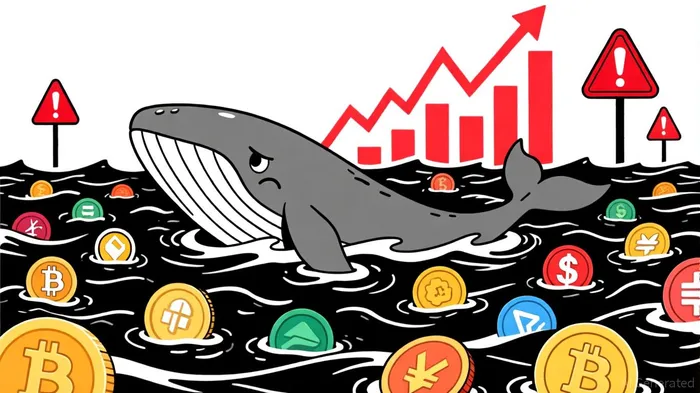
In September 2025, the PUMP token ecosystem witnessed a seismic event: a single whale purchased 1.1 billion PUMP tokens for $8 million in USDCUSDC--, establishing a cost basis of $0.0072 per token and injecting liquidity into the market [1]. This move, executed on decentralized exchanges, has sparked intense debate among traders and analysts. Is this a strategic accumulation signaling a bullish catalyst for PUMP's price, or a calculated setup for a classic pump-and-dump scheme? To answer this, we must dissect the token's recent trajectory, whale behavior patterns, and the broader dynamics of memeMEME-- coin markets.
The Bull Case: Liquidity, Buybacks, and Ecosystem Growth
PUMP's recent surge in trading volume—peaking at $1.16 billion in 24 hours—suggests strong retail and institutional interest [2]. The whale's purchase aligns with Pump.fun's aggressive buyback strategy, which has reinvested over 102% of its revenue into the ecosystem [2]. By purchasing tokens at a discount to the current price of $0.00849, the whale could be signaling confidence in PUMP's fundamentals. Analysts argue that this transaction may establish a new support level, potentially triggering a 65% price rally as the whale's holdings are locked in [3].
Moreover, Pump.fun's strategic pivot toward community-led initiatives—such as the CTO token and Project Ascend—has added utility to PUMP, moving it beyond a pure meme coin [2]. These developments, coupled with a projected price target of $0.0107 by 2026 [1], suggest that the whale's purchase could be part of a broader narrative of value creation. The platform's daily buyback program, which absorbs $2 million in tokens, further reinforces this bullish thesis by reducing circulating supply and increasing scarcity [4].
The Bear Case: Historical Dumps and Market Manipulation
However, PUMP's history is marred by volatility and whale-driven manipulation. In July 2025, the same platform's “PUMP Top Fund 1” dumped 17 billion tokens, sending the price below $0.004 and eroding retail confidence [4]. Similarly, a recent whale sold $7.27 million in PUMP on Binance before repurchasing $3.22 million on Hyperliquid, hinting at strategic trading rather than long-term conviction [5]. These patterns raise red flags about the September whale's intentions.
The crypto market in 2025 is rife with pump-and-dump schemes, particularly in meme tokens. Wash trading and coordinated hype campaigns—common in DeFi ecosystems—have artificially inflated volumes on platforms like EthereumETH-- and BNBBNB-- Smart Chain [6]. While PUMP's whale purchase lacks direct evidence of such manipulation, the sheer size of the transaction ($8 million for 1.1 billion tokens) could be a prelude to a coordinated price pump followed by a profit-taking exit. Retail investors, often the last to react, risk being left holding the bag if the whale's strategy mirrors past schemes.
Broader Implications for Meme Token Dynamics
PUMP's case highlights the paradox of meme coins: they thrive on community-driven hype but are inherently vulnerable to whale dominance. The token's market cap of $3 billion [4] and projected 2030 valuation of $14.5 billion [1] reflect both optimism and speculation. Yet, as Machi Big Brother's $8.8 million loss from long PUMP positions demonstrates, meme tokens are a high-risk asset class [7].
For retail investors, the key takeaway is to treat PUMP as a speculative bet rather than a long-term investment. While the whale's purchase could catalyze a short-term rally, the token's future hinges on sustained utility development and regulatory clarity. Pump.fun's pivot to creator rewards and ecosystem projects is a positive sign, but it remains to be seen whether these initiatives can offset the inherent volatility of meme coin markets.
Conclusion: Navigating the Whale's Wake
The September 2025 whale purchase of 1.1 billion PUMP tokens is a double-edged sword. On one hand, it injects liquidity and aligns with Pump.fun's buyback-driven strategy, potentially propelling the token toward $0.0107 by 2026 [1]. On the other, it mirrors historical patterns of whale-driven manipulation, with the risk of a pump-and-dump scenario looming large [4].
For investors, the path forward requires a balanced approach: leveraging short-term momentum while hedging against downside risks. As the crypto market evolves, the line between innovation and speculation will continue to blur—making due diligence and risk management more critical than ever.






Comentarios
Aún no hay comentarios