
PUMP Token's Recent Surge and Buyback Strategy: Evaluating the Strategic Impact on Token Valuation and Market Sentiment in Volatile Crypto Markets
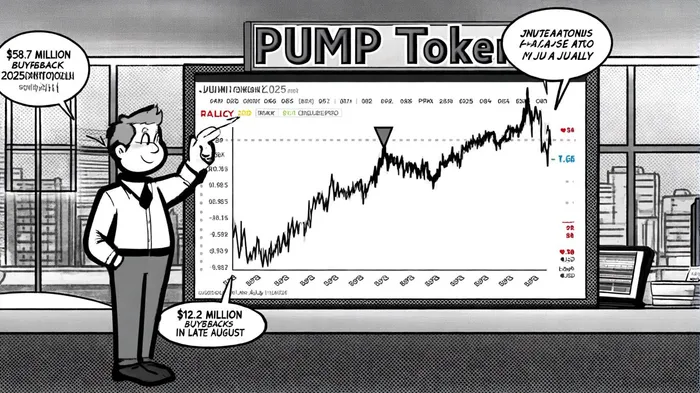
In the volatile world of crypto, where sentiment can shift overnight, Pump.fun's PUMP Token has emerged as a case study in aggressive supply-side strategy. Over the past two months, the platform has spent nearly $84 million on buybacks, reducing the circulating supply by 6.1% and driving a 66% price surge in a single month [2]. This bold approach—allocating up to 98% of weekly revenue to repurchases—raises critical questions about the long-term viability of buybacks as a tool for stabilizing token valuations in a market prone to speculative swings.
The Mechanics of the Buyback Program
Pump.fun's strategy hinges on a simple premise: reduce supply to create artificial scarcity. Since mid-July 2025, the platform has spent $58.7 million on buybacks, with daily repurchases often exceeding $1 million [2]. By August, this escalated further, with $12.2 million spent in a single week (August 28–September 3), representing 98.23% of its weekly revenue [2]. The program is funded by 30% of the platform's daily revenue, which derives from 1% transaction fees on memecoin creation and trading [2].
This approach has had immediate effects. The average buyback price of $0.0058—significantly higher than the current market price of $0.0039—has removed 7.43 billion tokens from circulation, even as platform revenue has plummeted by 80% since January 2025 [3]. The result? A 20% price jump in two days following a major buyback announcement [2], and a broader 66% rally in the past month, fueled by initiatives like Project Ascend and Dynamic Fees V1 [2].
Strategic Impact on Valuation and Sentiment
The buybacks have acted as a psychological and financial anchor for PUMP's price. After hitting a low of $0.00228 in July 2025, the token rebounded to $0.003019 by late August, stabilizing investor confidence [2]. This stabilization is critical in a market where liquidity can evaporate rapidly. By consistently repurchasing tokens at a premium, Pump.fun has signaled to the market that it is willing to absorb short-term volatility to maintain a floor price.
Market sentiment has also been bolstered by the platform's dominance in Solana's memecoin ecosystem. Pump.fun controls 84% of the market share, facilitating $781 million in trading volume from 413,000 users in a single day [2]. This network effect—combined with the perception of a “floor” created by buybacks—has attracted both retail and institutional attention. However, the sustainability of this strategy remains questionable.
Risks and Long-Term Viability
While the buybacks have driven short-term gains, they are not without risks. The platform's revenue has declined sharply, and its buyback program now consumes a disproportionate share of available funds. For example, the $12.2 million spent in late August represented nearly all of Pump.fun's weekly revenue [2], leaving little room for innovation or regulatory compliance.
Compounding these challenges is a $5.5 billion lawsuit alleging that Pump.fun operates an unlicensed casino [1]. Regulatory scrutiny could force the platform to divert resources from buybacks to legal defense, potentially triggering a selloff. Additionally, the buyback strategy's reliance on artificial scarcity may backfire if demand for PUMP tokens wanes. At current prices, the token is still 55.7% below its July 2025 all-time high of $0.0068 [2], suggesting that market fundamentals—beyond supply manipulation—will ultimately determine its trajectory.
Conclusion
Pump.fun's buyback program exemplifies the double-edged sword of supply-side interventions in crypto. On one hand, it has stabilized PUMP's price, boosted investor confidence, and reinforced the platform's dominance in the memecoin space. On the other, it has created a high-risk, high-reward dynamic that could unravel if revenue declines further or regulatory pressures intensify. For investors, the key takeaway is clear: while buybacks can create short-term momentum, they are not a substitute for sustainable product development or regulatory compliance. In the volatile crypto landscape, the PUMP Token's journey underscores the delicate balance between strategic innovation and market reality.







Comentarios
Aún no hay comentarios