
PUMP Token: A Make-or-Break Moment at Critical Support Amid Escalating Market Volatility
The PUMP Token, a digital asset that has surged over 180% in September 2025, now stands at a pivotal juncture. Trading near $0.0078, the token's price action reflects a volatile tug-of-war between bullish accumulation and bearish selling pressure. For tactical investors, the coming days will testTST-- whether PUMP can hold critical support levels and capitalize on its recent momentum—or face a sharp correction.
Technical Analysis: A Double-Bottom Breakout Under Scrutiny
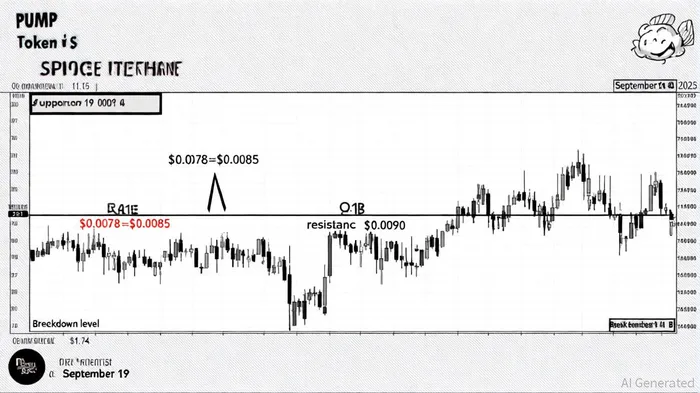
PUMP's price chart reveals a textbook double-bottom pattern, with key support clustered between $0.0078 and $0.0085. A successful hold above this range could propel the token toward $0.0090 resistance, a psychological threshold that, if breached, might trigger a rally toward $0.0100 [1]. Conversely, a breakdown below $0.00740—a level not tested since late August—could accelerate a slide to $0.0064, erasing much of September's gains [2].
The Relative Strength Index (RSI) currently sits at 74, signaling overbought conditions and hinting at a potential near-term pullback [2]. This aligns with historical patterns where aggressive buybacks and speculative inflows create short-term imbalances. However, the token's derivatives market remains a wildcard: open interest (OI) has ballooned to $1.1 billion, reflecting intense speculative positioning that could amplify both upward and downward swings [2].
Market Dynamics: Buybacks vs. Whale Exits
Pump.fun's $33 million buyback program has reduced circulating supply by 6.898%, a move that has bolstered short-term price stability [1]. On-chain data also shows a $26.08 million net inflow on September 11, underscoring retail and institutional accumulation [1]. Yet, these bullish signals face headwinds from whale activity. While a $30.65 million buyback by large holders has reinforced supply-side optimism, early investors have offloaded $40 million in tokens since July, creating overhead resistance and eroding confidence [3].
Critics argue that Pump.fun's buyback strategy functions more as market-making than organic demand generation [1]. This raises questions about the sustainability of current price levels, particularly if inflows stall or selling pressure intensifies.
Tactical Risk Assessment: Positioning for Volatility
For short-term investors, the immediate priority is risk management. A breakout above $0.0090 could justify aggressive positioning, given the token's potential to test $0.0100 and even $0.022 by 2030 under a moderate scenario [1]. However, this path assumes continued buyback efficacy and minimal whale exits. A breakdown below $0.00740, meanwhile, would signal a shift in sentiment, potentially leading to a 15–20% correction.
A prudent approach involves:
1. Partial Entries at Resistance: Buying PUMP above $0.0090 with tight stop-losses below $0.0085 to capitalize on momentum while limiting downside.
2. Hedging Near Support: Selling or shorting if the token fails to hold $0.0078, using the $0.0064 level as a hard stop.
3. Monitoring On-Chain Flows: Watching for further net inflows or outflows, which could validate or invalidate the current bullish narrative [2].
The Bottom Line
PUMP Token's next move hinges on its ability to defend critical support while navigating conflicting signals from buybacks and whale exits. For tactical investors, the coming week will offer clarity: a sustained close above $0.0090 could validate long-term bullish projections, while a breakdown below $0.00740 would signal a high-risk environment. Positioning here requires discipline, with stop-losses and real-time on-chain monitoring as non-negotiable tools.
In a market defined by extremes, PUMP's volatility is both a threat and an opportunity—provided one knows when to lean in and when to cut losses.






Comentarios
Aún no hay comentarios