
Pump.fun's Tumultuous 2025: Assessing the Impact of Declining Buybacks and Revenue Erosion on Long-Term Value
The Volatility of a MemeMEME-- Coin Powerhouse
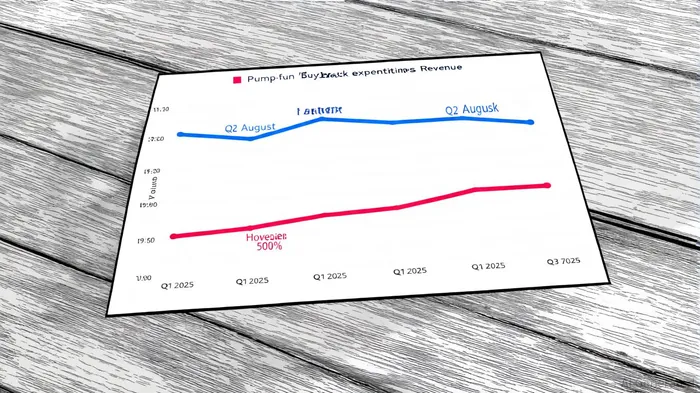
Pump.fun, the Solana-based memecoinMEME-- platform, has become a case study in the highs and lows of speculative crypto markets. In Q2 2025, the platform's buyback activities collapsed by 50%, plummeting to $1.27 million—a level not seen since mid-August 2025[1]. Simultaneously, revenue contracted to $1.3 million, reflecting a broader slump in protocol usage and transactions, which hit a three-month low[1]. This dual decline raised alarms about the sustainability of Pump.fun's business model and its ability to maintain investor confidence.
However, the narrative shifted dramatically in late August and early September. A 700% surge in weekly revenue—peaking at $13.48 million—coincided with a resumption of aggressive buybacks, with $8.4 million spent on PUMP tokens[4]. Cumulative buybacks since July 2025 reached $95.27 million, reducing the circulating supply by 6.67% and stabilizing the token's price[3]. These actions signaled a short-term revival, yet the underlying challenges persist.
Revenue Erosion and Market Realities
The broader context reveals a platform struggling to maintain its January 2025 peak. Monthly revenue in July 2025 fell to $24.96 million, an 80% drop from its January high of over $130 million[2]. By late September, revenue hit a 2025 low of $1.3 million[2], while decentralized exchange (DEX) volume averaged just $77 million—a stark contrast to the frenetic activity of early 2025[5]. These trends underscore the fragility of Pump.fun's revenue streams, which are heavily reliant on speculative trading and a volatile user base.
The decline in transactions further exacerbates concerns. In Q3 2025, total transactions fell to 1.4 million, with Pumpswap recording zero activity[1]. This suggests a loss of utility for the platform, as users increasingly treat PUMP as a speculative asset rather than a functional token. The result is a self-reinforcing cycle: declining usage reduces revenue, which limits buyback capacity, further eroding investor confidence.
Investor Sentiment: A Tale of Two Halves
Investor sentiment has oscillated wildly in 2025. The initial buyback-driven optimism—where PUMP surged past $0.00849 in September—was tempered by the token's 50% decline from its July debut price[3]. This volatility reflects a market grappling with conflicting signals: on one hand, the platform's $95 million buyback program and supply reduction; on the other, regulatory uncertainties and a $5.5 billion lawsuit[4].
The legal risks are particularly concerning. A high concentration of PUMP tokens among top wallets—posing dumping risks—compounds the uncertainty[4]. Meanwhile, macroeconomic factors, including a broader crypto market downturn, have amplified risk-off sentiment. PUMP's 41% drop from its all-time high of $0.0089[3] mirrors the broader industry's struggles, with critical support levels now at $0.0050[5]. A break below this threshold could trigger a cascade toward $0.0040, further testing investor resolve.
Long-Term Value Destruction: A Looming Threat
While short-term buybacks have provided a temporary lifeline, the long-term implications are troubling. The platform's ability to sustain its buyback program hinges on consistent revenue, which has proven elusive. With DEX volume and transactions in freefall, Pump.fun faces a stark choice: innovate to regain utility or risk becoming a relic of the 2025 memecoin boom.
Analysts remain divided on PUMP's future. Optimistic forecasts suggest a potential $0.00845 average price by year-end[1], while bearish scenarios project a decline toward $0.0040[5]. Long-term predictions are even more polarized, with some envisioning a $0.0145 average by 2030[1] and others warning of a $0.0529 peak by 2031[2]. These divergent views highlight the uncertainty surrounding Pump.fun's trajectory.
Conclusion: A High-Risk, High-Reward Proposition
Pump.fun's 2025 journey encapsulates the paradox of memecoins: immense short-term hype paired with structural vulnerabilities. While the recent buyback rebound and revenue spike offer glimmers of hope, the platform's long-term viability depends on addressing revenue erosion, regulatory risks, and declining user engagement. For investors, the key takeaway is clear: Pump.fun remains a high-risk, high-reward asset, where fortunes can shift overnight. In a market defined by volatility, the question is not whether Pump.fun can recover—but whether it can adapt.






Comentarios
Aún no hay comentarios