
Pump.fun's Shifting Fee Model and Its Implications for Meme Coin Ecosystems
Pump.fun has emerged as a defining force in Solana's memeMEME-- coin ecosystem, reshaping how value accrues and liquidity is generated in a market once dominated by speculative chaos. Over the past year, the platform has iterated its fee model multiple times, each shift recalibrating incentives for creators, traders, and the broader DeFi landscape. By 2026, these changes have not only redefined token economics but also signaled a maturation of the meme coin space-one where structured incentives and market-driven dynamics begin to replace pure speculation.
The Evolution of Pump.fun's Fee Model
Pump.fun's journey began in May 2025 with a groundbreaking revenue-sharing model: 50% of trading fees on its native DEX, PumpSwap, were allocated to token creators, who received 0.05% of each trade in SOLSOL--. This model incentivized creators to launch tokens, with over $60,000 in earnings generated within 24 hours of its launch. By September 2025, the platform amplified this further, increasing creator earnings tenfold and distributing over $4 million in fees in a single day.
The next phase, dubbed "Project Ascend," introduced a dynamic fee structure in late 2025. Fees now vary based on a token's market cap, ranging from 0.95% for smaller projects to 0.05% for those exceeding $20 million in value. This tiered approach aimed to balance fairness and scalability, ensuring smaller tokens retained liquidity while larger ones avoided excessive friction.
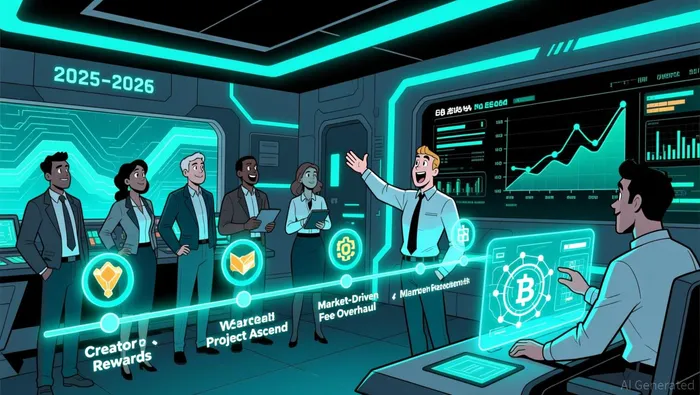
However, the most transformative shift came in early 2026, when founder Alon Cohen announced a market-driven fee model. This overhaul, termed "Creator Fee Sharing," allows creators to distribute fees to up to 10 wallets, offering greater flexibility in managing token ownership and aligning incentives with community-driven governance. The model prioritizes trader behavior over creator-centric rewards, encouraging liquidity provision and risk-taking-key drivers of a healthy market.
Implications for Token Value Accrual and Trading Behavior
The evolving fee model has directly influenced how value accrues in the Pump.fun ecosystem. By mid-2026, PumpSwap achieved a record daily trading volume of $1.28 billion, with cumulative DEX trading across the Pump ecosystem reaching $176.8 billion. Despite this, fee generation remained modest, with only $2.98 million in fees recorded on that day, underscoring the low-cost, high-volume nature of memecoinMEME-- trading. Analysts attribute this to Solana's competitive DEX landscape, which drives fees downward but sustains user activity through speed and scalability.
The PUMP token, central to the ecosystem, has seen its value closely tied to platform growth. As of early 2026, its price surged 10% following the announcement of the 2026 fee overhaul, reflecting investor confidence in the platform's ability to adapt. However, the token's future remains contingent on Solana's broader DeFi ecosystem and the sustainability of meme coin culture. Experts note that while Pump.fun has become a dominant force in Solana's DeFi landscape, converting high trading volumes into consistent revenue remains a challenge.
The market-driven approach also shifts focus from creator incentives to trader behavior. By allowing traders to decide which trends deserve fee allocation, Pump.fun aligns with its core mission of fostering a "healthier market environment." This could increase liquidity and volatility, as traders prioritize tokens with strong community support or speculative potential. Legacy Solana meme tokens, such as White Whale, have already seen gains of up to 63% in early 2026, signaling renewed interest in established names.
Future Outlook and Risks
Looking ahead, Pump.fun's success will depend on its ability to innovate beyond a launchpad and into a robust ecosystem with recurring revenue mechanisms. Experts suggest features like fee burns, expanded governance, and token utility enhancements could stabilize the PUMP token's value and align it with Solana's broader DeFi growth. Regulatory developments also loom as a critical factor; while Pump.fun's low barriers to entry have fueled its rise, they could attract scrutiny if meme coin speculation is deemed a systemic risk.
The platform's market-driven model also carries risks. By reducing creator incentives, it may deter new token launches-a core driver of Pump.fun's initial growth. However, the introduction of Creator Fee Sharing allows creators to retain control over their token's trajectory, potentially mitigating this risk by fostering long-term community engagement.
Conclusion
Pump.fun's shifting fee model represents a pivotal evolution in the meme coin ecosystem. By transitioning from creator-centric rewards to a trader-driven framework, the platform is redefining how value accrues in a market once dominated by chaos. While challenges remain-particularly in converting volume into sustainable revenue-the 2026 overhaul positions Pump.fun as a key player in Solana's DeFi future. For investors, the PUMP token's trajectory will hinge on the platform's ability to balance innovation, liquidity, and regulatory resilience.






Comentarios
Aún no hay comentarios