
Pump.fun's Fee Overhaul: A Strategic Shift from Deployers to Traders
The memecoinMEME-- ecosystem has long grappled with a fundamental misalignment of incentives: token creators (deployers) often capture disproportionate value upfront, while traders bear the risk of illiquidity and volatile price discovery. Pump.fun's 2025 fee overhaul represents a bold attempt to recalibrate this imbalance, shifting economic value from deployers to traders while fostering sustainable liquidity. By introducing a dynamic fee model and creator fee-sharing mechanisms, the platform aims to align rewards with market-driven outcomes, ensuring long-term viability in an increasingly competitive space.
The Problem with Static Incentives
Prior to the overhaul, Pump.fun operated under a flat fee structure that disproportionately rewarded deployers for launching low-market-cap tokens. As noted by co-founder Alon Cohen, this system incentivized "token issuance over active trading," creating a scenario where deployers could extract high creator fees with minimal effort, while traders faced thin liquidity and unpredictable price action according to platform analysis. For instance, under the previous Dynamic Fees V1 model, tokens under $300,000 in market cap incurred a 0.95% fee, with creator fees declining as tokens scaled-a structure that effectively penalized projects for growing beyond a certain threshold as detailed in project updates. This created a self-reinforcing cycle: deployers prioritized quick profits, traders avoided illiquid assets, and the platform's health deteriorated.
Dynamic Fees: Aligning Rewards with Market Conditions
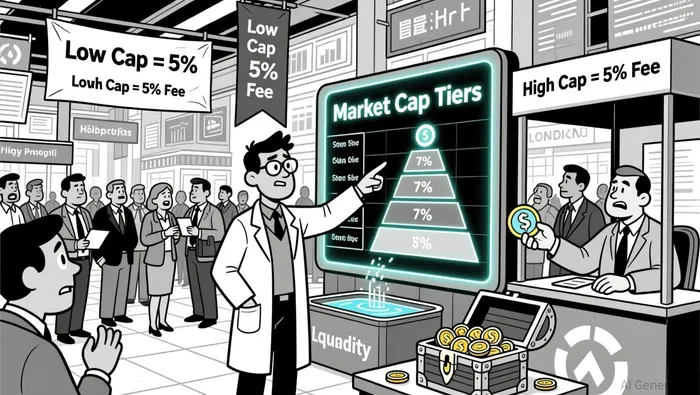
The new fee model, dubbed "Project Ascend," introduces a tiered structure where transaction fees scale inversely with a token's market capitalization. Tokens under $300,000 now face a 0.95% fee, while those exceeding $20 million in market cap see fees drop to as low as 0.05% according to market reports. This shift disincentivizes the creation of low-quality, speculative tokens by reducing deployer rewards for projects that fail to gain traction. Conversely, it rewards traders and creators who build projects capable of sustaining larger market caps, as fees decrease with success rather than penalizing growth.
A critical component of this model is its liquidity provision mechanism: between 0.02% and 0.2% of each transaction is allocated to token liquidity pools, with the percentage decreasing as market caps rise as described in technical documentation. This ensures that graduating projects retain sufficient liquidity to support trading activity, addressing a key weakness of the previous system. For traders, this means reduced slippage and improved order execution, particularly for tokens in the mid-to-high market cap tiers.
Creator Fee Sharing: Distributing Value More Equitably
Pump.fun's overhaul also introduces "Creator Fee Sharing," a feature allowing deployers to distribute creator fees across up to 10 wallets. This flexibility enables creators to share rewards with early supporters, liquidity providers, or even traders who contribute to a token's success according to industry analysis. By decentralizing fee distribution, the platform reduces the risk of centralization and fosters a more collaborative ecosystem.
This mechanism also addresses a key criticism of the old model: the concentration of value in a single deployer's wallet. For example, a creator could now allocate 50% of fees to a liquidity pool, 30% to a community treasury, and 20% to a strategic partner, ensuring that multiple stakeholders benefit from a token's growth as reported in governance updates. Such transparency and adaptability are likely to attract projects with more sustainable governance models, further enhancing the platform's appeal.
Market Response and Long-Term Implications
The market has already signaled optimism about these changes. Following the announcement, the PUMP token surged nearly 11%, reflecting investor confidence in the platform's renewed focus on trader incentives according to trading data. This aligns with broader industry trends, where platforms that prioritize liquidity and balanced incentives-such as Solana-based memecoins with robust fee-sharing models-have outperformed peers in 2025 as noted in financial analysis.
However, the true test of Pump.fun's strategy will lie in its ability to sustain trading volume and attract high-quality projects. By reducing deployer rewards for low-market-cap tokens, the platform risks deterring short-term speculators. Yet, if the dynamic fee model successfully channels capital toward projects with real utility or community support, the long-term value of both the platform and its native token could compound significantly.
Conclusion: A Blueprint for Sustainable Growth
Pump.fun's fee overhaul is more than a technical update-it's a strategic repositioning to address the core flaws of the memecoin ecosystem. By aligning deployer and trader incentives, the platform aims to create a self-sustaining cycle where liquidity, price discovery, and token value reinforce one another. For investors, this represents a compelling case study in how structural changes can transform a speculative asset class into a more resilient market. As the 2026 memecoin cycle unfolds, Pump.fun's success will hinge on its ability to execute this vision and adapt to evolving trader behavior.






Comentarios
Aún no hay comentarios