
Pulsar Helium Inc.: A Strategic Play for U.S. Helium Security in a Fractured Global Market
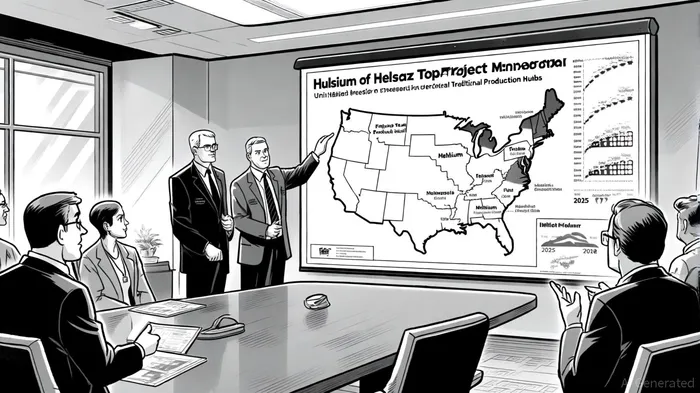
The global helium market, long plagued by volatility and geopolitical fragility, has entered a new phase of uncertainty. With the U.S. Federal Helium Reserve's 2024 sale sparking fears of supply chain disruptions and prices doubling since 2022 due to geopolitical shocks[1], domestic producers like Pulsar Helium Inc. (TSXV: PSRHF) are emerging as critical players in securing resource independence. For investors, the question is no longer whether helium demand will grow but whether companies like Pulsar can deliver stable, scalable production to offset the U.S.'s declining legacy infrastructure and geopolitical exposure.
Operational Resilience: Pulsar's Topaz Project as a Game Changer
Pulsar's Topaz Project in Minnesota has demonstrated exceptional helium concentration and flow rates, positioning it as one of the most promising primary helium discoveries in the U.S. Recent operational updates reveal that the Jetstream #1 well achieved a maximum natural flow rate of ~501,000 cubic feet per day (Mcf/d) in August 2025[3], more than tripling its 2024 performance. This output, achieved without compression and using a 38/64-inch choke, underscores the reservoir's robust productivity. Notably, the well sustained flows of 150–300 Mcf/d for 12–18 hours, with no formation water encountered—a rarity in helium extraction that simplifies processing and reduces operational costs[4].
The Jetstream #2 well, though initially hampered by wellbore blockages, has shown helium concentrations of up to 8% and a shut-in pressure of 151 psi[4], reinforcing the project's scalability. Pulsar's drilling contract with Timberline Drilling Inc. for up to ten additional wells, set to begin in late September 2025, further signals confidence in the resource base[3]. These advancements align with the company's 24-month timeline to final investment decision (FID) and an 18-month path to first production[2], suggesting a disciplined approach to capital deployment.
Financial Prudence in a Capital-Intensive Sector
Despite the operational optimism, Pulsar's financials reveal a mixed picture. For the nine months ended June 30, 2025, the company reported a net loss of $8.52 million, a 60% reduction compared to $21.44 million in the same period of 2024[4]. This improvement, driven by tighter cost controls and a non-cash gain of $1.10 million on warrant liability revaluation[4], reflects management's focus on fiscal discipline. However, exploration and evaluation expenditures remain high at $6.46 million, with $2.50 million drawn from a $4 million project finance facility[4].
The company's cash position of $1.66 million as of March 31, 2025[3], raises questions about long-term liquidity, though recent private placements (e.g., $2.43 million in January 2025 and £3.72 million in August 2025[4]) provide temporary relief. Investors must weigh these financial constraints against Pulsar's strategic access to U.S. Department of Energy (DOE) funding initiatives, which aim to bolster domestic helium production through technological innovation[4].
Geopolitical Resilience: Why Pulsar Matters Beyond the Balance Sheet
The U.S. helium market is at a crossroads. With domestic production projected to decline at a compound annual growth rate (CAGR) of -14.0% through 2028[2], the country's reliance on imports from politically unstable regions—such as Qatar and Russia—has intensified. The 2022 global shortage, triggered by fires in Russia and maintenance issues in Qatar[1], exposed the fragility of this dependency. Pulsar's U.S.-based production offers a critical counterbalance.
The company's high-grade helium (7–14.5% concentration[2]) and water-free extraction profile not only reduce processing complexity but also align with DOE priorities to diversify supply chains[4]. Moreover, Pulsar's pre-feasibility study for the Tunu project in Greenland[4] hints at a broader strategy to insulate operations from regional geopolitical risks while tapping into new reserves.
Conclusion: A High-Risk, High-Reward Proposition
Pulsar Helium's operational progress at Topaz is undeniably compelling, with helium concentrations and flow rates rivaling global benchmarks. However, the company's financial constraints and the broader U.S. production decline create a high-stakes environment. For investors prioritizing long-term resource security and geopolitical resilience, Pulsar represents a strategic bet on domestic helium independence. Yet, success hinges on securing additional capital, executing the drilling program efficiently, and navigating the regulatory complexities of scaling production. In a market where helium shortages could persist for years[1], Pulsar's ability to deliver stable output may determine its role as a cornerstone of U.S. supply chain resilience—or a cautionary tale of overambition.







Comentarios
Aún no hay comentarios