
Pudgy Penguins: A Blueprint for Web3 Mainstream Adoption Through Phygital Integration
The NFT and crypto space has long grappled with the challenge of mainstream adoption. While early projects like CryptoPunks and Bored Ape Yacht Club (BAYC) captured institutional attention, their high entry barriers and niche appeal limited broader consumer engagement. Enter Pudgy PenguinsPENGU--, a project that has redefined the playbook for Web3 growth by prioritizing real-world visibility, community-driven incentives, and seamless phygital (physical-digital) integration. By 2025, Pudgy Penguins has not only outperformed its peers in sales but also demonstrated a scalable model for bridging the gap between crypto-native audiences and traditional markets.
Phygital Retail: Bridging the Digital Divide
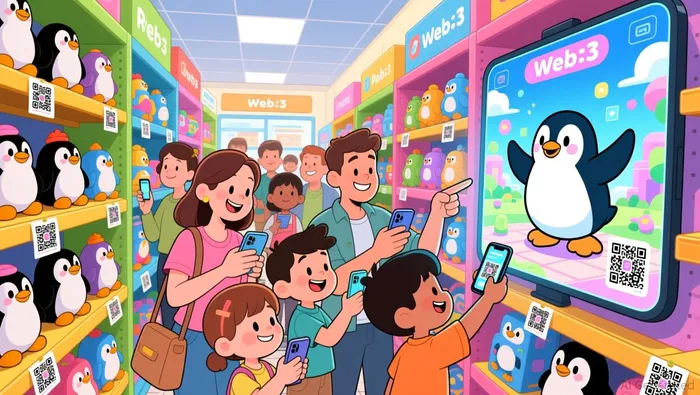
Pudgy Penguins' most transformative strategy has been its aggressive expansion into physical retail. By 2025, the brand's Pudgy Toys were available in over 5,000 retail locations globally, including WalmartWMT--, TargetTGT--, and AmazonAMZN--. These toys, embedded with scannable QR codes, link to digital avatars in Pudgy World-a virtual platform where users can interact with their characters. This approach democratizes access to Web3, allowing non-crypto users to engage with NFTs through familiar, tangible products. According to a report by SoluLab, the initiative generated over $13 million in retail revenue by mid-2025, with more than 2 million units sold. The success of this strategy lies in its simplicity: it eliminates the need for users to navigate complex crypto wallets or marketplaces, instead offering a "scan-to-engage" experience that mirrors the ease of traditional retail.
Community-Driven Incentives and IP Licensing
 Pudgy Penguins has also leveraged its NFT holders as active participants in its growth. Through platforms like OverpassIP, holders can license their penguin characters for merchandise, earning royalties from sales. This model not only aligns incentives between the brand and its community but also creates a decentralized revenue stream. As stated by a LinkedIn analysis, this approach has fostered long-term engagement, with NFT holders contributing to design submissions and co-owning the brand's intellectual property. In contrast, projects like BAYC have struggled with delayed launches and underwhelming community integration, leading to a decline in market dominance from 29.3% in 2022 to 12.8% by October 2024.
Token Utility and Financial Innovation
The launch of the $PENGU token in December 2024 further solidified Pudgy Penguins' financial ecosystem. Built on SolanaSOL--, the token powers in-game economies and staking within Pudgy World, offering utility beyond speculative trading. Data from TheBlock indicates that $PENGU's floor price surged by 44.9% weekly in late 2024, driven by its role as a "social currency" and the anticipation of an ETF filing. This tokenization strategy mirrors broader trends in Web3, where utility-driven tokens outperform pure speculation. Meanwhile, CryptoPunks, despite retaining a 30.9% market share, remain largely speculative, with high-value sales like CryptoPunk 8124 fetching $214,310-transactions that cater to deep-pocketed investors rather than mass adoption.
### Social Media and Emotional Storytelling
Pudgy Penguins' mainstream appeal is further amplified by its focus on emotional storytelling and social media. The brand's family-friendly narrative, coupled with viral content on TikTok and Instagram, has generated over 40 billion GIPHY views and attracted audiences uninterested in crypto. This strategy contrasts sharply with the technical jargon and exclusivity often associated with blue-chip NFTs. By humanizing its penguin characters and emphasizing relatable themes, Pudgy Penguins has transcended the crypto space, becoming a cultural touchstone.
A Comparative Edge in Web3 Adoption
The divergence in strategies between Pudgy Penguins and its peers is stark. While BAYC and CryptoPunks rely on prestige and scarcity, Pudgy Penguins prioritizes accessibility and utility. A Coingecko report highlights that Pudgy Penguins' market capitalization briefly surpassed BAYC in 2024, underscoring the effectiveness of its phygital model. Additionally, the project's educational initiatives, such as Pudgy Learn and AR-enabled apps, further lower entry barriers for new users. These factors collectively position Pudgy Penguins as a case study in sustainable Web3 growth.
Conclusion: The Future of Web3 Branding
Pudgy Penguins' success underscores a critical lesson for the NFT and crypto industries: mainstream adoption requires more than technological innovation. It demands a holistic approach that integrates physical and digital experiences, empowers communities, and leverages emotional resonance. As Web3 brands compete for market share, Pudgy Penguins' model offers a replicable framework-one that prioritizes user-friendly design, tangible utility, and cross-platform engagement. For investors, the project's financial metrics and institutional recognition (e.g., the proposed $PENGU ETF) signal a maturing ecosystem where crypto-native brands can thrive in the traditional economy.





Comentarios
Aún no hay comentarios