
Prosus Ventures' Strategic Investment in KGeN and Its Implications for the Generative AI Landscape
The AI infrastructure market in 2025 is undergoing a seismic shift, marked by rapid consolidation and surging private capital inflows. According to a Forbes report, over $29 billion was raised in Q2 2025 alone, with 85.87% of capital directed toward AI infrastructure, underscoring its foundational role in digital transformation. In this evolving landscape, Prosus Ventures' recent $13.5 million strategic investment in KGeN-a Singapore-based startup building a verified distribution protocol-signals a calculated bet on early-stage infrastructure players poised to address critical gaps in scalability, trust, and user engagement.
KGeN's Position in the AI Infrastructure Ecosystem
KGeN's core offering, the Verified Distribution Protocol (VeriFi), aims to solve a persistent challenge in AI, DeFi, and gaming: bot resistance and user verification. By leveraging its POGE identity and reputation framework, KGeN aggregates over 876 million attributes from real user engagement and commerce signals, enabling developers to build trustless, incentive-aligned ecosystems, according to IBTimes. The company's financials further validate its traction: 38.9 million verified users, $48.3 million in annualized revenue, and a total funding raise of $43.5 million, including a $20 million seed round in 2023 and a $10 million ecosystem round in 2024, as reported by Ventureburn.
This growth aligns with broader market trends. As noted in a Mordor Intelligence analysis, the AI infrastructure market is projected to grow at a 17.71% CAGR through 2030, driven by demand for energy-efficient hardware and specialized software frameworks. KGeN's focus on hybrid deployment models-expanding its infrastructure across 60+ countries-positions it to capitalize on the shift toward cloud-based AI solutions, which are growing at a 20.6% CAGR, according to a Flexential report.
Prosus Ventures' Strategic Rationale
Prosus Ventures' investment in KGeN reflects a deliberate pivot toward application-layer AI startups, as outlined in Prosus' 2025 strategy. Jayme Kwek, a principal at Prosus Ventures, emphasized KGeN's unique architecture, which combines user identity, incentive alignment, and verifiable engagement to unlock workflows "agnostic to specific use cases," according to Coinpedia.
This approach mirrors broader industry dynamics. As highlighted in a Ropes & Gray report, strategic M&A in AI-related sectors surged in H1 2025, with deal value on pace to exceed prior years by 123%. Prosus's focus on regions like Europe, Latin America, and India-where it sees untapped innovation potential-also aligns with its goal of diversifying risk while capturing the next wave of AI-driven value creation, as noted in a LinkedIn post.
Market Consolidation and Long-Term Investment Value
The AI infrastructure market's consolidation raises critical questions about the long-term viability of early-stage players. While hyperscalers like Microsoft and Oracle dominate with $300 billion+ deals, this concentration has been documented by TechCrunch. Startups like KGeN must therefore differentiate through niche capabilities. KGeN's POGE framework, for instance, addresses a pain point in generative AI: ensuring data integrity in training sets. By verifying real users and their engagement, KGeN reduces the risk of synthetic data poisoning, a growing concern as AI models grow in complexity, according to S&P Global Market Intelligence.
Moreover, the firm's revenue model-monetizing verified user networks and commerce signals-offers a scalable path to profitability. With annualized revenue already at $48.3 million, KGeN's ability to expand its VeriFi protocol into AI, DeFi, and gaming ecosystems suggests strong unit economics, as reported by Yahoo Finance. This is particularly relevant in a market where enterprises are prioritizing infrastructure investments to support secure, scalable AI workloads, according to TrendForce.
Implications for the Generative AI Landscape
KGeN's success could have ripple effects for generative AI. By providing a bot-resistant distribution layer, the company enables developers to focus on innovation rather than fraud mitigation. This is critical for applications like AI-driven content creation, where trust in user inputs directly impacts model quality. As generative AI matures, infrastructure players that address these foundational challenges-like KGeN-are likely to see increased demand.
Prosus Ventures' investment, therefore, is not just a vote of confidence in KGeN but a broader statement about the future of AI infrastructure. In a market where cloud providers and semiconductor firms are consolidating power, startups that bridge the gap between foundational models and end-user applications will define the next phase of growth.
Conclusion
Prosus Ventures' strategic investment in KGeN underscores a compelling thesis: early-stage AI infrastructure players with scalable, application-specific solutions will thrive in a consolidating market. As KGeN expands its Verified Distribution Protocol and Prosus leverages its global data network, the partnership exemplifies how venture capital can catalyze innovation at the intersection of AI, blockchain, and consumer growth. For investors, the key takeaway is clear-focusing on infrastructure that addresses trust, scalability, and real-world adoption will be critical to capturing long-term value in the AI era.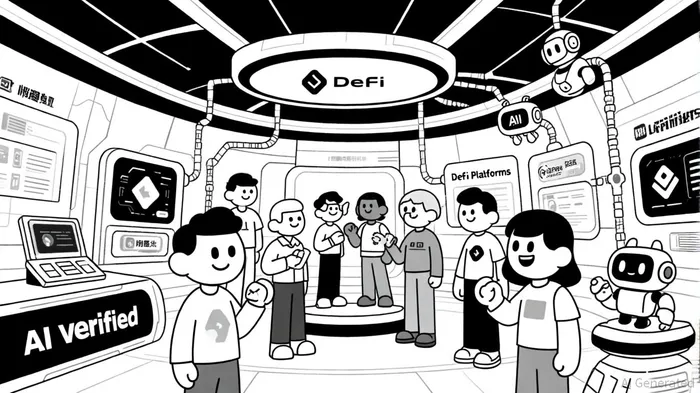







Comentarios
Aún no hay comentarios