
Profound Medical's TULSA-PRO: Mapping the Infrastructure Layer for Minimally Invasive Prostate Care
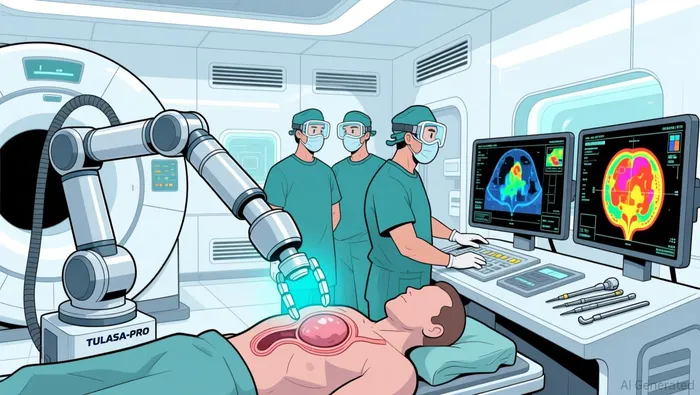
The official launch of ProfoundPROF-- Medical's TULSA-PRO system at Johns Hopkins Hospital marks a pivotal structural validation for the platform. Treating its first commercial patient on January 6, 2026, coincides with the opening of a new interventional MRI suite, a move that signals a fundamental shift in medical infrastructure. This is not merely a hospital adopting a new device; it is a leading academic center building a dedicated therapeutic environment where real-time MRI is the operational backbone, moving far beyond its traditional diagnostic role.
This milestone demonstrates the platform's ability to treat a broad spectrum of prostate disease, a key commercial requirement. The TULSA Procedure is designed for patients across the entire prostate disease continuum, from those with low- to high-risk cancer, to men with benign prostatic hyperplasia (BPH), and crucially, to hybrid patients suffering from both conditions. By establishing itself at a center of innovation like Johns Hopkins, the technology gains a powerful endorsement for its clinical versatility and precision.
The setup at Johns Hopkins reflects a growing trend: the integration of advanced imaging and therapeutic robotics into a single, purpose-built suite. This infrastructure is essential for the platform's value proposition. The procedure relies on real-time MRI thermography for continuous visualization and autonomous temperature control, a process that demands a stable, high-performance imaging environment. The fact that a premier institution is investing in this specialized infrastructure to support TULSA-PRO suggests that the technology's operational needs are now being met by the healthcare system itself, paving the way for broader adoption.
For Profound, this is a critical step from clinical validation to commercial infrastructure. It shows that the ecosystem required to deliver this incision-free, one-and-done therapy is beginning to form. The next phase will be seeing if other leading centers follow Johns Hopkins's lead in building or adapting their facilities to support this new standard of care.
The Technological S-Curve: Profound's First-Mover Positioning
Profound Medical is positioned at the inflection point of an exponential adoption curve for MRI-guided focused ultrasound. The global market for this technology is projected to grow from $1.05 billion in 2025 to $1.66 billion by 2032, exhibiting a steady 8.2% compound annual growth rate. This trajectory is fueled by a powerful confluence of clinical demand for minimally invasive therapies and a favorable economic ecosystem. Yet, within this expanding market, Profound's TULSA-PRO has carved out a first-mover advantage that is both technological and, critically, economic.
The company's lead product, TULSA-PRO, has achieved a landmark regulatory and reimbursement milestone. It is the first and only prostate treatment to achieve Urology APC Level 7 classification under the Medicare Outpatient Prospective Payment System. This status commands a Medicare national average hospital reimbursement of $12,992. That rate is over 40% higher than other Level 6 treatments and 25% higher than robotic prostatectomy. This is not merely a billing code; it is a powerful economic signal that validates the procedure's complexity and resource intensity, creating a direct financial incentive for hospitals to adopt the technology.
The positioning is Profound's asymmetric advantage. While competitors like Insightec and Medtronic are driving innovation across neurological and oncological applications, Profound has secured a premium reimbursement tier in a high-volume, high-cost clinical area-prostate cancer and benign prostatic hyperplasia. The technology's inherent benefits-precision ablation, outpatient setting, reduced side effects-align with healthcare systems' goals for cost containment. The high reimbursement rate, however, turns this alignment into a compelling business case for providers, accelerating the adoption curve.
The bottom line is that Profound is monetizing its first-mover status at the precise moment the market is scaling. It has navigated the typical S-curve challenge of high capital investment and reimbursement friction by securing a premium payment for its specific application. This creates a virtuous cycle: higher reimbursement funds further clinical validation and commercial expansion, which in turn supports the technology's broader market penetration. For investors, the thesis is clear: Profound is not just a participant in the MRI-guided focused ultrasound story, but a beneficiary of its most valuable early inflection.
Financial Engine and Path to Profitability
Profound Medical's financial engine is firing on all cylinders, with recent results showing a powerful acceleration in both top-line growth and operational efficiency. Revenue for the third quarter of 2025 hit a record $5.3 million, surging 87% year-over-year. This growth is built on a dual foundation: capital system sales and a robust stream of recurring consumables. The company reported $4.1 million from recurring revenue, which includes consumables, leases, and services, demonstrating the early stages of a scalable, subscription-like model as its installed base expands.
The most striking metric, however, is the dramatic improvement in profitability. Gross margin expanded by a staggering 1,119 basis points to 74.3% in the quarter. This leap is a direct result of manufacturing efficiency gains, signaling that the company is successfully translating higher volume into better unit economics. This margin expansion is critical; it provides the financial fuel needed to fund the aggressive sales and marketing investments required to drive further system placements.
The path to sustained profitability is now clearly visible, supported by a healthy sales pipeline. The company's TULSA-PRO qualified sales pipeline stands at 93 new systems in the final stages of the sales cycle. This pipeline, combined with an installed base of 70 systems and the expectation to reach at least 75 by year-end, creates a predictable growth trajectory. Each new system sale not only contributes to capital revenue but also seeds years of recurring consumables and service income.
The bottom line is a company transitioning from early commercialization to scaling profitability. While operating expenses rose to support this growth, the massive gross margin expansion provides a clear runway. The key watch item is whether this financial momentum can continue to outpace the rising costs of building a direct sales force and expanding global distribution. If the pipeline converts efficiently, Profound is well-positioned to move from a growth phase to a profitable one, with its installed base serving as the engine for recurring cash flow.
Catalysts, Risks, and the Path Forward
The commercial thesis for Profound MedicalPROF-- now hinges on a single, measurable execution test: converting its robust sales pipeline into a growing installed base. The company's TULSA-PRO qualified sales pipeline stands at 93 new systems in the final stages of negotiation, a figure that directly determines its near-term revenue trajectory. The primary catalyst is the successful closure of these deals. With the installed base at 70 systems and management guiding for at least 75 by year-end, the pipeline represents the immediate runway for scaling. The key watch item is whether the company can maintain its 87% year-over-year revenue growth momentum by converting these qualified leads, especially as it invests heavily in its direct sales force in North America.
This path forward is complicated by a significant structural barrier: the high capital investment required for adoption. The evidence highlights that MRgFUS systems typically carry an upfront cost of $3-5 million per unit, a substantial hurdle for smaller healthcare facilities. This financial threshold is a primary restraint on market penetration, limiting expansion to well-capitalized medical centers. For Profound, this means its strategy of direct sales in North America must be exceptionally effective at securing commitments from larger, better-funded institutions. The company's recent partnership model, like the TULSA-PROgram launched with Texas Prostate and Dallas Medical Center, is a direct attempt to mitigate this by leveraging hospital infrastructure, but it does not eliminate the core capital barrier for the broader market.
The company's dual-track go-to-market strategy is critical for navigating this tension. By deploying its own direct sales team in North America, Profound aims to capture high-value deals where it can manage the complex sales cycle and demonstrate ROI. Simultaneously, its strategic distribution partnerships in regions like Canada, Saudi Arabia, and Australia are designed to accelerate adoption where local expertise and relationships can overcome capital and regulatory friction. This hybrid model is the key to scaling the installed base beyond the constraints of a single, capital-intensive sales force. The bottom line is that success depends on flawless execution of the pipeline conversion, a strategy that leverages both direct control and external partnerships to work around the industry's fundamental capital hurdle.





Comentarios
Aún no hay comentarios