
The Production Paradox and the New Commodity Power Players in 2026
The global commodity market in 2026 is defined by a paradox: while macroeconomic headwinds and geopolitical tensions persist, low-cost producers of critical metals and minerals are outperforming, driven by surging demand from the energy transition, AI infrastructure, and industrial decarbonization. This phenomenon-what we term the production paradox-reflects a structural shift in commodity dynamics, where supply constraints and strategic regionalization collide with long-term demand fundamentals. For investors, identifying the new power players in this landscape is critical to navigating the bearish environment while capitalizing on tailwinds.
Copper: The Backbone of the Energy Transition
Copper is at the epicenter of the production paradox. Morgan Stanley forecasts a 2026 base case price of $10,650 per ton, with a bull case reaching $12,780 per ton, driven by demand from renewable energy grids, electric vehicles (EVs), and AI data centers. Despite weaker Chinese end-use indicators, global demand remains robust, particularly in the U.S. and Europe, where green infrastructure projects are accelerating.
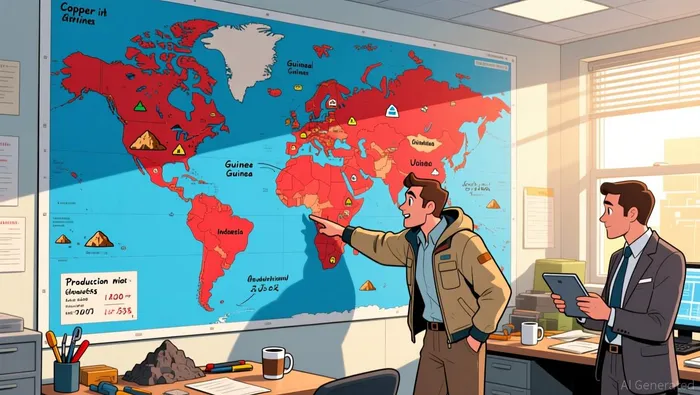
Low-cost leaders in copper production are leveraging cost efficiencies and strategic positioning. Rio Tinto has slashed unit costs to 80-100 cents per pound in 2025, with production guidance of 800,000–870,000 metric tons in 2026. The company's Oyu Tolgoi mine in Mongolia and Simandou project in Guinea are pivotal to its long-term growth, with ambitions to reach 1 million tons of annual output by 2030. Freeport-McMoRan (FCX) and Southern Copper Corporation (SCCO) are also key players, with FCX benefiting from its low-cost operations in Indonesia and the U.S. Meanwhile, Gunnison Copper (GCU) is emerging as a disruptive force, with a preliminary economic assessment projecting 167 million pounds of annual copper production at an average cash cost of $1.42 per pound.
Lithium: China's Rise and Global Demand Surge
Lithium demand is entering a new growth cycle, fueled by battery energy storage systems, AI data centers, and humanoid robotics. China is projected to overtake Australia as the world's top lithium miner by 2026, producing 8,000–10,000 more metric tons than its Australian counterparts. This shift is driven by strategic investments in domestic refining capacity and supply chain security.
Leading producers like Albemarle Corporation, SQM, and Ganfeng Lithium are capitalizing on this trend. Albemarle's operations in Argentina and Australia, combined with its partnerships in China, position it to benefit from both raw material extraction and downstream processing. Ganfeng, meanwhile, is expanding its lithium hydroxide production to meet EV battery demand according to benchmark minerals analysis. For investors, the key is to focus on companies with diversified geographies and vertical integration, as supply chain disruptions remain a risk.
Nickel: Supply Constraints and Strategic Players
Nickel demand is being driven by stainless steel production and EV battery manufacturing, with Indonesia emerging as the dominant producer. The country's 2026 production capacity is expected to exceed 1.6 million tonnes annually, supported by government policies that prioritize domestic refining. Indonesia's role is critical, as its export restrictions and quota controls have tightened the global nickel market, pushing prices higher in 2025.
Key producers include MMC Norilsk Nickel (Nornickel), Glencore, and Jinchuan Group International Resources Co. Ltd. Nornickel, the world's largest nickel producer, benefits from its Russian operations and proximity to Asian markets. Glencore, with its Rusal joint venture, is also expanding its nickel refining capacity in Indonesia according to market analysis. For investors, the nickel sector offers exposure to both industrial demand and geopolitical dynamics, particularly in Southeast Asia.
Gold: Safe Haven Amid Uncertainty
Gold has maintained its status as a safe-haven asset, with prices hitting $4,530 per ounce in 2025 and projected to average $4,200 per ounce in 2026. Central bank purchases, particularly from China and India, have underpinned demand, while inflationary pressures and rate-cut expectations have reinforced its appeal.
Leading gold producers like Newmont Corporation and Barrick Gold Corporation are well-positioned to benefit. Newmont's low-cost operations in the U.S., Australia, and Canada provide resilience against price volatility, while Barrick's focus on high-margin assets in Nevada and Argentina ensures steady cash flow according to trading view analysis. As geopolitical tensions persist, gold's role as a hedge against macroeconomic uncertainty will remain a tailwind for these producers.
Conclusion: The Future of Commodity Markets
The production paradox in 2026 underscores a fundamental truth: low-cost producers with strategic assets and operational flexibility will outperform in a bearish market. Copper, lithium, nickel, and gold are not just commodities-they are enablers of the global energy transition and digitalization. For investors, the key is to align with companies that can navigate supply constraints while scaling to meet demand. As Morgan Stanley notes, global energy transition investments are projected to reach $3.3 trillion in 2026, with two-thirds allocated to clean technologies. The winners of this transition will be those who master the production paradox.







Comentarios
Aún no hay comentarios