
Procter & Gamble Insider Stock Sale: Signal or Noise in a Volatile Market?
Let's cut to the chase: ProcterPG-- & Gamble's recent insider selling has sparked chatter. But is this a red flag or just routine noise? To answer that, we need to dissect the why behind the transactions-and not just the what.
First, the facts. In October 2025, Jennifer L. Davis, CEO of P&G's Health Care division, sold 3,227 shares at $152.23 per share to cover tax obligations tied to a Restricted Stock Unit (RSU) settlement, according to the Form 4 filing. This isn't a liquidity-driven move; it's a compliance play. After the sale, Davis still holds over 61,000 shares directly and 15,500 indirectly through retirement plans, per that filing. That's not the behavior of someone fleeing the stock-it's the behavior of someone managing personal finances while maintaining a hefty stake.
But here's the rub: P&G's top brass has been selling aggressively. CEO Jon R. Moeller unloaded 40,119 shares on August 19, 2025, for $6.3 million, per InsiderTrades. CFO Andre Schulten sold 4,252 shares at $152.23 on October 2, according to Insider Monkey. And let's not forget Gary A. Coombe, the former CEO, who sold 1,000 shares in late August, the Insider Monkey data show. These aren't small transactions. They're significant, and they're happening across multiple layers of leadership.
Now, let's not panic. Insiders are required to sell RSUs and cover taxes, especially when compensation is tied to equity. But when you see a pattern-like P&G's executives selling over $7 million worth of stock in a single month-it's worth asking: Is this confidence or caution?
The answer lies in context. P&G's Q3 2025 results show a company that's still a cash-flow machine. Net sales hit $19.8 billion, with organic growth of 1% and core earnings per share up 1% year-over-year, according to the company's 10-Q. The company returned $3.8 billion to shareholders via dividends and buybacks, per the same filing. If insiders were truly worried about the business, wouldn't they be buying, not selling?
But here's where behavioral economics comes into play. Insiders often sell to diversify their wealth-a rational move for someone with a large portion of net worth tied to their company's stock. For example, Davis's post-sale holdings still represent a meaningful position, as the filing shows. Schulten and Moeller's sales also align with typical RSU settlement timelines, according to Insider Monkey. These are not panic selloffs; they're calculated, tax-efficient moves.
Still, let's not ignore the optics. In a volatile market, where retail investors are skittish and macro risks loom, insider selling-even routine selling-can amplify noise. The key is to differentiate between strategic selling (e.g., tax obligations, diversification) and strategic buying (e.g., confidence in undervaluation). P&G's insiders haven't been buying, but they've also not been dumping their stakes en masse.
Here's the bottom line: P&G's insider activity is a mix of signal and noise. The signal? A disciplined approach to tax compliance and wealth diversification. The noise? Overreacting to sales that don't reflect pessimism about the business. With P&G's fundamentals intact and its dividend yield hovering near 3%, the stock remains a defensive play for long-term investors.
But let's keep watching. If insiders start selling without RSU settlements or retirement plan distributions as cover, that's a different story. For now, though, the message is clear: This isn't a sell-off-it's a sell through.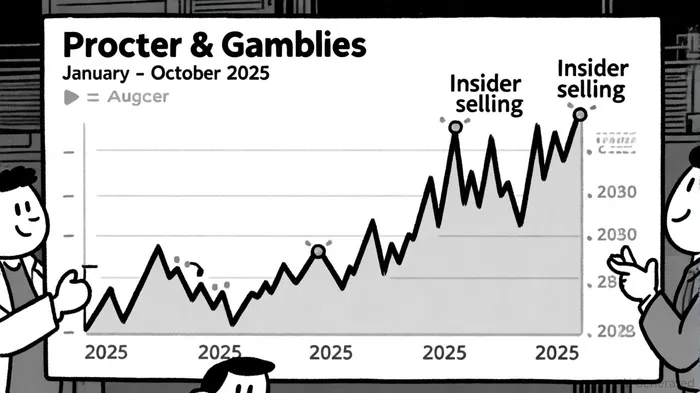





Comentarios
Aún no hay comentarios