
Processa's J.P. Morgan Appearance: A Catalyst for the NGC-Cap Data Reveal
The immediate event is here. Processa's management team is in San Francisco for the 44th Annual J.P. Morgan Healthcare Conference, which runs from January 12 to 15. This isn't just a routine investor relations stop. It's a deliberate tactical platform, timed to generate maximum attention ahead of a critical data catalyst.
The primary focus for investors will be the ongoing Phase 2 study of NGC-Cap in breast cancer. The company has set the stage for a binary outcome. Last week, on January 5, ProcessaPCSA-- completed the enrollment and dosing of the 20 patients required for a formal interim analysis. This means the data readout is now imminent, with the company expecting to complete the analysis in the first quarter of 2026.
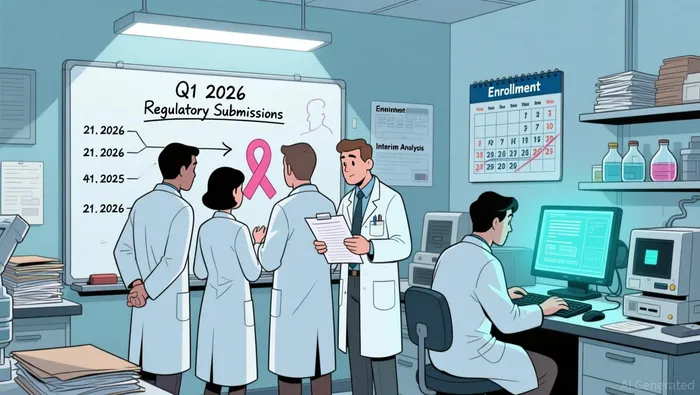
The conference timing is a clear prelude. Management will be available for one-on-one meetings to discuss the pipeline, but the market's eyes will be fixed on the upcoming data. The stock's reaction will be binary and entirely dependent on the quality of that initial signal. The interim analysis is designed to evaluate early signals of clinical benefit and guide dose selection, making it a make-or-break moment for the program's trajectory.
The Setup: A High-Risk, High-Reward Data Readout
The mechanics of this event are now clear. Processa is running a randomized, FDA-recommended Phase 2 trial that directly pits its NGC-Cap combination against standard capecitabine monotherapy. The interim analysis of the first 20 patients is the critical first checkpoint to see if the new regimen shows a meaningful improvement.
The study design is straightforward but pivotal. It compares NGC-Cap-where a single dose of PCS6422 is given the day before capecitabine, followed by a specific dosing schedule-to the standard Mono-Cap regimen. The goal is to evaluate both safety and efficacy in patients who have already undergone multiple prior treatments. The interim analysis is explicitly designed to guide dose selection and study optimization, not to provide a final verdict.
The early promise comes from preliminary data showing NGC-Cap increases exposure to capecitabine's cancer-killing metabolites while maintaining a safety profile comparable to standard therapy. This is the core hypothesis: by re-engineering the drug's metabolism, the combination could offer better results without adding toxicity. The interim analysis will test that theory head-on.
For investors, the setup is binary and high-stakes. The data from these first 20 patients will determine whether the company should proceed with a higher or lower dose in a potential third arm, and whether to adjust the overall study size. A positive signal could validate the NGC platform and propel the stock. A negative or inconclusive result would likely stall the program and pressure the balance sheet. The risk is high, but the potential reward is a clear path to a more effective therapy.
The Valuation and Risk Landscape
The binary data readout is set against a backdrop of extreme financial and market vulnerability. Processa is a micro-cap with a market capitalization of just $7.87 million. This tiny equity value means the stock is a pure speculation vehicle, with every news flow capable of causing outsized price swings. The recent 52-week range-from a low of $2.74 to a high of $22.80-illustrates this volatility, with the stock having moved over 700% in a single year. The recent trading session, where shares fluctuated between $3.27 and $3.40, shows how thin the order book can be.
This setup is a direct function of the company's strategy and scale. With a team of just 10 employees, Processa operates as a lean, asset-focused entity. Its entire business model hinges on out-licensing its clinical assets after pivotal studies, rather than funding costly commercialization itself. The upcoming NGC-Cap data is therefore the critical catalyst for any partnership value. A positive signal could trigger an immediate re-rating and a licensing deal, effectively multiplying the stock's value. A negative or inconclusive result would likely leave the company with a diminished asset and a severely pressured balance sheet, as it has no other near-term revenue.
The risk/reward profile is stark. The stock's current price, around $3.27, reflects a speculative bet on a successful data readout. The company's small size amplifies this bet, as there is minimal operational cushion to absorb a setback. For now, the entire valuation narrative is on hold, awaiting the interim analysis. The J.P. Morgan conference provides the platform, but the market's verdict will be delivered by the data.
Catalysts and Watchpoints
The immediate next step is clear. The company expects to complete the formal interim analysis from the first 20 patients in the first quarter of 2026. This is the primary catalyst that will dictate the stock's direction. Investors should watch for the official report of those safety and efficacy data as the definitive signal.
During the J.P. Morgan conference, management will be available for one-on-one meetings. This is the platform for initiating partnership discussions. The key watchpoint is whether Processa uses these meetings to generate early interest from potential partners, which could provide a positive sentiment lift even before the data is public. Any forward guidance on the study's path-such as confirming plans to add a third arm or adjust the sample size based on interim findings-would also be a material signal.
The risk is binary and severe. If the interim data fails to show a clear efficacy or safety advantage for NGC-Cap over standard therapy, the stock is likely to face a sharp decline. The analysis is designed to guide dose selection and study optimization, so a negative result would likely stall the program's development and severely pressure the company's already-tiny balance sheet. With a market cap of just $7.87 million, there is no operational cushion to absorb a setback.
The bottom line is that the stock's reaction will be entirely dependent on the quality of that Q1 data. The J.P. Morgan conference provides the stage, but the market's verdict will be delivered by the numbers.





Comentarios
Aún no hay comentarios