
Private Credit as a Strategic Hedge Against Liquid Debt Volatility
The Resilience of Private Credit in Volatile Markets
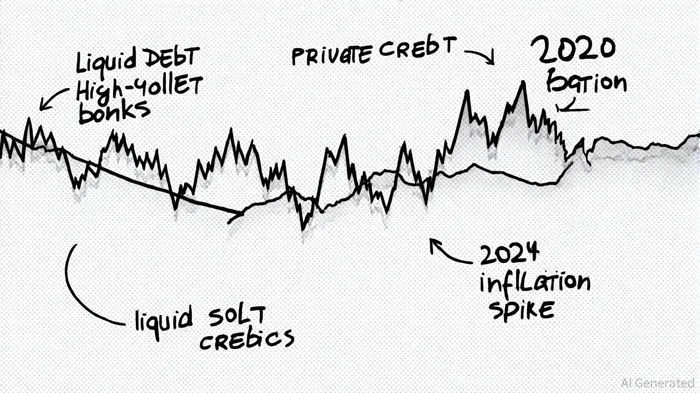
Private credit's ability to weather market turbulence stems from its structural advantages over liquid debt. Unlike public bonds, which are subject to sudden repricing during crises, private credit offers customized terms, proactive risk management, and direct borrower relationships, as BlackRockBLK-- observes. For instance, during the 2020–2023 pandemic period, direct lending strategies recorded lower loss rates compared to leveraged loans and high-yield bonds, underscoring their capacity to mitigate credit risk, according to a Morgan Stanley analysis.
The sector's scalability has further amplified its appeal. Fund sizes have grown substantially, with average private credit fund sizes rising from $627 million in 2020 to $1.05 billion in 2024, BlackRock reports. This expansion has enabled private credit to compete with traditional lenders in financing large transactions, including jumbo loans exceeding $1 billion, per BlackRock. However, this rapid growth has also intensified competition, compressing yields and heightening the need for disciplined underwriting, the CFA Institute article argues.
Institutional Due Diligence: Customization, Technology, and ESG
Institutional investors are adopting multifaceted due diligence frameworks to navigate the complexities of private credit. With global private credit assets under management (AUM) projected to surpass $3 trillion by 2025, as highlighted in a Delphos report, investors are prioritizing:
1. Customized Deal Structures: Diversifying across senior secured loans, mezzanine debt, and NAV-based facilities to align with borrower needs and risk profiles.
2. AI-Driven Underwriting: Leveraging machine learning for predictive analytics, enhancing transparency, and enabling scalable decision-making.
3. ESG Integration: Embedding environmental, social, and governance (ESG) covenants to futureproof portfolios against regulatory and reputational risks.
Regulatory shifts, particularly in the U.S., are also reshaping due diligence priorities. The SEC's focus on expanding private market access has prompted investors to scrutinize liquidity terms, fee structures, and cross-border interconnectedness, according to a Carta analysis. For example, pension funds and insurers are now assessing how private credit interacts with traditional banking systems to mitigate systemic fragility, as the Carta piece notes.
Case Studies: Lessons from the Field
CoStar Group's Acquisition of Domain: In 2025, CoStar Group initiated a $2.8 billion bid for Australia's Domain, granting itself exclusive due diligence access to evaluate the target's financial and operational health, according to Capital Brief. This case, reported by Global Banking & Finance, highlights how institutional investors use rigorous data-room reviews and scenario analysis to mitigate risks during high-stakes transactions.
Pasadena Private Lending's $50 Million Loan: Pasadena Private Lending Inc. (PPL) secured a $50 million secured term loan with SLR Capital Partners amid economic uncertainty, demonstrating how institutional lenders prioritize conservative leverage ratios and covenant structures to manage borrower risk, according to a MarketScreener article. Such transactions reflect the sector's shift toward defensive industries and high-quality borrowers, as detailed in a Configure Partners outlook.
The Road Ahead: Balancing Yield and Risk
While private credit offers compelling returns, its growth has introduced new challenges. Liquidity mismatches, contagion risks, and regulatory scrutiny require investors to balance yield-seeking objectives with disciplined risk management, a CFA Institute blog post warns in its analysis of the sector's surge. For instance, KKR's Global Head of Private Credit, Dan Pietrzak, emphasizes the importance of credit asset selection in inflationary environments, where companies with tight cash flows face heightened vulnerability, according to KKR's outlook.
Institutional investors are also exploring innovative solutions, such as tokenized private credit platforms, to enhance liquidity and accessibility, as described in a Proskauer alert. However, the CFA Institute blog cautions that these innovations demand robust frameworks to address governance and transparency concerns.
Conclusion
Private credit has evolved from a niche alternative to a cornerstone of institutional portfolios, offering a strategic hedge against liquid debt volatility. By combining rigorous due diligence, technological innovation, and ESG alignment, investors can harness its potential while mitigating systemic risks. As the sector continues to mature, the ability to adapt to regulatory and macroeconomic shifts will define long-term success in this dynamic market.







Comentarios
Aún no hay comentarios