
Privacy-First Innovation vs. Web3 Gamification: Monero's Fluorine Fermi Upgrade and LivLive's $LIVE Presale in 2025
In 2025, the cryptocurrency landscape is witnessing a pivotal shift between two distinct paradigms: privacy-centric infrastructure and utility-driven Web3 platforms. Monero's Fluorine Fermi upgrade (v0.18.4.3) and LivLive's ($LIVE) gamified AR ecosystem represent these divergent paths. For risk-aware investors, the question is not merely which project is superior but which aligns better with the evolving demands of digital innovation and regulatory realities.
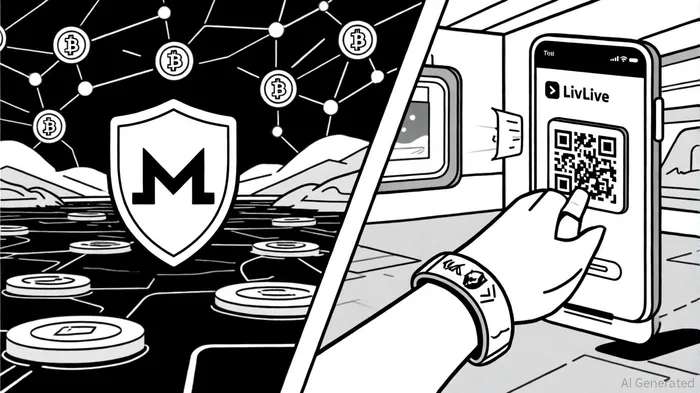
Monero's Fluorine Fermi: A Technical Fortress Against Surveillance
Monero (XMR) has long been the gold standard for privacy, and its Fluorine Fermi upgrade, released on October 9, 2025, underscores its commitment to untraceable transactions. The upgrade introduces a smarter peer selection algorithm that actively avoids connecting to large IP subnets associated with spy nodes-malicious entities that correlate IP addresses with transactions to undermine anonymity, as detailed in a Capwolf report. This enhancement builds on existing privacy tools like Dandelion++, stealth addresses, and ring signatures, creating a multi-layered defense against de-anonymization, according to a CoinAlertNews article.
From a technical standpoint, the upgrade includes 36 code changes from 13 developers, including P2P communication optimizations and wallet performance improvements, according to the Monero release notes. These updates not only strengthen privacy but also ensure network stability, a critical factor for long-term adoption. However, the market's initial reaction was mixed: XMR dipped to $330 post-upgrade before recovering to $336.81, according to a JU blog post. Over the 30-day period, XMR demonstrated resilience, with a 26% price increase and a market cap of $6.19 billion (the JU blog post reports these figures).
Despite these gains, Monero faces an existential challenge: regulatory scrutiny. Privacy coins are increasingly targeted by governments seeking to combat illicit finance, and Fluorine Fermi's release does not eliminate this risk. Yet, the upgrade's technical rigor and strong developer engagement signal a project that remains committed to its core mission, even as it navigates a hostile regulatory environment, according to a Tecronet article.
LivLive ($LIVE): Gamifying Web3 with Real-World Utility
LivLive's ($LIVE) presale has emerged as a disruptive force in 2025, leveraging augmented reality (AR) and proof-of-presence mechanics to bridge the gap between digital assets and physical-world engagement. The platform rewards users for scanning QR codes, visiting partnered venues, or participating in sponsor challenges via a wristband that verifies real-time location data, as reported in a BTCC report. This model creates a tangible use case for blockchain, addressing the criticism that many Web3 projects lack practical applications.
The presale has already raised $2 million, with early investors purchasing $LIVE at $0.02 per token. A limited-time bonus code (EARLY30) offers 30% more tokens, amplifying potential returns for early adopters (the BTCC report covered these presale details). Analysts project a post-launch fair value of $1, implying a 100x gain for presale participants, per the BTCC report. The project's deflationary tokenomics-featuring token burns, locked liquidity, and a $2.5M Rewards Vault-further enhance investor appeal by creating scarcity and incentivizing long-term participation, according to a Crypto Reporter piece.
LivLive's growth is also fueled by its community-driven approach, with 65% of the token supply allocated to users. This contrasts with traditional projects like TronTRX-- (TRX) and ChainlinkLINK-- (LINK), which have struggled to break through price ceilings amid market stagnation, as the BTCC report notes. However, the project's success hinges on execution: the AR platform must achieve mass adoption, and the wristband hardware must prove reliable and user-friendly.
Comparative Investment Analysis: Privacy vs. Gamification
For risk-aware investors, the choice between Monero and LivLive depends on their risk tolerance and investment horizon.
- Monero's Strengths:
- Technical Resilience: Fluorine Fermi's peer selection algorithm and network hardening represent a significant step forward in privacy, a feature that remains in high demand as digital surveillance expands (the Capwolf report highlights this point).
- Proven Track Record: Monero's 30-day 26% price increase and $6.19 billion market cap demonstrate its ability to retain value despite regulatory headwinds (reported in the JU blog post).
- Developer Engagement: The 36 commits from 13 contributors highlight a robust, decentralized development team-a critical factor for long-term sustainability, per the Monero release notes.
Weaknesses: Regulatory pressure could limit Monero's adoption in jurisdictions with strict anti-money laundering (AML) laws. Additionally, the price dip post-upgrade suggests market uncertainty, though this is typical for major protocol changes (the JU blog post discussed the dip).
- LivLive's Strengths:
- High Growth Potential: The presale's 100x projected return and deflationary mechanics make it an attractive speculative play, particularly for investors seeking exposure to Web3's next phase (the BTCC report outlines these projections).
- Real-World Utility: The AR platform's gamified approach addresses a key criticism of crypto-lack of tangible use cases-by incentivizing physical-world engagement (covered by BTCC).
- Community Focus: Allocating 65% of tokens to users fosters organic growth and aligns incentives between the project and its community (the BTCC report emphasizes the allocation).
Weaknesses: LivLive is an early-stage project with unproven execution. The success of its AR ecosystem depends on hardware adoption, partnerships, and user retention-variables that are difficult to predict.
Strategic Recommendations for Risk-Aware Investors
- Monero (XMR) is better suited for investors prioritizing long-term privacy infrastructure and willing to tolerate regulatory uncertainty. Its Fluorine Fermi upgrade strengthens its position as a foundational privacy tool, and its 30-day price resilience suggests it can weather short-term volatility (see the JU blog post).
- LivLive ($LIVE) appeals to investors seeking high-risk, high-reward opportunities in the Web3 space. The presale's projected 100x return and gamified utility model position it as a potential breakout project, but its success depends on execution and market adoption, as the BTCC report cautions.
Conclusion
Monero's Fluorine Fermi upgrade and LivLive's $LIVE presale represent two distinct but complementary paths in the evolution of digital assets. Monero's technical rigor and privacy-first ethos make it a cornerstone for a world increasingly concerned with data security, while LivLive's gamified AR platform exemplifies the potential of Web3 to create real-world value. For risk-aware investors, the optimal strategy may involve a balanced allocation: hedging against regulatory risks with Monero's established infrastructure while allocating a portion of capital to LivLive's speculative but high-growth potential.






Comentarios
Aún no hay comentarios