
Privacy-Enhancing Cryptocurrencies as the Next Institutional Infrastructure Play
The crypto market is undergoing a profound transformation as privacy-enhancing technologies transition from niche experimentation to foundational infrastructure. Institutional investors, once wary of privacy coins due to regulatory ambiguity, are now actively integrating these protocols into their portfolios and operational frameworks. This shift is driven by two converging forces: the maturation of privacy-preserving technologies like zero-knowledge proofs (ZKPs) and the evolving regulatory landscape, particularly in the United States. ZcashZEC-- (ZEC) and Solana's (SOL) privacy integrations exemplify this trend, while the SEC's recent engagement with privacy advocates signals a pivotal moment in the sector's evolution. For investors, this represents a high-conviction entry point into an asset class poised to redefine digital finance.
Zcash: Bridging Privacy and Regulatory Compliance
Zcash has emerged as a bellwether for privacy-centric cryptocurrencies in 2025, with its strategic alignment with regulatory frameworks and institutional demand. The U.S. Securities and Exchange Commission (SEC) invited Zcash founder Zooko Wilcox to its December 15, 2025, roundtable on financial surveillance and privacy, a move that underscores the growing legitimacy of privacy-focused protocols in mainstream finance. This engagement is not accidental: Zcash's shielded transactions, powered by zk-SNARKs, offer a unique value proposition by enabling verifiable compliance without exposing sensitive user data according to analysis.
Institutional adoption has accelerated as a result. Grayscale's proposed Zcash ETF filing, coupled with investments from entities like Cypherpunk Technologies and Reliance Global Group, has positioned ZECZEC-- as a privacy-centric asset with mainstream appeal according to reports. These developments are critical because they demonstrate that privacy and regulatory compliance are not mutually exclusive. Instead, Zcash's technology allows institutions to meet anti-money laundering (AML) requirements while preserving user confidentiality-a balance the SEC's roundtable aims to formalize according to analysis.
Solana's Privacy-First Infrastructure Play
While Zcash has long been synonymous with privacy, Solana's 2025 upgrades position it as a formidable infrastructure player in the privacy space. The network's introduction of Confidential Balances, a token standard leveraging ZKPs to encrypt transaction amounts, marks a significant step toward institutional adoption. This innovation builds on earlier features like Confidential Transfers, which allow encrypted token management while maintaining compliance-ready verification mechanisms.
Solana's privacy ecosystem is further bolstered by partnerships with projects like Arcium and DarkLake. Arcium's multi-party computation (MPC) solutions enable encrypted computations for DeFi protocols and gaming applications, while DarkLake's confidential AMM (Automated Market Maker) introduces MEV-resistant order execution. These tools are not just theoretical-they are being integrated into real-world use cases such as encrypted payroll systems and B2B settlements, demonstrating privacy's utility beyond speculative trading.
Technically, Solana's Alpenglow upgrade has enhanced its scalability and performance, reducing transaction finality to 150 milliseconds and introducing P-tokens to optimize network efficiency. These upgrades, combined with JavaScript-based ZK libraries for broader accessibility, position Solana as a high-throughput, privacy-first platform for institutional-grade applications.
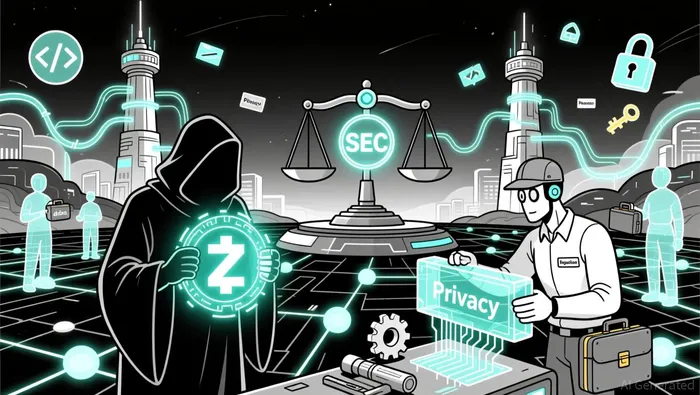
The SEC's Privacy-Compliance Balancing Act
The SEC's December 2025 roundtable on privacy and financial surveillance is a watershed moment for the sector. By inviting Zcash, Aleo, and other privacy-tech builders alongside civil liberties advocates, the agency is signaling a willingness to engage with the philosophical and technical challenges of privacy-preserving systems. Commissioner Hester Peirce's emphasis on recalibrating oversight to protect civil liberties while maintaining national security highlights the regulatory tightrope.
This discourse is occurring against a backdrop of high-profile prosecutions, such as those of Tornado CashTORN-- developer Roman Storm and Samourai Wallet co-founders, which have raised questions about the liability of privacy tool developers according to reports. However, the SEC's roundtable suggests a shift toward constructive dialogue rather than punitive action. The agency is exploring whether selective disclosure mechanisms-where users can prove compliance without revealing transaction details-can coexist with AML regulations.
For investors, this regulatory engagement is a green light. The SEC's involvement indicates that privacy is no longer a fringe concern but a core component of the digital asset ecosystem. As Commissioner Peirce noted, the goal is to create a framework where privacy tools enhance compliance rather than undermine it according to analysis.
Investment Thesis: Privacy as Foundational Infrastructure
The convergence of Zcash's regulatory alignment, Solana's technical advancements, and the SEC's evolving stance creates a compelling case for privacy-enhancing cryptocurrencies as the next institutional infrastructure play. Here's why:
- Regulatory Legitimacy: The SEC's engagement with privacy advocates and its exploration of ZKP-based compliance mechanisms signals a regulatory environment that is beginning to accommodate privacy-first protocols.
- Institutional Demand: Corporate treasuries are allocating significant capital to privacy-centric assets. For example, Solana's institutional holdings of 5.9 million SOLSOL-- (1% of its circulating supply) reflect a growing appetite for scalable, privacy-preserving infrastructure.
- Technical Maturity: Innovations like Confidential Balances and MPC-based privacy solutions are moving beyond proof-of-concept stages, enabling real-world applications in finance, gaming, and data sharing.
- Market Dynamics: Privacy coins like Zcash have experienced price surges in late 2025, driven by institutional adoption and regulatory clarity. This trend is likely to accelerate as more investors recognize privacy as a non-negotiable feature in a post-privacy era.
Conclusion
Privacy-enhancing cryptocurrencies are no longer a niche experiment-they are the bedrock of the next phase in digital finance. Zcash's strategic alignment with regulatory frameworks and Solana's infrastructure upgrades exemplify how privacy can coexist with compliance, scalability, and institutional demand. As the SEC's roundtable demonstrates, the regulatory pendulum is swinging toward a balanced approach that recognizes privacy as both a civil liberty and a compliance tool. For investors, this is a high-conviction opportunity to position capital in an asset class that is not just surviving but thriving in a maturing market.






Comentarios
Aún no hay comentarios