
Privacy Coins as a Strategic Hedge in a Regulated Crypto Era
The Regulatory Catalyst: Why Privacy Coins Matter
Regulatory scrutiny has intensified since 2023, with authorities demanding full transaction visibility. This has created a paradox: while compliance is non-negotiable, users still crave privacy. Privacy coins address this by offering cryptographic solutions that obscure transaction details without violating legal frameworks. For instance, Zcash's optional-privacy model allows users to toggle between transparent and shielded transactions, aligning with anti-money laundering (AML) requirements while preserving anonymity when needed, as noted in a Coinotag analysis. In contrast, Monero's mandatory privacy features-ring signatures, stealth addresses, and confidential transactions-ensure complete anonymity but clash with regulatory expectations, leading to delistings on major exchanges like Binance and Kraken, according to a The Standard report.
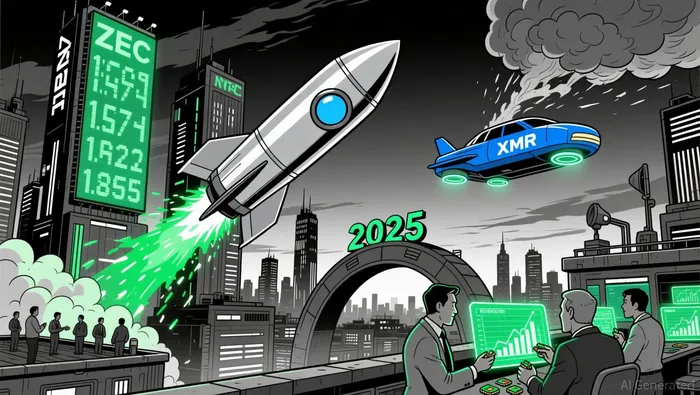
The market has responded decisively. Zcash's market capitalization surged to $8.9 billion in 2025, overtaking Monero for the first time, as reported by an Investor Empires article. This shift reflects a growing preference for compliance-friendly privacy solutions. Meanwhile, Monero's price rebounded to $342 in November 2025 after a 18-block reorganization event, signaling resilience despite regulatory headwinds, according to Coinlaw data.
Technological Upgrades: Privacy Meets Compliance
Zcash's technological roadmap has been a key driver of its success. The launch of Zashi Cross Pay in September 2025 enabled private cross-chain transactions, allowing shielded ZECZEC-- to be converted into BTC and ETH without exposing sender or receiver details, as reported by a Cryptopotato analysis. This innovation, coupled with Project Tachyon and the Orchard protocol, has enhanced scalability and institutional appeal. For example, Grayscale's Zcash Trust now manages $137 million in ZEC assets, attracting institutional investors seeking privacy without sacrificing compliance, according to a Bitget report.
Monero, meanwhile, has focused on refining its core privacy protocols. Bulletproofs+ and view tags have reduced transaction sizes and improved wallet syncing, making it more accessible to mainstream users, as noted in a Bitget analysis. However, its mandatory privacy model remains a barrier to adoption in regulated markets. Dash, though less prominent in the privacy sector, has seen institutional interest due to its hybrid proof-of-work/proof-of-stake consensus and masternode network. Despite a 17.83% single-day price drop in November 2025, institutional investors like Sterling Capital Management increased holdings by $10.34 million, signaling long-term confidence, according to a CoinDesk report.
Real-World Adoption: From Niche to Mainstream
Zcash's real-world adoption has accelerated through partnerships like Zashi Cross Pay, which integrates with major crypto ecosystems. Arthur Hayes, co-founder of BitMEX, now holds ZEC as his second-largest liquid asset after BitcoinBTC--, citing its compliance-friendly privacy model, as noted in a Coinotag analysis. This endorsement underscores Zcash's growing legitimacy in institutional circles.
Monero's adoption, while constrained by regulatory challenges, remains robust in privacy-conscious sectors. It is increasingly accepted by digital service providers and marketplaces, though its scalability and liquidity issues persist, according to a Bitget analysis. Dash, despite its volatility, has shown strong performance in Q3 2025, with revenue growing 27% year-over-year. However, its 2026 spending plans and profit misses have triggered short-term selloffs, as noted in a TechSpot report.
Strategic Value in a Compliance-Driven Market
Privacy coins are uniquely positioned to thrive in a regulated era. Zcash's hybrid model offers a blueprint for balancing privacy and compliance, while Monero's technological rigor ensures it remains a privacy-first standard. Dash's institutional traction, despite volatility, highlights its potential as a compliance-driven asset.
For investors, the key is to differentiate between these coins based on risk tolerance and regulatory alignment. Zcash's institutional adoption and flexible privacy features make it a safer bet in regulated markets, whereas Monero's mandatory anonymity suits those prioritizing absolute privacy. Dash, though volatile, offers exposure to a compliance-friendly ecosystem with growing institutional support.
Conclusion
As global regulators continue to tighten their grip on crypto, privacy coins are evolving from niche assets to strategic hedges. Zcash's rise, Monero's resilience, and Dash's institutional traction illustrate a broader trend: privacy is no longer a luxury but a necessity. In a world where transparency and confidentiality must coexist, these coins offer a path forward-one that aligns with both regulatory demands and user expectations.






Comentarios
Aún no hay comentarios