
Privacy Coins and Regulatory Pushback Under the EU's DSA: A Tension-Driven Investment Opportunity
The European Union's Digital Services Act (DSA) and Markets in Crypto-Assets (MiCA) regulation have reshaped the digital asset landscape in 2025, creating a regulatory environment that simultaneously pressures privacy coins while inadvertently fueling demand for their services. As the EU enforces stricter transparency and anti-money laundering (AML) requirements, privacy-focused cryptocurrencies are navigating a paradox: regulatory scrutiny is driving institutional and retail adoption of privacy-preserving technologies, even as compliance challenges threaten their long-term viability. This article examines the interplay between regulatory enforcement and market dynamics, highlighting the resilience of privacy coins and the investment potential of protocols adapting to evolving compliance frameworks.
Regulatory Pressure and the Enforcement Landscape
The EU's DSA, which entered enforcement in late 2025, has demonstrated its teeth through high-profile actions. In December 2025, the European Commission fined X (formerly Twitter) €120 million for violations of transparency and data access obligations, signaling a zero-tolerance approach to non-compliance. While the DSA does not explicitly target privacy coins, its emphasis on accountability for "very large online platforms" (VLOPs) has indirectly impacted crypto ecosystems. For instance, MiCA prohibits crypto exchanges from supporting privacy coins or anonymous wallets for transactions exceeding €1,000, mandating identity verification. This has led to delistings of privacy coins like MoneroXMR-- (XMR) and ZcashZEC-- (ZEC) on major exchanges such as Kraken, creating a fragmented market.
The enforcement framework under the DSA and MiCA includes tools like information requests, inspections, and fines, enabling regulators to hold platforms accountable for non-compliance. For privacy coins, this means heightened scrutiny of transactional opacity. The European Securities and Markets Authority has warned that privacy coins inherently conflict with MiCA's transparency requirements, as their design obscures sender, receiver, and transaction amount details. This regulatory stance has forced privacy-focused protocols to innovate, blending privacy-preserving technologies with compliance-driven features.
Regulatory-Driven Demand for Privacy Coins
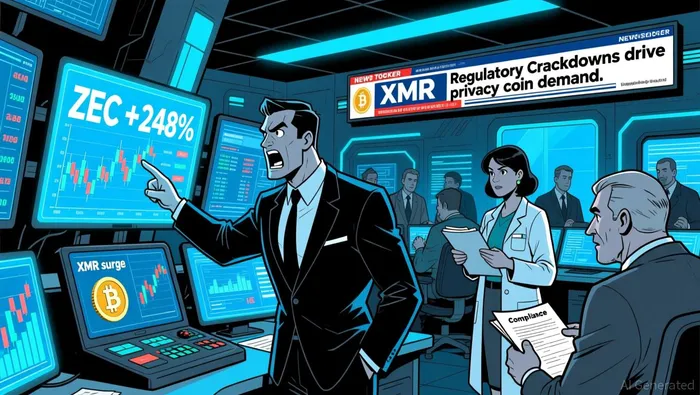
Despite these challenges, 2025 has seen a surge in demand for privacy coins, driven by both retail and institutional investors. According to a report by OpenExO, the market capitalization of privacy coins rose by approximately 80% in 2025, reaching $23.5–$25 billion. Zcash (ZEC) and Monero (XMR) have outperformed major cryptocurrencies, with ZECZEC-- surging 248% in October 2025 alone. This growth is attributed to the increasing demand for financial privacy amid digital surveillance and regulatory overreach.
Institutional adoption has further accelerated this trend. The Grayscale Zcash Trust, for example, has enabled large investors to gain exposure to privacy-enhancing assets without direct ownership of the underlying cryptocurrency. Similarly, Ethereum-based privacy solutions like Aztec's Ignition Chain have attracted interest from enterprises seeking to protect sensitive data in high-stakes transactions. These developments suggest that privacy coins are not merely resisting regulation but adapting to it, offering value in a world where data privacy is increasingly commodified.
Long-Term Investment Potential in Resilient Protocols
The long-term viability of privacy coins hinges on their ability to balance regulatory compliance with core privacy features. Protocols like Zcash and Monero are exploring hybrid models that integrate zero-knowledge proofs (ZKPs) with compliance-driven verification mechanisms. For instance, Zcash's use of shielded transactions-enabled by ZKPs-allows users to obscure transaction details while still meeting AML requirements through selective disclosure. This innovation positions privacy coins as viable assets in a regulated environment, attracting institutional capital that prioritizes both security and compliance.
The broader crypto market is also shifting toward MiCA-compliant protocols. By late 2025, institutional investors had allocated over $115 billion into spot BitcoinBTC-- ETFs, signaling a preference for regulated assets. However, privacy coins are carving a niche for themselves by addressing gaps in transparency. For example, the tokenization of real-world assets under MiCA has created demand for privacy-preserving tools to protect sensitive business data. This duality-where privacy coins serve as both regulated assets and privacy-first solutions-highlights their unique value proposition.
Risks and the Path Forward
While the regulatory environment is fostering demand, privacy coins face significant risks. The EU's Digital Omnibus package, which proposes redefining personal data and easing AI-driven data processing, could further erode privacy protections. Additionally, the delisting of privacy coins on major exchanges has reduced liquidity, as seen with Monero's struggles to maintain mainstream exposure.
However, the resilience of privacy-focused protocols suggests a path forward. Startups and projects operating in jurisdictions like Switzerland and the UAE are leveraging less restrictive regulatory frameworks to innovate. For investors, this fragmentation presents opportunities to support protocols that adapt to compliance requirements while retaining their privacy-centric ethos.
Conclusion
The EU's DSA and MiCA regulations have created a high-stakes environment for privacy coins, but the resulting demand for privacy-preserving technologies underscores their enduring relevance. As institutional investors seek to balance compliance with confidentiality, protocols that innovate within regulatory boundaries-such as Zcash and Monero-are well-positioned for long-term growth. While challenges remain, the tension between regulation and privacy is likely to drive further innovation, making privacy coins a compelling, albeit niche, investment in the evolving crypto landscape.






Comentarios
Aún no hay comentarios