
Privacy Coins: The Next Frontier in Digital Sovereignty
Regulatory Clampdowns: A Double-Edged Sword
The intensifying regulatory scrutiny of privacy coins has created a paradoxical dynamic: while compliance measures threaten to stifle adoption, they also validate the sector's strategic value. By March 2025, 97 countries had introduced or updated regulations targeting privacy coins, up from 79 in 2023, according to a CoinLaw analysis. Key developments include the Financial Action Task Force (FATF) extending its Travel Rule to explicitly include privacy coins, the EU's Markets in Crypto-Assets (MiCA) framework reducing privacy coin offerings on European exchanges by 22%, and the U.S. Financial Crimes Enforcement Network (FinCEN) mandating record-keeping for transactions over $500, as noted in the same CoinLaw analysis.
These measures have led to a wave of delistings, with 73 exchanges globally removing privacy coins in 2025-up from 51 in 2023. Binance, Kraken, and Poloniex have all taken steps to comply, with Poloniex delisting Monero (XMR) entirely in April 2025, per the CoinLaw analysis. Yet, such actions have not deterred investors. Instead, they've driven demand to more privacy-friendly jurisdictions like Switzerland and Liechtenstein, where regulated sandboxes allow controlled experimentation with privacy coins, as the CoinLaw analysis also documents.
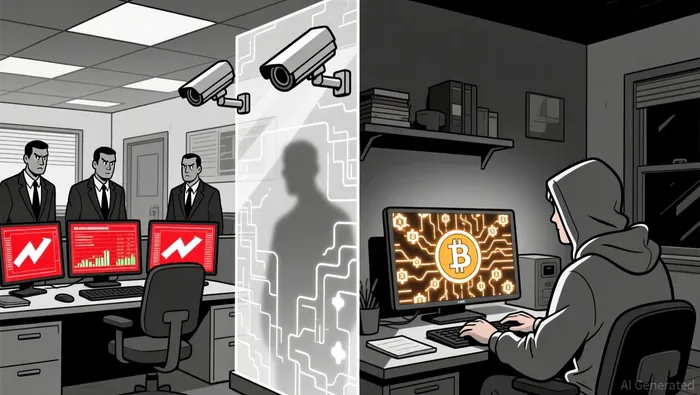
Geopolitical Catalysts: From Panic to Premium
The geopolitical landscape in 2025 has further amplified the appeal of privacy coins. On November 4, 2025, DashDASH-- (DASH) surged 50% in 24 hours, reaching $145.95 and pushing its market capitalization to $1.8 billion, according to the CoinLaw analysis. This rally coincided with similar gains in ZcashZEC-- (ZEC) and Monero (XMR), reflecting a flight to privacy amid macroeconomic uncertainty. Analysts attribute this momentum to a combination of market rotation into undervalued assets and the inherent utility of privacy features in a world where financial surveillance is becoming the norm, the CoinLaw analysis adds.
Meanwhile, institutional interest in privacy-centric infrastructure has reached a tipping point. Tharimmune, a biotech firm, secured a $540 million private placement to acquire Canton Coin (CC), a utility token powering the Canton Network. Backed by Goldman Sachs and BNP Paribas, this move highlights the growing legitimacy of privacy-enhancing blockchain solutions. The Canton Network, which processes over 500,000 daily transactions, offers atomic settlements, interoperability, and robust privacy-features that align with the strategic goals of institutional investors seeking to navigate regulatory complexity, as reported in a Pulse2 article.
Strategic Allocation: Balancing Risk and Reward
For investors, the privacy coin sector presents a unique opportunity to hedge against both regulatory and geopolitical risks. While the sector faces liquidity challenges-exacerbated by delistings and bans in key markets-its resilience in 2025 demonstrates its appeal as a store of value in uncertain times. Monero (XMR), for instance, holds 58% of the privacy coin market capitalization at $4.3 billion, while Zcash (ZEC) commands 21%, figures highlighted in the CoinLaw analysis. These figures suggest that well-established protocols with strong community support are better positioned to weather regulatory storms.
A strategic allocation should prioritize assets with clear use cases, active development, and institutional backing. The Canton Network's integration into Tharimmune's treasury strategy, for example, signals a shift toward utility-driven privacy coins that can coexist with regulatory frameworks. Similarly, Railgun (RAIL)'s 300% return in 30 days and Zcash's (ZEC) $440 peak highlight the potential for high-growth opportunities within the sector, as noted in the BitcoinBTC--.com report.
Conclusion: Sovereignty in the Digital Age
Privacy coins are no longer a niche curiosity but a critical component of digital sovereignty. As governments continue to erode financial privacy through surveillance and compliance measures, the demand for untraceable value transfer will only grow. While regulatory risks remain significant, the sector's outperformance in 2025 and institutional adoption of privacy-centric infrastructure suggest that strategic investors who navigate these challenges with due diligence will be rewarded.
In the end, the next frontier of digital finance is not just about innovation-it's about reclaiming control over one's financial identity in an increasingly monitored world.






Comentarios
Aún no hay comentarios