
Principal Financial's (PFG) Strong Q3 Earnings Outlook and Implications for Growth
Premium and Fee Income: A Segment-Driven Recovery
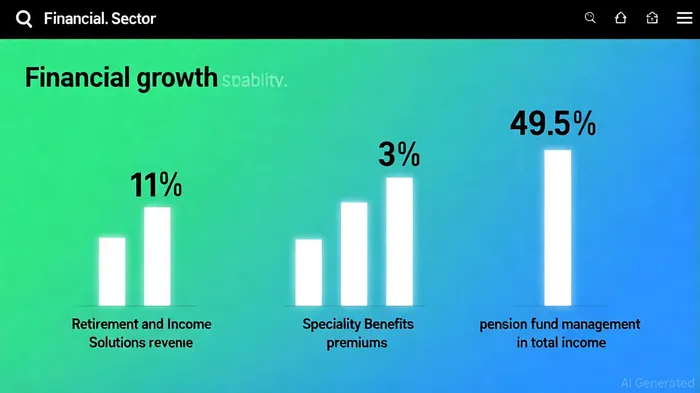
PFG's Q3 2025 earnings report, according to a Business Wire release, highlighted a 13% year-over-year increase in non-GAAP operating earnings per diluted share to $2.32, driven by strong performance in its Retirement and Income Solutions and Specialty Benefits segments. The Retirement and Income Solutions division saw net revenue rise by 11% to $751.7 million, reflecting growing demand for retirement planning services in a low-interest-rate environment, as noted in a Reuters report. Meanwhile, the Specialty Benefits segment, which provides employee benefit plans to small and mid-sized businesses, reported a 3% increase in premiums and fees to $845.2 million, bolstered by improved risk management and a 6.3 percentage point reduction in incurred loss ratios, according to a Panabee analysis.
However, the company's ability to sustain this growth hinges on its diversification. According to a MarketScreener breakdown, pension fund management accounted for 49.5% of total premium and fee income, while life and non-life insurance contributed 31%, and asset management represented 19%. This concentration in pension fund management-though a stable revenue stream-exposes PFGPFG-- to market volatility tied to global equity and bond markets.
AUM-Driven Fee Income: A Double-Edged Sword
Assets under management (AUM) rose 6% year-over-year to $784.3 billion in Q3 2025, directly boosting asset-based fees, according to Reuters. This growth aligns with PFG's strategy to leverage its $1.8 trillion in assets under administration (AUA) to generate recurring revenue. However, the company's reliance on AUM as a fee driver introduces vulnerability to market downturns. For instance, a 10% decline in global equities could erode $78.4 billion in AUM, translating to a proportional drop in asset-based fees.
Analysts project total Q3 2025 revenue to reach $4.10 billion, an 11.5% year-on-year increase, in an IndexBox preview. Yet, this optimism is tempered by PFG's recent track record: the same IndexBox preview noted that in Q2 2025 the company reported $3.69 billion in revenue, missing estimates by 7% and declining 9.4% year-on-year. Such volatility raises questions about the consistency of its AUM-driven model.
Low-Debt Model: Strength or Complacency?
PFG's balance sheet remains a key strength, with $1.6 billion in excess and available capital and no disclosed leverage ratios for Q3 2025, according to a TradingView post. While the absence of debt metrics suggests a conservative approach, it also indicates a lack of aggressive reinvestment in high-growth opportunities. For example, the company's $398 million in shareholder returns-comprising $225 million in share repurchases and $173 million in dividends-signals prioritization of capital preservation over expansion, as shown in the Business Wire release.
The sustainability of this low-debt model is further challenged by external factors. An IndexBox preview notes that PFG's revenue growth projections assume a stable macroeconomic environment, yet ongoing corporate tax debates and potential trade policy shifts could disrupt fee income streams. Additionally, the company's dividend payout ratio of 62.78%-while healthy-leaves limited room for reinvestment in innovation or market share gains, according to a MarketBeat filing.
Implications for Investors
For long-term investors, PFG's Q3 results underscore a business model that balances stability with stagnation. The 13% increase in operating earnings and 8% dividend hike demonstrate resilience in core operations, as the Business Wire release showed. However, the historical pattern of missing revenue estimates and reliance on AUM-driven fees suggest that growth may not be self-sustaining without strategic reinvention.
Investors should monitor two key metrics in the coming quarters:
1. AUM Volatility: AUM growth must outpace market downturns to maintain fee income.
2. Debt Transparency: The absence of leverage ratios in Q3 2025 raises questions about PFG's risk management discipline.
In conclusion, while PFG's low-debt model and premium income growth offer a buffer against short-term shocks, the company's long-term trajectory depends on its ability to diversify revenue streams and adapt to macroeconomic headwinds. For now, the 3.8% annual yield and 13% earnings growth provide a compelling case for cautious optimism, as noted in the MarketBeat filing.





Comentarios
Aún no hay comentarios