
Primary Dealers and U.S. Treasury Auction Dynamics in a Shifting Rate Environment
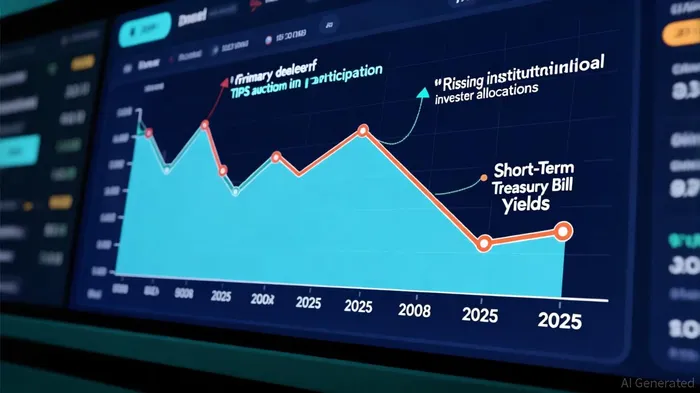
The U.S. Treasury market, a cornerstone of global finance, is undergoing structural shifts driven by evolving dealer behavior, regulatory constraints, and institutional investor strategies. As the Federal Reserve navigates a rate-cutting cycle amid fiscal uncertainty, the interplay between primary dealer participation in Treasury auctions and short-term bond yields has become a critical factor for portfolio positioning. This analysis examines how dealer dynamics are reshaping auction outcomes and offers strategic insights for adjusting fixed-income allocations in a shifting rate environment.
The Evolving Role of Primary Dealers
Primary dealers, mandated to bid on a pro-rata basis in Treasury auctions, have historically provided liquidity and stability to the market. However, recent data reveals a marked decline in their influence, particularly in Treasury Inflation-Protected Securities (TIPS) auctions, where their allocation share has dropped by over 45% since 2008 [2]. This shift reflects a broader trend: institutional investors and direct bidders now dominate auction demand, with investment funds accounting for approximately 75% of TIPS purchases in 2019 [2].
Despite this, primary dealers continue to distort auction demand through mechanical bidding practices. Bid/bought ratios—measuring the ratio of bids submitted to actual purchases—have surged to 50–100 times in recent auctions, signaling artificial support rather than genuine investor interest [3]. This "window dressing" masks underlying liquidity challenges, as non-dealer participation dwindles to minimal rollover flows. As debt ceiling constraints ease and net issuance accelerates, this façade risks collapsing, potentially triggering a sharp rise in Treasury yields when dealers can no longer absorb supply at current pricing levels [3].
Regulatory Constraints and Yield Dynamics
Regulatory frameworks, such as the supplementary leverage ratio (SLR), have further constrained dealer balance sheets, limiting their capacity to hold Treasury inventories. These constraints reduce turnover and widen bid-ask spreads, indirectly elevating short-term yields [1]. Post-Global Financial Crisis (GFC), primary dealers transitioned from net short to net long positions in Treasury bonds, a shift correlated with negative swap spreads and higher Treasury yields relative to swap rates [4]. This dynamic underscores how dealer balance sheet costs and financing spreads directly influence yield curves, with yields rising to compensate for intermediation risks [4].
The Cross-Market Treasury Repo (CMTR) spread, a proxy for dealer compensation in repo markets, further illustrates this relationship. As balance sheet costs fluctuate with regulatory adjustments, dealers adjust their auction bidding behavior, impacting bid-to-cover ratios and accepted yields [1]. For instance, tighter SLR requirements have historically dampened dealer bidding, lowering bid-to-cover ratios and pushing yields higher [1].
Institutional Investor Adaptation
Institutional investors are recalibrating portfolios in response to these dynamics. With the Fed's September 2025 rate cut and anticipated further reductions, investors are shifting away from cash and short-term holdings toward intermediate-duration bonds, particularly the "belly" of the yield curve (3–7 years), which balances yield and duration risk [5]. This shift is amplified by Moody's May 2025 downgrade of U.S. sovereign debt to Aa1, which heightened concerns about fiscal sustainability and pushed longer-term Treasury yields higher [6].
Portfolio strategies now prioritize yield optimization and risk diversification. Investors are favoring shorter-dated instruments and active strategies to navigate macroeconomic volatility, while also hedging against potential yield spikes from auction market imbalances [6]. Additionally, the weakening demand for long-dated Treasuries—driven by foreign investors' reduced appetite and fiscal concerns—has reinforced this trend [5].
Strategic Implications for Fixed-Income Allocations
Given these developments, investors should consider the following adjustments to fixed-income portfolios:
1. Duration Management: Extend duration modestly into the 3–7-year segment to capitalize on higher yields while mitigating long-term interest rate risk.
2. Liquidity Buffers: Maintain liquidity to navigate potential auction-driven yield spikes, particularly as dealer participation wanes.
3. Diversification: Allocate to alternatives such as high-quality corporate bonds or inflation-linked securities to hedge against Treasury market volatility.
4. Active Monitoring: Closely track auction bid-to-cover ratios and dealer balance sheet metrics, as these indicators can signal impending yield shifts.
Conclusion
The interplay between primary dealer behavior, regulatory constraints, and institutional investor strategies is reshaping U.S. Treasury auction dynamics. As dealer participation declines and artificial demand masks liquidity risks, short-term yields remain vulnerable to sudden shifts. Investors must adapt by optimizing duration, maintaining liquidity, and diversifying holdings to navigate this evolving landscape. In a world of shifting rates and fiscal uncertainty, proactive portfolio management is no longer optional—it is imperative.







Comentarios
Aún no hay comentarios