
Presale Token Performance and Market Cap Dynamics in Late-2025 Crypto Markets: Risk-Rebalance Opportunities in High-Growth Meme Coins
In late 2025, the cryptocurrency market has entered a new phase of innovation and volatility, with high-growth memeMEME-- coins dominating headlines. These projects, blending internet culture with blockchain utility, have redefined presale token performance and market cap dynamics. However, their speculative nature demands a nuanced approach to risk-rebalance strategies. This analysis explores the interplay between presale mechanics, market trends, and risk mitigation frameworks, drawing on recent data and expert insights.
Presale Token Performance: Utility-Driven Meme Coins Lead the Charge
Presale token performance in late 2025 is increasingly tied to projects that combine meme-driven virality with real-world utility. For instance, Bitcoin Hyper (HYPER) has attracted attention by offering a Layer-2 solution for BitcoinBTC--, enabling faster transactions and staking rewards of up to 63%, according to a CryptoNews roundup. Similarly, Maxi Doge (MAXI) leverages a 1000x trading narrative, with staking rewards as high as 130% for early participants (the CryptoNews roundup cited above). These projects exemplify a shift toward utility, where meme coins are no longer purely speculative but integrate features like staking and governance.
Dynamic presale mechanics further amplify returns. BullZilla ($BZIL) employs a time-based price increase model, raising its token price every 48 hours or upon reaching $100,000 in funds raised. This creates urgency for early adopters, with projected ROI ranging from 914% to over 5,000% by public listing, according to a FinancialContent analysis. Such mechanisms highlight the importance of timing in presale participation, as early entry often correlates with exponential gains.
Market Cap Dynamics: A $1 Trillion Meme Coin Super Cycle
The meme coin market cap has surged to unprecedented levels, with analysts predicting a total market cap of $1 trillion by 2025, according to a MemeStreet Journal analysis. Two coins are projected to exceed $100 billion, while ten will surpass $10 billion-a stark contrast to their traditional altcoin counterparts. This growth is fueled by projects like Arctic Pablo Coin ($APC), which raised $1.3 million in presales with projected returns of 13,451.72%, per a Cryptsy guide, and AlphaPepe (ALPE), boasting 1,200 presale participants and a 3,000-member Telegram community, per an Analytics Insight report.
The success of these projects hinges on viral adoption, driven by social media engagement and community-driven hype. Unlike traditional cryptocurrencies, meme coins often launch with full supply in circulation, eliminating token unlocks and fostering cleaner price discovery (the MemeStreet Journal analysis cited above). This model reduces manipulation risks but amplifies volatility, as seen in tokens like $TRUMP, which surged 200% pre-Inauguration Day before plummeting 50%, in a ResearchGate case study.
Risks and Regulatory Shifts: Navigating a High-Stakes Landscape
Despite their potential, high-growth meme coins face significant risks. Volatility remains a defining trait, with tokens like MoonBull and Apecoin experiencing hourly price swings of 50% or more (reported in the CryptoNews roundup cited earlier). Political and celebrity-backed tokens, such as $TRUMP and $MELANIA, further complicate this landscape, as their values are tied to unpredictable real-world events (the Analytics Insight report cited above).
Scams and fraud are also pervasive. Rug pulls, honeypots, and pump-and-dump schemes have left retail investors with losses exceeding $214 million in early 2025 (the ResearchGate case study cited above). Regulatory scrutiny, while evolving, adds another layer of uncertainty. The U.S. Securities and Exchange Commission (SEC) clarified in February 2025 that typical meme coins are not securities under federal law, as they lack pooled enterprise structures and profit expectations tied to third-party efforts (the FinancialContent analysis cited above). However, tokens offering staking rewards or governance rights may still face regulatory challenges (the FinancialContent analysis cited above).
Risk-Rebalance Strategies: Diversification, Hedging, and Timing
To mitigate these risks, investors are adopting risk-rebalance frameworks tailored to meme coin volatility. Key strategies include:
- Diversification: Limiting exposure to individual tokens by spreading investments across multiple projects. Hedge fund manager Joe McCann, for example, caps non-blue-chip meme coin allocations at 2% of total assets (the CryptoNews roundup cited above).
- Dollar-Cost Averaging (DCA): Smoothing out volatility by investing fixed amounts at regular intervals, reducing the impact of market timing errors (the Analytics Insight report cited above).
- Stop-Loss and Take-Profit Orders: Automating exits at predefined thresholds to lock in gains and limit losses. The 1-3-5 Rule-allocating 1% per trade, 3% total exposure, and exiting at 2x, 5x, and 10x gains-is gaining traction (the FinancialContent analysis cited above).
- Hedging with Stablecoins: Converting portions of meme coin holdings into stablecoins during volatility spikes to preserve capital (the Cryptsy guide cited above).
- Community and Regulatory Vigilance: Monitoring social media sentiment and regulatory updates to avoid scams and compliance risks (the MemeStreet Journal analysis cited above).
Automated tools are also emerging to optimize risk management. Platforms like Orca and Meteora use AI-driven rebalancing to adjust liquidity provider (LP) positions in real time, maximizing returns while minimizing exposure (the Cryptsy guide cited above).
Conclusion: Balancing Hype and Hedging in the Meme Coin Era
The late-2025 meme coin market presents a paradox: immense growth potential coexists with extreme volatility and regulatory ambiguity. For investors, success lies in leveraging presale mechanics, diversifying portfolios, and adopting disciplined risk-rebalance strategies. While projects like BullZilla and Arctic Pablo Coin offer tantalizing returns, they also demand rigorous due diligence and adaptive risk management. As the SEC's regulatory framework continues to evolve, the key to navigating this space will be balancing speculative enthusiasm with strategic caution.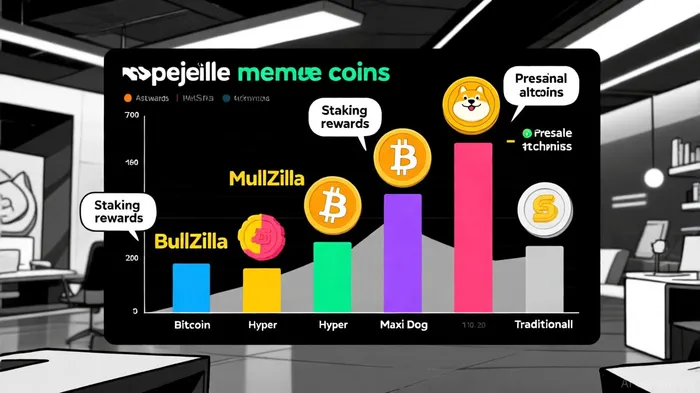







Comentarios
Aún no hay comentarios