
Preparing for an Uncertain Retirement in an AI-Driven Economy
The rapid advancement of artificial intelligence (AI) is reshaping the global economy, creating both opportunities and risks for workers and investors alike. As AI-driven automation displaces traditional jobs and redefines career trajectories, retirees and pre-retirees face a pressing challenge: how to build resilient portfolios that withstand economic uncertainty while maintaining income stability. This article explores strategies for constructing income-generating investment portfolios and adapting career flexibility in an era where AI is both a disruptor and a tool for innovation.
The AI-Driven Labor Market: Displacement and Adaptation
AI's impact on employment is no longer speculative-it is here. By 2025, over 35,000 AI-related jobs were created in the U.S. alone, with roles like Machine Learning Engineers commanding average salaries of $156,998. However, nearly 24% of companies replaced workers with AI tools, resulting in over 10,000 job cuts in the first seven months of 2025. Older workers, in particular, face heightened vulnerability. A 2025 study highlights that many older employees struggle to adapt to AI-driven technologies, leading to job insecurity and mental health concerns. Meanwhile, 52% of U.S. workers now fear AI-driven job loss-a figure that has nearly doubled in a year.
The U.S. Bureau of Labor Statistics (BLS) acknowledges that AI's effects on employment are gradual but significant, particularly in high-exposure fields like computer, legal, and engineering roles. While AI is displacing certain tasks, it is also creating demand for new skills, underscoring the need for upskilling and reskilling programs. For investors, this dynamic labor market necessitates a shift toward portfolios that balance growth and income, ensuring financial stability amid potential career disruptions.
Building Resilient Portfolios: Dividend Stocks and Real Estate
A cornerstone of retirement resilience lies in income-generating assets that provide steady cash flow and hedge against volatility. Dividend stocks, particularly those with a history of consistent growth, offer a reliable income stream. For example, the S&P 500 Dividend Aristocrats Index-comprising companies with decades of uninterrupted dividend increases-has historically outperformed broader market benchmarks with lower volatility. These firms, often in sectors like healthcare and utilities, are well-positioned to weather economic shifts driven by AI and automation.
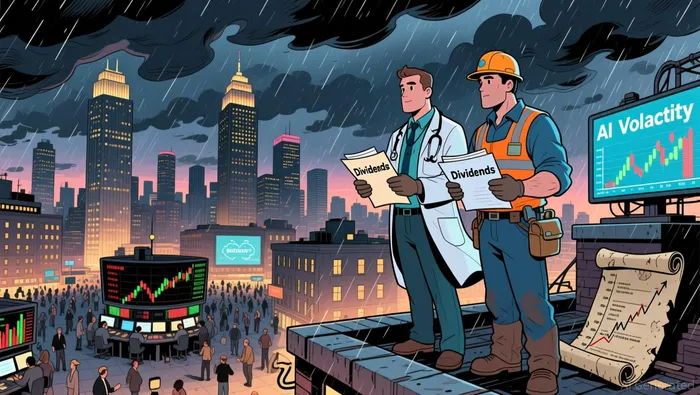
Real estate also plays a critical role in diversifying retirement portfolios. Prologis Inc. (PLD), a leader in industrial real estate, exemplifies this strategy. With a 3.2% dividend yield and a $120 billion market capitalization, PLD benefits from AI-driven demand for logistics infrastructure, such as automated warehouses. Real estate investments not only generate income but also act as a hedge against inflation, a growing concern in an AI-driven economy where traditional asset correlations are shifting.
Dual-Income Strategies: Balancing Growth and Stability
For retirees navigating an uncertain labor market, dual-income strategies combine growth-oriented assets with income-generating investments. This approach mitigates risk by diversifying across uncorrelated asset classes. For instance, the BlackRock Investment and Portfolio Solutions team recommends incorporating liquid alternatives, digital assets, and international equities to enhance diversification. Closed-end funds like the Adams Diversified Equity Fund (ADX), which holds high-yield tech and infrastructure stocks, offer a compelling blend of income and growth potential. ADX's 8.4% withdrawal rate and exposure to AI-driven productivity gains make it an attractive option for retirees seeking resilience.
AI itself is a double-edged sword in this context. While automation threatens traditional roles, it also drives productivity gains in sectors like technology and infrastructure, boosting equity valuations. Investors who align their portfolios with these trends-while maintaining a disciplined approach to risk-can capitalize on long-term growth without sacrificing income stability.
Career Flexibility and the Role of Upskilling
Beyond portfolio construction, career flexibility is essential for mitigating AI-related risks. The BLS emphasizes that worker adaptability and regulatory frameworks will shape the pace of AI's impact on employment. For older workers, reskilling in AI-compatible fields-such as data analysis, cybersecurity, or healthcare-can extend career longevity and reduce displacement risks. Employers, too, must invest in training programs to ensure employees are not merely replaced but empowered to contribute to an evolving economy.
Conclusion: Navigating Uncertainty with Strategy
The AI-driven economy demands a proactive approach to retirement planning. By prioritizing income-generating assets like dividend stocks and real estate, while adopting dual-income strategies, investors can build portfolios that withstand economic volatility. Simultaneously, embracing career flexibility through upskilling and adaptability ensures that retirees remain financially secure, even in the face of AI-driven disruptions. As the lines between work and retirement blur, the key to resilience lies in balancing innovation with prudence.







Comentarios
Aún no hay comentarios