
Preparing for Federal Reserve Rate Volatility: Strategies to Mitigate Risk in a Hike-or-Cut Scenario
As the Federal Reserve stands at a crossroads—maintaining its 4.25%–4.50% federal funds rate while balancing inflation risks and economic resilience—investors face a critical dilemma: prepare for both potential rate hikes and cuts. With the Fed's June 2025 projections hinting at two cuts by year-end, but inflationary pressures lingering, the path forward is fraught with uncertainty. This article explores how investors can navigate this volatility using historical precedents and actionable portfolio adjustments.
The Current Fed Crossroads
The Fed's June statement emphasized patience, with the median projection calling for a year-end rate of 3.9%. However, risks loom large:
- Inflation: Core PCE inflation is expected to edge down to 2.1% by 2027 but remains elevated in the near term.
- Geopolitical Tensions: Conflicts like Israel-Iran could disrupt energy markets, inflating costs.
- Economic Data: Softening retail sales and housing markets suggest a slowdown, but strong labor markets (3.5% unemployment) could justify rate stability.
The Fed's dilemma—hike to curb inflation or cut to support growth—creates a “hike-or-cut” scenario where investors must hedge both outcomes.
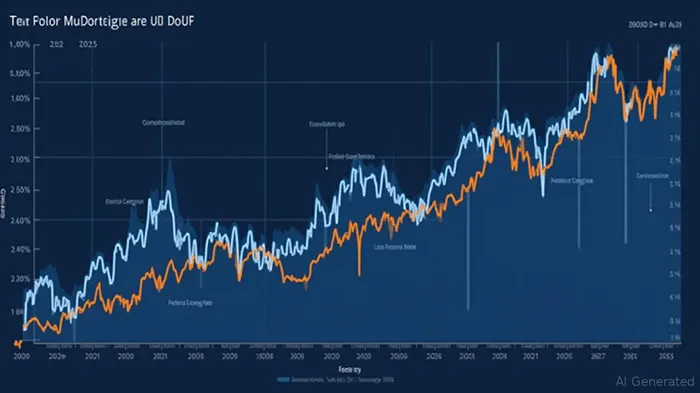
Historical Precedents: Lessons from Past Cycles
- The Zero-Rate Era (2008–2015)
- Context: Post-Great Recession, the Fed slashed rates to near zero and deployed QE.
Strategies That Worked:
- Defensive Sectors: Utilities and healthcare outperformed during prolonged uncertainty.
- Cash and Short-Term Bonds: Provided liquidity amid equity volatility.
The Hiking Cycle (2015–2019)
- Context: Rates rose 225 bps to 2.5% as the economy recovered.
Strategies That Worked:
- Cyclical Sectors: Industrials and consumer discretionary thrived during early hikes.
- Floating-Rate Instruments: Bank loans and ETFs like minimized duration risk.
The 2019 Mid-Cycle Cut
- Context: Three cuts totaling 75 bps amid trade wars and slowing growth.
- Strategies That Worked:
- Equity Exposure: The S&P 500 rose 14% post-cuts, with tech and consumer discretionary leading.
- Risk-On Sectors: Real estate and industrials capitalized on lower borrowing costs.
Actionable Strategies for Hike-or-Cut Uncertainty
Scenario 1: Rate Hikes Persist
If inflation surprises to the upside or geopolitical risks spike, the Fed may delay cuts. Focus on defensives and duration management:
- Sectors to Overweight:
- Utilities (e.g., NextEra EnergyNEE-- (NEE)), healthcare (e.g., UnitedHealth GroupUNH-- (UNH)), and consumer staples (e.g., Procter & Gamble (PG)).
- .
- Fixed Income: Short-duration bonds (e.g., Vanguard Short-Term Bond ETF (BSV)) and inflation-protected securities (e.g., iShares TIPS Bond ETF (TIP)).
Scenario 2: Rate Cuts Materialize
If data supports easing (e.g., sub-4% unemployment or cooling inflation), equities and cyclicals could rally. Rotate into growth and cyclicals:
- Sectors to Overweight:
- Technology (e.g., Microsoft (MSFT), NVIDIA (NVDA)) and industrials (e.g., Caterpillar (CAT)).
- .
- Equity Exposure: Overweight small-caps (e.g., iShares Russell 2000 (IWM)) and international equities (e.g., iShares MSCI Emerging Markets (EEM)) for yield-seeking flows.
The Balancing Act: Navigating Both Risks
- Hedging Tools:
- Use options (e.g., S&P 500 puts) or inverse ETFs (e.g., ProShares Short 20+ Year Treasury (TBT)) to protect against rate shocks.
- Gold (GLD) as a safe haven during uncertainty.
- Portfolio Diversification:
- Allocate 20% to cash/short-term Treasuries for liquidity.
- Use factor tilts: Quality stocks (e.g., BlackRock Quality Opportunities Fund (ROQAX)) and low-volatility ETFs (e.g., iShares Edge MSCI Min Vol USA (USMV)) reduce downside risk.
Data-Driven Decisions
Monitor these key indicators:
- Inflation: Core PCE and wage growth. A 2.5%+ core PCE reading may delay cuts.
- Employment: Weekly jobless claims and ADP Employment Report.
- Fed Communication: Watch for changes in the dot plot and Chair Powell's commentary.
Conclusion
The Fed's hike-or-cut dilemma demands a dual-track strategy. By overweighting defensives and duration-friendly assets for hikes, and cyclicals and equities for cuts, investors can position portfolios to thrive regardless of the Fed's next move. Historical cycles show that sector rotation, hedging, and data-driven discipline are the keys to navigating volatility. Stay agile, and let the Fed's signals guide your adjustments.
Investment advice: Always assess your risk tolerance and consult a financial advisor before making portfolio changes.







Comentarios
Aún no hay comentarios