
Predictive Maintenance in Aviation: Strategic Partnerships and Operational Gains Driving RTX's Growth in 2025
Strategic Partnerships: The Catalyst for Industrial Transformation
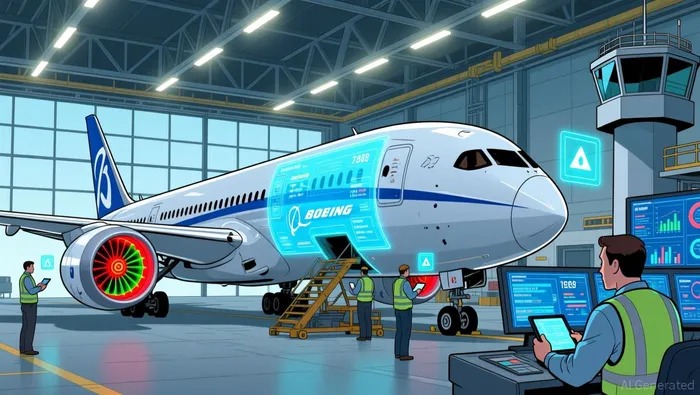
RTX's Collins Aerospace division has taken a bold step by partnering with Qatar Airways to implement its Ascentia predictive maintenance solution across the airline's fleet of 52 Boeing 787 aircraft. This collaboration, announced at the Dubai Air Show on November 17, 2025, underscores RTX's ability to translate its OEM expertise into actionable insights. Ascentia combines real-time sensor data with historical records and statistical models to predict component health, enabling proactive maintenance scheduling and spare parts provisioning.
The partnership's success hinges on RTX's unique position as the original equipment manufacturer (OEM). By directly mapping analytics to component-level actions, Collins Aerospace ensures that predictive insights are seamlessly integrated into Qatar Airways' maintenance workflows. This alignment reduces reliance on reactive repairs, minimizes aircraft downtime, and lowers operating costs-a critical advantage in an industry where even minor delays can cascade into significant financial losses.
Beyond aviation, RTX's Raytheon business has expanded its industrial footprint through a partnership with Avio, an Italian aerospace firm, to establish a new solid rocket motor (SRM) facility in the U.S. This collaboration, formalized via a memorandum of understanding (MoU) in 2025, grants Raytheon preferred access to production capacity while accelerating Avio's engineering work on advanced propulsion systems. Such strategic alliances highlight RTX's dual focus on commercial aviation and defense markets, both of which demand precision-driven maintenance and logistics.
Operational Efficiency Gains: A Quantifiable Edge
While specific case study metrics for Qatar Airways' 787 fleet remain undisclosed, RTX's Q3 FY2025 financial results provide indirect evidence of Ascentia's impact. Collins Aerospace reported 8% sales growth and 9% operating profit growth, driven by strong demand for predictive maintenance solutions. Similarly, Pratt & Whitney's 16% sales growth and 26% profit growth reflect improved operational execution, likely bolstered by analytics-driven resource optimization.
The broader implications are clear: predictive maintenance is not just a cost-saving tool but a revenue accelerator. By reducing unplanned maintenance events and extending component lifecycles, RTX's analytics solutions free up capital for reinvestment while enhancing customer satisfaction. For airlines like Qatar Airways, this translates to higher on-time performance rates and lower fuel consumption-a critical differentiator in an industry grappling with sustainability pressures.
The Road Ahead: Scaling Industrial Analytics
RTX's 2025 partnerships signal a shift toward industrial analytics as a core growth driver. With Ascentia already deployed on 40% of Boeing 787s in operation, the platform's scalability positions RTX to capture market share in other aircraft models and industrial sectors. Meanwhile, the Avio collaboration underscores the company's ambition to dominate defense propulsion systems, where predictive maintenance can mitigate supply chain bottlenecks and ensure mission-critical reliability.
However, challenges remain. The success of these initiatives depends on data quality, model calibration, and integration with legacy systems-factors that require sustained R&D investment. RTX's ability to navigate these hurdles will determine whether its analytics platforms become industry standards or niche solutions.
Conclusion: A High-Conviction Play on Industrial Innovation
RTX's strategic partnerships in predictive maintenance and industrial analytics are more than incremental improvements; they represent a fundamental reimagining of asset management in aviation and defense. By aligning OEM expertise with data-driven decision-making, RTX is creating a flywheel effect: enhanced operational efficiency drives customer loyalty, which in turn fuels further innovation and market expansion. For investors, this positions RTX as a high-conviction play in the industrial tech sector-a company not just adapting to change, but leading it.







Comentarios
Aún no hay comentarios