
Prediction Markets as the Next-Generation Asset Class: Kalshi's Regulatory Breakthrough and Market Infrastructure Potential
Prediction markets are no longer niche speculative tools; they are emerging as a transformative asset class, blending financial innovation with real-time information pricing. At the forefront of this evolution is Kalshi, a U.S.-based prediction market platform that has leveraged regulatory clarity under the Commodity Futures Trading Commission (CFTC) to redefine the sector. By securing a $2 billion valuation after a $185 million funding round led by Paradigm and Sequoia Capital, as reported by Imp News, Kalshi has not only outpaced competitors like Polymarket in trading volume but also demonstrated how regulatory alignment can catalyze institutional and retail adoption, according to a Traders Magazine report.
Kalshi's Regulatory Edge: A Catalyst for Growth
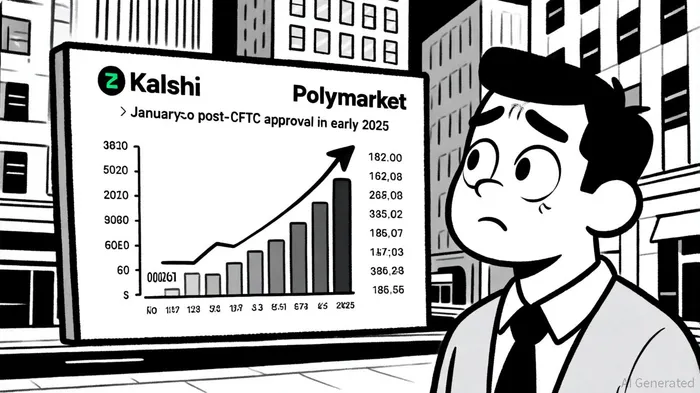
Kalshi's breakthrough lies in its CFTC-regulated framework, which distinguishes it from unregulated or pseudonymous platforms. As of September 2025, Kalshi reported $1.3 billion in monthly trading volume-surpassing Polymarket's $773 million-largely due to its ability to legally serve U.S. residents, according to Traders Magazine. This regulatory legitimacy has attracted a hybrid user base, including hedge funds and individual traders, who view event-based contracts as tools for hedging geopolitical and economic risks, a trend covered by the New York Times.
The CFTC's oversight has also enabled Kalshi to integrate blockchain technology for stablecoin deposits and transparent contract execution, creating a hybrid model that balances innovation with compliance, as discussed in Traders Magazine. This infrastructure has been critical in scaling liquidity, with Kalshi's annualized trading volume now exceeding $50 billion-a 167x increase from 2024, a development the New York Times described in its coverage.
Legal Challenges and Federal-State Tensions
Despite its momentum, Kalshi faces legal headwinds. State regulators in Nevada and Maryland have challenged its sports-related contracts, arguing they function as unlicensed sports betting, according to a Regulatory Oversight report. A federal court in Nevada temporarily blocked state regulators from halting Kalshi's operations, citing CFTC preemption under the Commodity Exchange Act (CEA); the Regulatory Oversight report also details that ruling. Conversely, a Maryland court denied Kalshi's injunction, sending the case to the Fourth Circuit, a development the same Regulatory Oversight report outlines. These divergent rulings highlight the fragmented regulatory landscape and the potential for circuit-level judicial interpretations to shape the industry's future.
Infrastructure Innovations and Strategic Partnerships
Kalshi's infrastructure developments further solidify its market leadership. The platform has partnered with Robinhood to integrate prediction markets for sports events, reducing entry barriers for retail users, according to a CoinRank analysis. Additionally, Kalshi is exploring AI-assisted forecasting via a collaboration with xAI's Grok system, which generates probabilistic predictions based on real-time data analysis; CoinRank's piece discusses this trend as well. These innovations position Kalshi as a bridge between traditional finance and decentralized technologies.
Broader Industry Trends and Economic Impact
Prediction markets are evolving beyond speculative tools into critical infrastructure for pricing information and managing risk. According to a Traders Magazine report, regulated platforms like Kalshi and PredictIt are setting new standards for transparency and contract frameworks, aligning with traditional exchanges. Meanwhile, macroeconomic trends-such as AI-driven power demand and digitalization-are amplifying the need for scalable infrastructure, with prediction markets offering novel hedging mechanisms, as noted by Regulatory Oversight.
The sector's economic impact is also expanding. Kalshi's global expansion into 140 countries has created a cross-border liquidity pool, enabling event trading on geopolitical outcomes, elections, and macroeconomic indicators, a development reported by the New York Times. This democratization of access, supported by evolving regulatory frameworks, is attracting institutional capital and reshaping asset management strategies, as the New York Times coverage explains.
Future Outlook: A Maturing Asset Class
As prediction markets mature, their integration into mainstream finance will depend on resolving regulatory ambiguities and scaling infrastructure. Kalshi's success underscores the potential for regulated platforms to coexist with decentralized alternatives, offering diverse risk management tools. However, the ongoing litigation in Nevada and Maryland serves as a cautionary tale: without federal-state alignment, the sector's growth could face bottlenecks.
For investors, the key opportunities lie in platforms that balance regulatory compliance with technological innovation. Kalshi's $5 billion valuation and strategic partnerships suggest it is well-positioned to dominate this space, but the broader industry's trajectory will hinge on its ability to navigate legal complexities and demonstrate economic value.







Comentarios
Aún no hay comentarios