
The Prediction Market Revolution and the Regulatory Crossroads: Is Kalshi the Tip of the Iceberg?
The Legal Frontlines: Kalshi's Battles and the Path to a Circuit Split
Kalshi's legal challenges have become a microcosm of the broader regulatory struggle. In November 2025, a federal judge in Nevada ruled that Kalshi is subject to state gaming regulations, rejecting the platform's argument that it operates under exclusive CFTC jurisdiction. This decision, which followed a preliminary injunction favoring Kalshi, underscores the difficulty of reconciling federal derivatives law with state anti-gambling statutes. Meanwhile, Maryland's federal court denied Kalshi's motion for a preliminary injunction, marking its first major legal setback. These conflicting rulings across jurisdictions-favorable in New Jersey but unfavorable in Maryland and Nevada-threaten to create a circuit split, a scenario that could force the U.S. Supreme Court to intervene.
The implications of such a split are profound. If the Supreme Court rules that state gaming laws preempt federal derivatives frameworks, prediction markets could face a patchwork of restrictions, stifling innovation and scalability. Conversely, a ruling affirming federal jurisdiction would provide clarity and legitimacy, potentially unlocking institutional investment and broader adoption. For now, the uncertainty persists, with Kalshi's business model-reliant on cross-state operations-vulnerable to enforcement actions from states like Nevada and New York, where a class-action lawsuit alleges deceptive practices.
Regulatory Uncertainty: A Double-Edged Sword for Investors
The regulatory ambiguity surrounding prediction markets presents both risks and opportunities. On one hand, the sector's rapid growth-driven by platforms like Polymarket, which acquired a CFTC-registered derivatives exchange-suggests a maturing market with institutional appeal. The U.S. administration's more permissive stance toward crypto and event-driven markets has further emboldened operators, with the Department of Justice dropping investigations into platforms like Polymarket. These developments hint at a potential regulatory "sweet spot" where prediction markets are neither outright banned nor fully integrated into traditional financial frameworks.
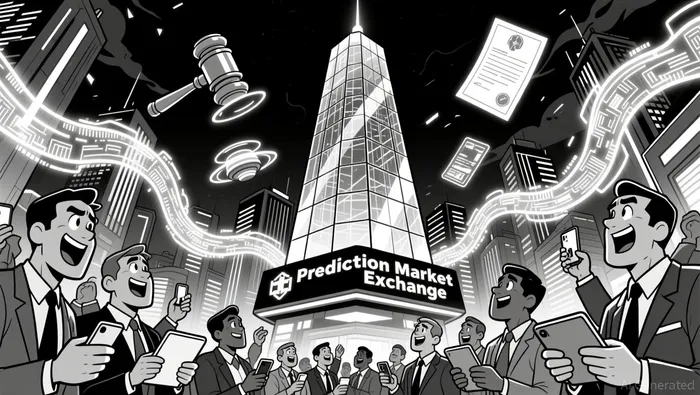
On the other hand, the lack of a unified regulatory approach creates operational and reputational risks. Traditional gaming associations, tribal nations, and state regulators are fiercely defending their existing frameworks, arguing that prediction markets exploit legal loopholes to circumvent consumer protection and tax obligations. The CFTC's ongoing evaluation of sports-based event contracts under the Commodity Exchange Act adds another layer of uncertainty, as regulators grapple with whether these contracts are financial derivatives or wagers. For investors, this means navigating a landscape where legal victories in one state could be nullified by losses in another, creating a volatile environment for long-term capital allocation.
Geopolitical and Macroeconomic Tailwinds
Beyond regulatory challenges, prediction markets are increasingly influenced by broader geopolitical and macroeconomic forces. J.P. Morgan Research notes that trade policy shifts and U.S. tariff hikes on imports remain high-likelihood risks, with potential to disrupt global growth and inflation trajectories. Prediction markets, which aggregate collective intelligence on event probabilities, are uniquely positioned to reflect these dynamics. For instance, contracts on U.S.-China trade tensions or Middle East conflicts have seen surging volumes, as participants bet on outcomes that could reshape global supply chains.
However, these tailwinds come with caveats. The IMF's 2025 World Economic Outlook projects subdued global growth at 3.2 percent, emphasizing the need for "credible, transparent, and sustainable policies" to restore confidence. While prediction markets thrive on volatility, prolonged economic stagnation could dampen participation. Additionally, the rise of AI-driven trading algorithms and institutional participation-evidenced by ICE's investment in Polymarket-introduces new risks, including market manipulation and regulatory scrutiny over algorithmic fairness.
The Road Ahead: Is Now the Time to Invest?
The answer hinges on two critical factors: the resolution of regulatory disputes and the sector's ability to adapt to evolving legal frameworks. If the Supreme Court sides with federal preemption, prediction markets could enter a new era of legitimacy, attracting institutional capital and expanding into global markets. Conversely, a fragmented regulatory landscape would likely limit growth to niche, state-sanctioned models, akin to the early days of online poker.
For now, the sector remains a high-risk, high-reward proposition. Investors with a long-term horizon may find value in platforms that prioritize regulatory compliance, such as Polymarket's CFTC registration strategy. However, those averse to legal uncertainty should tread cautiously, as the outcome of Kalshi's cases could trigger a domino effect across the industry. The key takeaway is clear: prediction markets are not just a financial innovation-they are a litmus test for how regulators will balance technological disruption with public interest in the 21st century.







Comentarios
Aún no hay comentarios