
Prediction Market Reliability and Governance Risk: The Centralization and Rule Ambiguity Crisis in Decentralized Oracle Systems
The rise of decentralized prediction markets has been hailed as a revolutionary application of blockchain technology, enabling users to bet on real-world outcomes with purportedly neutral, algorithmic resolution. However, the integrity of these platforms hinges on the reliability of their oracleADA-- systems-the mechanisms that translate ambiguous real-world events into binary outcomes. Polymarket, one of the most prominent prediction market platforms, relies on UMA's Optimistic Oracle to resolve bets. Yet, recent controversies and governance flaws have exposed systemic risks that undermine trust, including centralization, rule ambiguities, and manipulation by large token holders. For investors, these issues represent not just technical vulnerabilities but existential threats to the viability of decentralized prediction markets.
The UMAUMA-- Oracle: A Double-Edged Sword
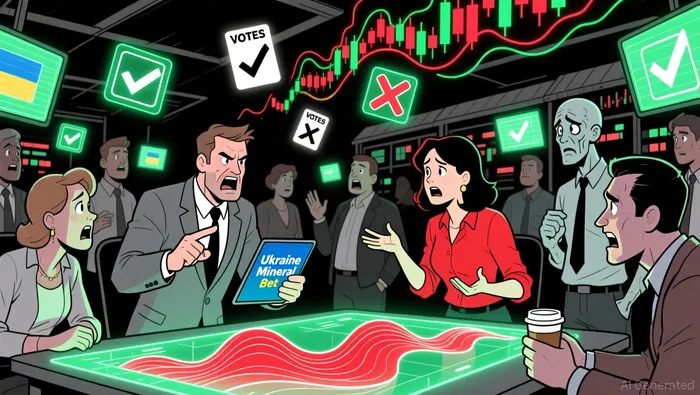
UMA's Optimistic Oracle is designed to resolve prediction markets by allowing token holders to vote on outcomes, assuming honesty unless challenged. In theory, this creates a decentralized, trustless system. However, in practice, the governance model is riddled with centralization risks. Large UMA token holders-often referred to as "whales"-can sway votes to benefit their own betting positions, as seen in the controversial resolution of a $7 million bet on a Ukrainian-U.S. mineral deal. Despite publicly available evidence suggesting the market should resolve as "Yes," UMA token holders voted to declare it "No," contradicting objective reality. This incident highlights a critical flaw: the financial incentives for honest voting are misaligned with the broader community's interests, enabling manipulation by those with disproportionate voting power.
Case Study: The $7 Million Ukraine Bet and Its Aftermath
The Ukraine mineral deal bet, which resolved against the apparent facts, became a flashpoint for criticism. Polymarket acknowledged the market was resolved prematurely but defended the UMA process, refusing refunds and labeling the outcome a "governance attack". Users accused the platform of enabling a scam by honoring a decision that defied public evidence. This case underscores how decentralized governance can fail when voting power is concentrated. As one expert noted, "The illusion of decentralization is shattered when a handful of actors can override reality to serve their financial interests."
Rule Ambiguities and Exploitable Governance
Beyond centralization, UMA's oracle system struggles with rule ambiguities. Markets often hinge on subjective interpretations of events, such as whether a specific legal document was signed or a policy enacted. The "Zelenskyy Suit Case," for instance, revealed how actors with large UMA holdings exploited ambiguous criteria to sway outcomes in their favor. These governance conflicts erode trust in smart contracts, which are supposed to enforce neutrality. When resolution mechanisms are discretionary, the entire premise of "code as law" collapses.
Broader Implications for Decentralized Prediction Markets
The risks extend beyond individual platforms. Decentralized finance (DeFi) as a whole faces challenges from liquidity fragmentation, smart contract exploits, and regulatory uncertainty. Prediction markets, in particular, are vulnerable due to their reliance on oracle systems. High-liquidity "head markets" attract most capital, while niche markets suffer from thin order books, making them easy targets for manipulation. For investors, this creates a paradox: the very decentralization that promises censorship resistance also introduces unpredictable governance risks.
Investment Implications and the Path Forward
For investors, the lessons are clear. Decentralized prediction markets are not immune to the same governance failures that plague traditional financial systems. The concentration of voting power in UMA's oracle system, combined with rule ambiguities, exposes users to unpredictable losses and market manipulation. While innovation in this space is promising, current models lack robust safeguards against centralization. Investors should approach these platforms with caution, prioritizing projects that implement transparent governance, token-weighted voting reforms, and multi-oracle verification systems.
Until decentralized oracle systems address these flaws, prediction markets will remain a high-risk asset class. The integrity of outcomes depends not just on code but on the alignment of incentives within governance structures. As the Ukraine bet controversy demonstrates, when reality is up for vote, the market's reliability-and the trust of its users-hangs in the balance.







Comentarios
Aún no hay comentarios