
Pre-Market Volatility in Blue-Chip and Cyclical Stocks: Momentum and Fundamentals in Focus
In the dynamic landscape of 2025, pre-market volatility in blue-chip and cyclical stocks has emerged as a focal point for investors seeking to balance momentum-driven opportunities with enduring fundamentals. As macroeconomic conditions shift and investor sentiment oscillates, the performance of these stocks reflects a complex interplay of valuation metrics, sector-specific challenges, and broader economic trends.
Blue-Chip Resilience Amid Pre-Market Swings
Blue-chip stocks, often seen as safe havens during market turbulence, have demonstrated mixed resilience in recent years. For instance, Johnson & JohnsonJNJ-- (JNJ) has maintained a forward P/E ratio of 13.76, showcasing its ability to weather downturns, such as its 21% decline at the onset of the pandemic [1]. Similarly, JP Morgan ChaseJPM-- (JPM) rebounded from a 40% drop in Q4 2022, now trading at an attractively low forward P/E ratio [1]. These examples underscore the importance of valuation metrics in assessing blue-chip stability.
In Q3 2025, blue-chip stocks like MicrosoftMSFT-- and VisaV-- outperformed the broader market, driven by robust financial stability, strategic leadership, and consistent dividend payouts [2]. This outperformance aligns with the broader US stock market's 1% premium to fair value as of June 30, 2025, with growth stocks commanding an even higher premium [1]. However, pre-market volatility remains a concern, particularly as investors react to looming tariff deadlines and the start of Q2 earnings season. Analysts warn that unresolved trade negotiations or earnings shortfalls could amplify market swings [1].
Cyclical Stocks: Navigating Macroeconomic Shifts
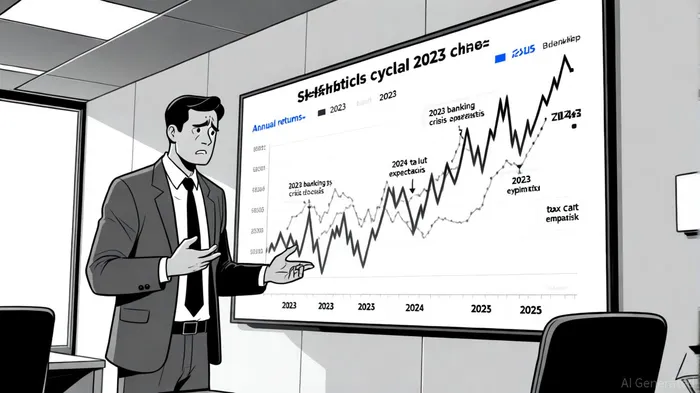
Cyclical stocks, which thrive in periods of economic expansion, have experienced pronounced volatility shaped by macroeconomic dynamics. In 2023, market volatility was muted, with the VIX hitting four-year lows, but spikes emerged during the U.S. regional banking crisis in March and the Fed's rate hikes in May [4]. By mid-2024, cyclical stocks rallied as investors anticipated tax cuts and deregulation post-election, reflecting improved economic expectations [3].
However, 2025 has seen a shift toward value and quality factors, with volatility and growth factors underperforming [5]. Climate risks have further complicated the outlook, particularly in energy sectors, where transition risks have contributed to short- to medium-term stock market fluctuations [6]. For example, Nike's five-year underperformance of -29.35% highlights the vulnerability of certain sectors to broader economic trends [1].
Momentum-Driven Opportunities and Fundamental Considerations
For momentum-driven investors, blue-chip stocks offer a blend of stability and growth potential. Microsoft and Visa's Q3 2025 performance exemplifies how strong fundamentals—such as consistent cash flow and strategic innovation—can drive sustained returns [2]. Conversely, cyclical stocks present opportunities for those willing to navigate macroeconomic uncertainties. The 2024 rally in cyclical sectors, fueled by tax cut expectations, illustrates the power of policy-driven momentum [3].
Yet, fundamentals remain critical. AbbVieABBV-- Inc (ABBV)'s 19% rebound in 2022, despite a broader market decline, underscores the importance of sector-specific resilience [1]. Similarly, the energy sector's exposure to climate risks highlights the need for rigorous due diligence [6]. Investors must weigh these factors against macroeconomic indicators, such as inflation trends and labor market stability, to identify undervalued opportunities [4].
Conclusion
Pre-market volatility in blue-chip and cyclical stocks offers both challenges and opportunities in 2025. While blue-chip stocks provide a buffer against market downturns, cyclical stocks remain sensitive to macroeconomic shifts and policy changes. By combining momentum-driven strategies with a focus on valuation metrics and sector-specific fundamentals, investors can navigate this dynamic landscape with greater confidence.





Comentarios
Aún no hay comentarios