
Pre-Market Moves: Tactical Plays on Bank Rate Cap and Exelixis Guidance
Two distinct pre-market catalysts are driving today's moves, creating separate risk/reward setups. The first is a political policy threat, while the second is a company-specific revenue update.
The immediate sector-wide risk comes from a new political pledge. President Trump called for a one-year cap on credit card interest rates at 10%, effective January 20. This announcement triggered a sharp sell-off in financial stocks, with Citigroup falling 4% and other major banks like JPMorganJPM-- and Bank of AmericaBAC-- down 2.5% to 3%. The move is a direct policy risk, as such a cap would compress the net interest margins that banks rely on for profits. The broader market is also under pressure, with Dow futures down over 300 points due to separate concerns about Fed independence, amplifying the negative sentiment.
On the flip side, ExelixisEXEL-- presents a tactical entry point if the market's reaction is excessive. The company reported preliminary fiscal 2025 U.S. net product revenue of $2.123 billion and provided fiscal 2026 guidance of $2.325 billion to $2.425 billion. This guidance implies a growth rate of roughly 10% to 14% year-over-year, which is in-line with the company's stated trajectory. Yet shares fell 4.6% in pre-market trading. The sell-off appears to be a knee-jerk reaction to the broader market weakness, not a fundamental reassessment of the company's revenue path. For a stock already trading at a discount, this creates a potential mispricing opportunity if the core business fundamentals remain intact.
The setup is clear: one catalyst introduces broad sector uncertainty, while the other offers a specific name where the news may be overblown.
Assessing the Mispricing: Policy vs. Pipeline
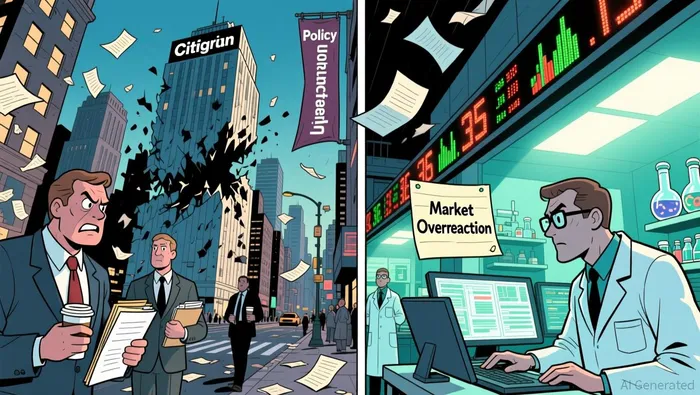
The pre-market moves create a stark contrast between two types of risk. For banks, the sell-off appears overdone given the high uncertainty around the policy threat. For Exelixis, the drop looks like a knee-jerk reaction to broader market weakness, not a fundamental reassessment.
The bank rate cap is a political pledge, not law. President Trump's call for a one-year cap on credit card interest rates at 10% requires Congressional action to become enforceable. Lawmakers have stated as much, and the move faces fierce industry opposition. Banking associations warn it would be "devastating" for millions of families and small businesses and make credit harder to access. This creates a high bar for passage, making the current stock price decline a bet on political certainty that is not yet a fact.
For Exelixis, the revenue guidance provides a clearer picture. The company's preliminary fiscal 2025 U.S. net product revenue of $2.123 billion sets a base. Its fiscal 2026 guidance of $2.325 billion to $2.425 billion implies growth of roughly 9% to 14% year-over-year. That trajectory is in-line with the company's stated path and does not represent a major beat or miss. The 4.6% pre-market drop on this news looks disconnected from the underlying financials.
The bottom line is one of mispricing versus overreaction. The bank sell-off prices in a high-probability policy outcome that is far from guaranteed, creating a potential setup if the political reality checks back in. The Exelixis sell-off, by contrast, seems like a temporary mispricing driven by sector-wide fear, not a change in its revenue fundamentals.
Near-Term Catalysts: What Could Reverse or Confirm the Moves
The pre-market moves set up a clear test. The bank sell-off hinges on political uncertainty, while the Exelixis drop looks like a market overreaction. The near-term events will determine which narrative wins.
For banks, the key catalyst is legislative action. President Trump's call for a one-year cap on credit card interest rates at 10% is a political pledge, not law. As lawmakers have stated, such a cap would require a bill to be passed by Congress. The next few weeks will show if this is a serious legislative push or a campaign talking point. Simultaneously, watch for Federal Reserve Chair Jerome Powell's response to this political pressure. His public stance on the independence of the central bank will be a major signal of the administration's regulatory posture and could amplify or ease the market's fears.
For Exelixis, the immediate catalyst is its presentation at the J.P. Morgan Healthcare Conference tomorrow, Monday, January 12. The company has already provided its fiscal 2026 revenue guidance, but the conference offers a chance for management to elaborate on the growth drivers behind that number and provide more detail on its pipeline, including the status of its potential second franchise. A strong, forward-looking update could quickly reverse the pre-market pessimism and validate the stock's discount.
Citi's situation is more immediate. The bank's Q4 earnings release on Wednesday, January 14, will be a major near-term event to assess its financial health. The stock's 4% pre-market drop reflects sector-wide fear, but the company's own results will show how much that fear is justified by its specific credit quality, capital levels, and net interest margin outlook. The earnings call will provide the concrete data needed to separate the policy risk from the company's operational reality.
The bottom line is that these events will provide the missing pieces. For banks, it's about translating political noise into legislative probability. For Exelixis, it's about adding substance to its guidance. For CitiC--, it's about grounding its stock price in quarterly performance. Watch these catalysts closely.





Comentarios
Aún no hay comentarios