
U.S. PPI Contraction and the Reshaping of Global Dollar Demand: A Strategic Outlook for Traders
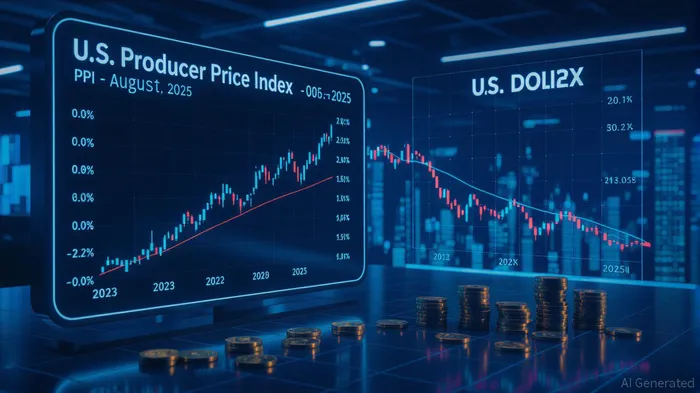
The U.S. (PPI) has long served as a barometer for inflationary pressures at the wholesale level, offering early signals about the trajectory of consumer prices and central bank policy. In August 2025, , . This unexpected moderation, , marked a pivotal shift in the inflation narrative. For and commodity investors, the implications are profound, reshaping strategies as the U.S. dollar's dominance faces renewed scrutiny.
The PPI Surprise: A Dovish Signal for the Fed
The August PPI report revealed a sharp divergence between headline and core metrics. While goods prices edged up 0.1%, , driven by collapsing margins in logistics and transportation. This divergence underscores a broader disinflationary trend, with the core PPI (excluding food, energy, . Such data points suggest that inflationary pressures are not only easing but doing so more rapidly than anticipated.
For the , this creates a critical dilemma. A dovish pivot appears increasingly likely, . The PPI's unexpected contraction amplifies this expectation, weakening the case for prolonged high-interest-rate policies. Historically, , .
Currency Strategies: Rebalancing in a Dovish Climate
The PPI data has already triggered a strategic repositioning in forex markets. Traders are favoring long positions in EUR/USD and GBP/USD, betting on the euro and British pound's resilience against a weaker dollar. The EUR/USD pair, for instance, has rebounded from 6-week lows, . Analysts suggest a corrective decline post-PPI, but a more pronounced move hinges on the upcoming CPI data.
Conversely, has become a short favorite, as Japan's export-dependent economy remains vulnerable to U.S. trade policies. The yen's weakness, exacerbated by , , .
Commodity Demand: Dollar Weakness as a Tailwind
The PPI contraction's impact extends beyond currencies, directly influencing commodity markets. A weaker dollar typically boosts demand for dollar-denominated assets, including gold and . Gold, for example, has historically thrived in , . However, if the Fed's rate cuts materialize, .
like copper and nickel, however, face headwinds. While the PPI's services-driven contraction signals easing inflation, on machinery and equipment have created uncertainty, dampening demand for industrial commodities. In contrast, (iron ore, coking coal) have shown resilience, buoyed by China's infrastructure-driven demand.
Investment Advice: Navigating the New Paradigm
For investors, the key takeaway is clear: the PPI contraction signals a shift toward a and a weaker dollar, creating opportunities in both currency and commodity markets. Here's how to position your portfolio:
- Currency Exposure:
- Long EUR/USD and GBP/USD: The euro and pound are well-positioned to benefit from the dollar's relative weakness, especially if the ECB and BoE maintain a .
Short USD/JPY: Japan's vulnerability to U.S. trade policies makes the yen a logical short, though volatility from geopolitical tensions should be monitored.
Commodity Allocations:
- Gold: Re-enter if the Fed cuts rates, .
- Ferrous Metals: Maintain exposure to and coking coal, given China's sustained demand.
Base Metals: Avoid overexposure to copper and nickel until trade policy clarity emerges.
Macro Hedges:
- Diversify into High-Yield Currencies: The 's recent surge, driven by the , offers a compelling case for yield-seeking investors.
- Monitor CPI and PPI Cross-Validation: The upcoming CPI report will be critical in confirming the PPI's disinflationary signal.
Conclusion: A Dovish Dawn for Global Markets
The August 2025 PPI contraction is more than a statistical anomaly—it is a harbinger of a dovish Fed and a recalibration of global capital flows. For traders, this means rethinking traditional USD-pegged strategies and embracing a more nuanced approach to . As the dollar's reign as the world's faces challenges, those who adapt to the new inflationary landscape will find themselves at the forefront of a transformative era in global finance.







Comentarios
Aún no hay comentarios