
How Power of Siberia 2 Could Displace U.S. LNG Exports and Reshape Asian Gas Markets
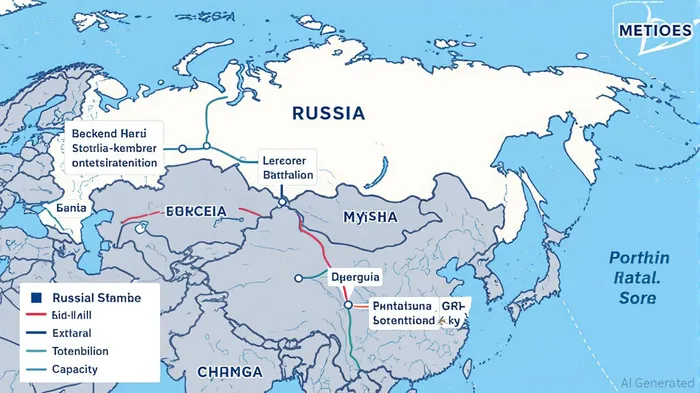
The Power of Siberia 2 (PoS-2) pipeline, a $13.6–$34 billion project to transport 50 billion cubic meters (bcm) of natural gas annually from Russia’s Yamal Peninsula to northern China via Mongolia, is poised to redefine global energy trade dynamics. As the project advances from negotiation to construction, its implications for U.S. liquefied natural gas (LNG) exporters and Asian gas markets are becoming increasingly clear. This analysis examines the financial and geopolitical risks and opportunities for LNG infrastructure players and suppliers, drawing on recent developments and market data.
Cost Competitiveness: A Structural Shift in Gas Trade
Pipeline gas from PoS-2 is projected to undercut U.S. LNG by 20–30% in China, according to a Bloomberg report [1]. This cost advantage stems from the elimination of liquefaction, shipping, and regasification expenses inherent to LNG. Russian pipeline gas has historically been a third cheaper than contracted LNG imports into China and less than half the cost of spot LNG [1]. For U.S. LNG exporters, this structural shift poses a direct threat to profitability, particularly as China’s demand for gas is expected to grow by 40% by 2030 [4].
The U.S. currently dominates global LNG exports, with 62% of new capacity in 2025 and 43% in 2026 tied to U.S.-led projects [2]. However, PoS-2 could displace up to 40 million metric tons of LNG annually in China’s import portfolio—equivalent to over half of its current LNG imports [1]. This displacement would disproportionately affect U.S. shale producers, whose higher production and transportation costs make them less competitive against Russian pipeline gas.
Geopolitical Leverage and Market Share Reallocation
China’s strategic pivot toward pipeline imports reflects its desire to reduce reliance on volatile LNG markets and maritime chokepoints like the Strait of Malacca [5]. By securing a stable, long-term supply via PoS-2, China gains leverage in global gas pricing and diversifies its energy sources. This shift aligns with Beijing’s broader goal of insulating its economy from geopolitical risks, including U.S.-China trade tensions and Middle East supply disruptions [5].
For Russia, PoS-2 is a critical countermeasure to declining European gas exports post-Ukraine invasion. Gazprom CEO Alexei Miller has emphasized that PoS-2 pricing will be lower than European rates, though unresolved negotiations with China over oil-indexed pricing (Russia seeks $265–$285 per 1,000 cubic meters; China prefers $120–$130) remain a hurdle [3]. If finalized, the pipeline would deepen the China-Russia energy alliance, challenging the dominance of U.S. and Qatari LNG in Asia [6].
Investment Risks for LNG Exporters and Infrastructure Players
The displacement of U.S. LNG exports by PoS-2 pipeline gas introduces significant financial risks for infrastructure players. U.S. LNG projects, already burdened by high capital costs and labor shortages, face further strain if Chinese demand wanes [7]. For example, U.S. LNG exports to China have declined due to trade disputes and tariffs, with no imports recorded in recent months [7]. This trend could accelerate as China prioritizes pipeline gas for its energy security.
Moreover, the pipeline’s success hinges on resolving financing and pricing disputes. Delays in these negotiations could delay construction beyond 2030, creating uncertainty for investors. Meanwhile, U.S. LNG exporters must contend with rising competition from Canada and Mexico, which are developing more cost-effective LNG projects with shorter shipping distances to Asia [7].
Opportunities in a Reshaped Market
While PoS-2 poses risks, it also creates opportunities for LNG players in non-Asian markets. As China reallocates LNG imports to other Asian countries, Southeast Asia and India could become key growth markets for U.S. and Qatari suppliers. Additionally, infrastructure players with flexible LNG assets—such as floating storage and regasification units—may benefit from increased market liquidity as China re-exports LNG [5].
For investors, the key lies in hedging against pipeline-driven displacement while capitalizing on emerging demand in Asia. Projects with lower break-even costs and access to diversified markets (e.g., U.S. LNG terminals serving India or Southeast Asia) are likely to outperform in this new landscape.
Conclusion
The Power of Siberia 2 pipeline represents a seismic shift in global energy markets, with far-reaching implications for U.S. LNG exporters and Asian gas dynamics. While the project’s cost advantages and geopolitical alignment between Russia and China pose significant risks to U.S. LNG infrastructure, they also create opportunities for diversification and innovation in non-Asian markets. Investors must navigate these dual pressures by prioritizing flexibility, cost efficiency, and strategic market diversification.
Source:
[1] How a Russia-China Gas Pipeline — Power of Siberia 2 [https://www.bloomberg.com/news/articles/2025-09-09/how-a-russia-china-gas-pipeline-power-of-siberia-2-threatens-us-lng-exports]
[2] LNG market in Q2 2025 [https://www.seala.ai/analytics/lng-2025q2]
[3] Power of Siberia 2: Russia's Pivot, China's Leverage, and Global Gas Implications [https://www.energypolic]
[4] How the Power of Siberia 2 Deal Could Reshape Global ... [https://www.hellenicshippingnews.com/how-the-power-of-siberia-2-deal-could-reshape-global-energy/]
[5] Power of Siberia 2: A Pipeline Between Ambition and ... [https://trendsresearch.org/insight/power-of-siberia-2-a-pipeline-between-ambition-and-uncertainty/?srsltid=AfmBOor_sU0Q4LnZwu7Idm-ZvHR9uyVr06lWXvIihDUrfh9OmVKOazhZ]
[6] China-Russia Pipeline Seen Displacing One-Third of LNG ... [https://oilprice.com/Latest-Energy-News/World-News/China-Russia-Pipeline-Seen-Displacing-One-Third-of-LNG-Imports-Analysts-Warn.html]
[7] Risks and Uncertainties Facing New LNG Projects On The ... [https://www.energycentral.com/energy-biz/post/risks-and-uncertainties-facing-new-lng-projects-us-gulf-and-east-coasts-h5JEcUhsURpjSc3]







Comentarios
Aún no hay comentarios