
Post-Winter Property Tech Revival and Its Divergence from Climate Investment Trends
The property technology sector, long characterized by its cyclical nature, is emerging from a prolonged "winter" marked by capital retrenchment and market normalization. According to CRETI's 2023 report, venture capital investment plummeted to $11.38 billion, a 42.38% decline from 2022 levels-proptech is now witnessing a recalibration. This revival, however, is diverging sharply from the trajectory of climate tech investments, which are increasingly prioritizing resilience and regulatory compliance over efficiency-driven innovation.
Proptech's Post-Downturn Recovery: Infrastructure and Debt Financing
The 2025 recovery in proptech is defined by a strategic pivot toward foundational infrastructure and backend systems. Per CRETI's Q1 2025 report, Q1 2025 data reveals $2.06 billion in venture capital investments, with debt financing dominating at $734 million-allocated to platforms like Roc360 and SATO that enable real estate operators to monetize utility interactions. This shift reflects investor caution, favoring revenue-tied lending and structured downside protection over high-risk early-stage ventures.
Capital allocation is also broadening beyond residential markets into commercial and construction real estate, driven by demand for operational efficiency. As noted by Baird, investors are now targeting technologies that enhance cash flows and streamline processes, such as AI-driven construction robotics and insurtech solutions. Meanwhile, the sector's focus on embedding climate-aligned technologies into asset operations-like smart grid integration-aligns with broader sustainability goals but remains distinct from climate tech's core priorities, as the same CRETI Q1 2025 report also observes.
Climate Tech's Resilience-Driven Momentum
In contrast, climate tech investment in 2025 is surging toward energy security and adaptation. H1 2025 data shows $13.2 billion in climate tech funding, with energy (35%) and gridtech (Q1 peak of $316 million) leading the charge, according to CTVC. Advanced nuclear power, critical minerals, and sustainable aviation fuels are attracting mega-deals, fueled by geopolitical tensions and policy frameworks like the U.S. Inflation Reduction Act, as reported by Latitude Media.
Climate management platforms-monitoring oceans, forests, and risk exposure-are also gaining traction, reflecting a renewed emphasis on adaptation. Unlike proptech's market-driven efficiency focus, climate tech is increasingly shaped by regulatory pressures and long-term environmental mitigation needs. For instance, industrial decarbonization and process electrification now capture 19.3% of U.S. climate tech funding, prioritizing cost-saving deployments over speculative innovation (Latitude Media).
Divergent Priorities: Efficiency vs. Resilience
The sector-specific divergence is stark. Proptech's revival hinges on embedding AI and infrastructure-native tools into real estate operations, redefining assets as active grid participants (the CRETI Q1 2025 report). Climate tech, meanwhile, is driven by energy security and resilience, with investors stacking capital into technologies that address aging infrastructure and AI-driven energy demands (CTVC).
Macroeconomic factors further amplify this split. Elevated interest rates and stagnant property transactions have constrained proptech M&A activity, pushing investors toward later-stage financing and capital preservation (CRETI's 2023 report). Climate tech, conversely, benefits from policy tailwinds and a growing emphasis on domestic supply chains, with gridtech and critical minerals sectors seeing surging interest (Latitude Media).
Implications for Investors
For investors, the post-downturn proptech revival offers opportunities in infrastructure-native platforms and debt-backed ventures, but with a focus on sustainable growth. Climate tech, meanwhile, demands a longer-term horizon, prioritizing resilience-driven technologies aligned with regulatory mandates. The key lies in balancing these divergent trajectories-leveraging proptech's operational efficiency while aligning with climate tech's resilience agenda-to navigate an increasingly fragmented capital landscape.
As the real estate and climate sectors evolve, the interplay between market dynamics and regulatory imperatives will shape investment outcomes. The challenge for stakeholders is to discern where these paths intersect-and where they must be navigated separately.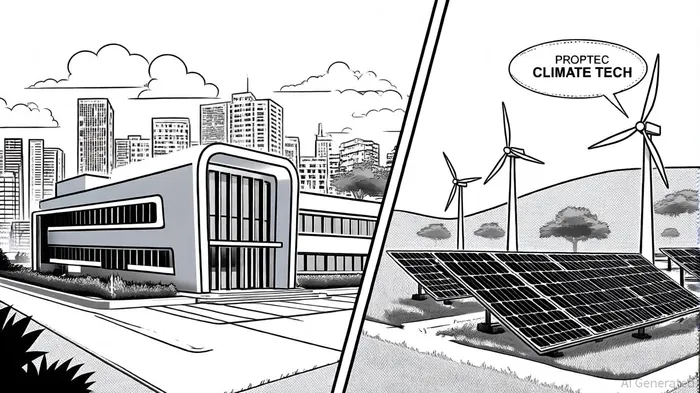







Comentarios
Aún no hay comentarios