
The Post-Truce AI Ecosystem: Strategic Alliances and Revenue Synergies in 2025
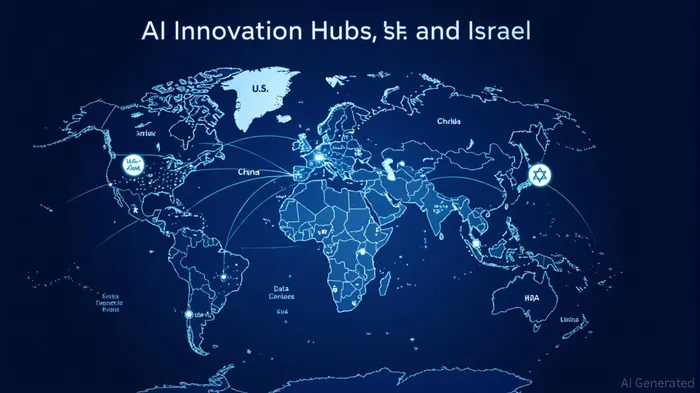
The post-truce AI ecosystem (2023–2025) has emerged as a battleground for strategic alignment and revenue generation, driven by geopolitical dynamics, technological breakthroughs, and corporate partnerships. As nations and firms recalibrate their priorities in a post-conflict world, the interplay between innovation and commercialization has become a critical determinant of competitive advantage. This analysis examines the evolving landscape of AI corporate partnerships, their financial outcomes, and the strategic imperatives shaping the sector.
Global Dynamics and Corporate Strategies
The U.S. continues to dominate AI infrastructure through export controls on advanced semiconductors and software, ensuring a technological edge over rivals like China[1]. Meanwhile, Israel's investment in AI R&D—exemplified by Nvidia's planned $1 billion campus in Tel Aviv—highlights the country's pivot to leveraging its engineering talent for global competitiveness[2]. In contrast, China's AI hubs in Beijing, Shanghai, and Shenzhen have prioritized foundational research and industry applications, with state-backed initiatives accelerating algorithm development and market penetration[3].
Strategic partnerships are increasingly defined by geographic specialization. For instance, Salesforce's $8 billion acquisition of InformaticaINFA-- in 2025 underscores the U.S. focus on data governance as a cornerstone of AI commercialization[5]. Similarly, Chinese firms are consolidating regional ecosystems, with Shenzhen-based startups securing venture capital to scale AI-driven manufacturing solutions.
Financial Outcomes and Strategic Alignment
Quantifiable revenue gains from AI partnerships are reshaping corporate finance. JPMorgan Chase's deployment of 600 AI use cases has yielded $120 million in annual savings by automating credit analysis and reducing fraud detection false positives by 15–20%[5]. In insurance, Zurich's AI-powered claims processing achieved a 94.5 combined ratio and $7.4 billion in 2023 profits, with claim resolution times slashed to 13 minutes[5].
Strategic alignment between partners is critical. HighRadius's AI-driven accounts receivable solutions for clients like 3MMMM-- and UnileverUL-- demonstrate how tailored platforms can reduce DSO (Days Sales Outstanding) by 32% for companies with 50%+ automation[5]. Similarly, Jumio's AI platform cut DSO by 24 days in under 30 days, illustrating the scalability of agentic systems in cash flow optimization[5].
Case Studies: Revenue Synergies in Action
- Salesforce & Informatica: The 2025 acquisition integrated Informatica's data integration tools into Salesforce's AI cloud, enabling enterprises to process 1.2 exabytes of data monthly. This synergy is projected to generate $1.5 billion in incremental revenue by 2026[5].
- Nvidia & Israeli Startups: Nvidia's R&D campus in Israel is expected to catalyze partnerships with local AI startups, such as Deep Instinct, which uses its AI for cybersecurity. Early collaborations have already reduced threat detection times by 40%[2].
- McKinsey's Gen AI Report: A 2024 study found that 65% of firms using generative AI (gen AI) reported revenue growth, with AI high performers attributing 10–15% of EBIT to customized gen AI applications[4]. For example, AI sales agents at a Fortune 500 company boosted qualified leads by 35% and revenue by 17%[5].
Strategic Implications for Investors
The post-truce AI ecosystem rewards partnerships that align technical capabilities with market demand. Firms like NvidiaNVDA-- and SalesforceCRM-- exemplify how infrastructure and data governance are foundational to monetizing AI. However, geopolitical risks—such as U.S. export controls—necessitate diversified strategies. Investors should prioritize companies with:
- Regional specialization (e.g., Israel's R&D, China's manufacturing AI).
- Vertical integration (e.g., Salesforce's data stack).
- Agentic AI adoption (e.g., McKinsey's 2024 findings on customization[4]).
Conclusion
The post-truce AI landscape is defined by a delicate balance between strategic alignment and revenue potential. As corporate partnerships evolve from speculative bets to revenue-generating engines, the ability to quantify outcomes—whether through reduced DSO, fraud detection savings, or EBIT contributions—will determine long-term success. For investors, the key lies in identifying partnerships that not only leverage cutting-edge technology but also align with macroeconomic and geopolitical currents.





Comentarios
Aún no hay comentarios