
Post-Token Crash Market Reallocation and Recovery Opportunities: Identifying Undervalued Blockchain Infrastructure Assets
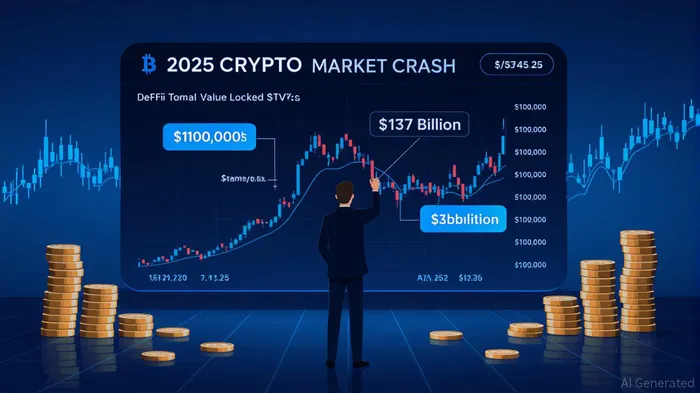
The 2025 crypto market crash, triggered by geopolitical tensions, regulatory uncertainty, and macroeconomic volatility, reshaped investor priorities. Bitcoin's 27% drop from $100,000 to $75,000 in early 2025 exposed systemic fragilities but also catalyzed a strategic reallocation of capital toward blockchain infrastructure projects with tangible utility. As institutional and retail investors recalibrate, the focus has shifted from speculative tokens to foundational technologies addressing scalability, interoperability, and real-world asset integration. This analysis identifies undervalued infrastructure assets poised to benefit from post-crash recovery dynamics.
Market Reallocation: From Speculation to Utility
The crash exposed the vulnerabilities of hype-driven assets, with altcoins and memecoins losing over 40% of their value[2]. Conversely, blockchain infrastructure projects—particularly those enabling cross-chain interoperability, DeFi scalability, and tokenized real-world assets (RWAs)—attracted inflows. For instance, DeFi Total Value Locked (TVL) rebounded from $87 billion in April 2025 to $137 billion by September 2025, driven by institutional liquidity and innovations like tokenized U.S. treasuries[3]. EthereumETH-- retained 53.3% TVL dominance, but blockchains like SolanaSOL-- (9.1%) and AvalancheAVAX-- (5.8%) gained traction, reflecting a maturing multi-chain ecosystem[4].
Regulatory clarity, such as the EU's MiCA framework and U.S. SEC rulings on stablecoins, further bolstered institutional confidence[2]. Meanwhile, venture capital funding for blockchain infrastructure hit $4.8 billion in Q1 2025, with cloud-mining firms like XY Miners securing $300 million to support AI-driven compute demands[5].
Undervalued Infrastructure Projects: Fundamentals and Metrics
- Qubetics ($TICS): A cross-chain aggregator and non-custodial wallet, Qubetics raised $16.2 million in presale and supports Ethereum, Solana, and Avalanche. With 24,900 token holders and a focus on interoperability, it addresses DeFi's fragmentation, positioning itself as a critical infrastructure layer[6].
- Aave and Lido: Despite high TVL ($12.4 billion and $38.3 billion, respectively), these protocols face gas inefficiencies and smart contract risks[7]. However, their dominance in lending and staking liquidity underscores their role in DeFi's recovery.
- BlockDAG: A hybrid Layer-1 blockchain with presale momentum, BlockDAG's community-driven model and hybrid consensus mechanism make it a contender for scalable, low-cost transactions[2].
- XRP: Post-SEC settlement, XRP's institutional adoption rebounded, with Ripple's cross-border payment solutions gaining traction in markets like Singapore and Latin America[3].
Investor Sentiment: Fear to Calculated Optimism
Post-crash sentiment, as measured by the Crypto Fear and Greed Index, hit an extreme fear level of 19 in April 2025[2]. However, sentiment analysis tools like LSTM-based models and VADER now detect a shift toward cautious optimismOP--. For example, Ethereum's Network Value-to-Transaction (NVT) ratio dropped to 62.4, suggesting undervaluation relative to usage[7]. Meanwhile, AI-powered DeFi (DeFAI) is projected to grow 900% by 2025, enhancing efficiency and security[4].
Institutional participation in DeFi lending—now exceeding $130 billion in TVL—signals a long-term structural shift[3]. Yet, retail-driven growth remains fragile, with leverage and borrowing activities amplifying volatility[7].
Recovery Opportunities: Infrastructure as the New Frontier
The post-crash landscape favors projects addressing three gaps:
1. Scalability: Layer-2 solutions like Optimism and Polygon are critical for Ethereum's competitiveness[4].
2. Interoperability: Cross-chain bridges and aggregators (e.g., Qubetics) enable seamless asset movement, reducing friction in a multi-chain world[6].
3. Real-World Asset Integration: Tokenized real estate and treasuries, with $15.1 billion in on-chain RWAs, are blurring lines between crypto and traditional finance[1].
Conclusion
The 2025 crash accelerated the transition from speculative hype to utility-driven blockchain adoption. Investors prioritizing infrastructure projects with robust fundamentals—such as Qubetics, AaveAAVE--, and XRP—are well-positioned to capitalize on the next phase of growth. As regulatory clarity and technological innovation converge, the focus on scalable, interoperable solutions will define the post-crash recovery.






Comentarios
Aún no hay comentarios