
Post-Shooting Security Technology Demand: Opportunities in Surveillance & Public Safety Infrastructure
The tragic 2025 mass shooting at Brown University has catalyzed a seismic shift in how institutions and governments approach public safety. The incident, which exposed critical gaps in campus surveillance and emergency response systems, has accelerated demand for advanced security technologies and infrastructure upgrades. This analysis examines the evolving landscape of post-shooting security investments, highlighting both the opportunities and challenges in a sector poised for rapid growth.
The Brown University Incident: A Catalyst for Change
The shooting at Brown University's Barus and Holley engineering building underscored vulnerabilities in campus security, including limited camera coverage and unlocked doors. These shortcomings prompted a national reckoning, with universities and policymakers prioritizing AI-powered video intelligence, real-time threat detection, and integrated surveillance systems. For instance, Brown itself has begun piloting AI-based monitoring systems with automated lockdown capabilities to address such gaps. The incident also amplified scrutiny of broader systemic issues, such as delayed communication protocols and inconsistent alert systems, further driving demand for holistic security solutions.
Surge in Security Technology Investments
The security technology market is experiencing unprecedented growth, driven by post-shooting demand and technological innovation. According to a report by Research and Markets, the global public safety and security market was valued at USD 581.9 billion in 2025 and is projected to reach USD 1.63 trillion by 2034, growing at a CAGR of 12.2%. In the U.S., the security market was valued at USD 38.43 billion in 2024 and is expected to grow at a CAGR of 6.3% to USD 66.60 billion by 2033 according to market data.
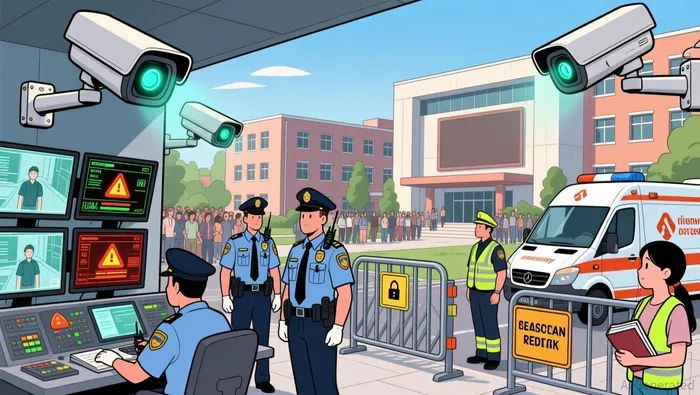
Key drivers include AI-powered surveillance, predictive analytics, and 5G-enabled communication systems, which enhance real-time situational awareness and emergency response capabilities according to industry analysis. For example, schools like Beverly Hills High have invested $4.8 million in security measures, including AI-driven gun detection software and drones as reported by Forbes. Similarly, companies like ZeroEyes and EvolvEVLV-- have gained traction for their ability to identify firearms in real time, despite occasional false alarms as noted by Forbes. The Department of Homeland Security's SAFETY Act Designation for certain tools further validates their efficacy according to Forbes.
Public Safety Infrastructure: A Mixed Funding Landscape
While private and institutional investments in security tech are surging, public safety infrastructure funding remains fragmented. Federal support has faced significant cuts under the Trump administration, with over $810 million in grants for violence prevention and community safety programs eliminated. These cuts have disproportionately affected community violence intervention (CVI) programs, which rely on evidence-based outreach to reduce gun violence. For instance, organizations like ROCA in Baltimore and Think Outside Da Block in Chicago have seen reduced capacity due to funding constraints according to Reuters.
However, local governments are stepping in to fill the void. As of mid-2025, U.S. annualized public safety construction spending reached $19.35 billion, with cities like Sugar Land, Texas, and Ridgefield, Connecticut, approving multi-million-dollar projects for police headquarters and consolidated public safety facilities. This trend reflects a strategic shift toward prioritizing physical infrastructure to enhance operational efficiency and adapt to modern threats as noted by market analysis.
Balancing Technology and Policy Challenges
The rapid adoption of security technologies raises critical questions about privacy, equity, and long-term sustainability. Critics argue that surveillance systems may not significantly reduce school shootings and could foster distrust among students as reported by Forbes. Additionally, federal funding cuts have stymied research into gun violence prevention and injury mitigation, creating a gap in data-driven policymaking.
Universities like Brown have also faced financial strain due to federal research funding freezes, forcing them to scale back capital investments and freeze hiring. While the university reached an agreement with the U.S. government to restore some funding, broader challenges persist as reported in official statements. These developments highlight the need for a balanced approach that integrates technology with community-based solutions, mental health support, and policy reforms.
Opportunities for Investors
The post-shooting security landscape presents compelling opportunities for investors, particularly in AI-driven surveillance, cybersecurity, and public safety infrastructure. Key sectors to watch include:
1. AI and IoT Solutions: Companies developing real-time threat detection, behavioral analytics, and integrated camera systems are well-positioned to capitalize on institutional demand according to industry reports.
2. Public Safety Infrastructure: Municipal bond markets are surging to fund projects like police headquarters and emergency response centers, offering stable returns for infrastructure-focused investors.
3. Community Violence Intervention (CVI) Platforms: Despite federal cuts, CVI programs with proven track records-such as those in Chicago and Baltimore-could attract private philanthropy and state-level funding according to research.
However, investors must remain mindful of regulatory risks, privacy concerns, and the political volatility surrounding federal funding. Diversifying portfolios across technology, infrastructure, and policy advocacy could mitigate these risks while aligning with long-term societal needs.
Conclusion
The Brown University shooting has acted as a catalyst for a paradigm shift in public safety, accelerating investments in security technology and infrastructure. While challenges such as federal funding cuts and privacy debates persist, the sector's growth trajectory remains robust. For investors, the key lies in identifying scalable solutions that address both immediate security needs and systemic vulnerabilities. As the U.S. grapples with the dual imperatives of safety and equity, the post-shooting security landscape offers a unique intersection of innovation, policy, and opportunity.







Comentarios
Aún no hay comentarios