
Post-Rate-Cut Dynamics in the Financial Sector: Capital Flows and Earnings Acceleration in 2025
The Federal Reserve's September 2025 rate cut, the first of three anticipated reductions this year, has triggered a recalibration of capital flows and earnings trajectories in the financial sector. With the fed funds rate now in a 4%-4.25% range and further cuts priced into October and December meetings, investors and institutions are navigating a landscape shaped by dovish monetary policy, compressed net interest margins (NIMs), and shifting asset allocations. This analysis examines the sector's response through the lenses of capital flow dynamics and earnings acceleration, drawing on granular data and institutional insights.
Capital Flow Shifts: From Money Markets to Strategic Fixed Income
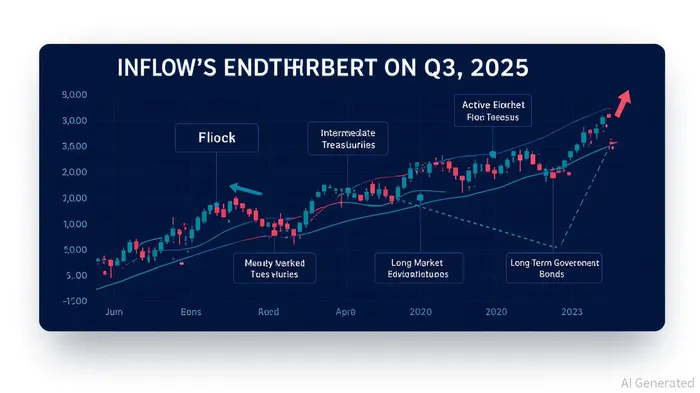
The Fed's rate cuts have accelerated a migration of capital from short-term, high-yield instruments to income-generating assets with balanced risk profiles. Bond ETFs, particularly those targeting taxable and intermediate-duration bonds, have seen record inflows. For instance, taxable-bond ETFs attracted $43 billion in August 2025 alone, as investors positioned for a low-rate environment[2]. This trend aligns with BlackRock's observation that intermediate Treasuries (e.g., VGIT) and active fixed-income strategies are gaining favor over long-term government bonds, which face yield compression due to term premium pressures[3].
Money market funds, once a haven for liquidity, are projected to see yields fall below 3% by mid-2026, prompting a strategic reallocation toward alternatives like bond ladders and credit instruments[1]. J.P. Morgan's Q3 2025 asset allocation strategy further underscores this shift, emphasizing credit and equity overweights in U.S. technology and international markets[3]. These movements reflect a broader recalibration of risk appetites amid the Fed's gradual easing cycle.
Earnings Acceleration: NIM Trends and Sub-Sector Divergence
The financial sector's earnings performance in Q3 2025 has been marked by resilience and divergence across sub-sectors. Community banks, for example, have outperformed larger institutions, with NIMs rising to 3.62% in Q2 2025—a 16-basis-point increase driven by higher asset yields and stable funding costs[4]. This contrasts with large banks, whose NIMs remain constrained between 2.5% and 3.5%, reflecting margin pressures from a lower-rate environment[5].
Deloitte projects industry-wide NIMs to stabilize around 3% by year-end 2025 as deposit costs remain elevated[5]. However, noninterest income is emerging as a critical offset. Investment banking fees and asset management revenues have surged, fueled by increased M&A activity and issuance volumes[2]. For example, banks with capital market expertise are benefiting from fee-driven growth, though this comes with higher compensation expenses and operational complexity[5].
The insurance and asset management sub-sectors face distinct challenges. Declining interest rates threaten returns on fixed-income portfolios underpinning annuities and life insurance products[1]. Meanwhile, asset managers are pivoting toward alternative assets and long-dated credit to preserve income generation[3].
Strategic Implications for Investors
The post-rate-cut environment demands a nuanced approach to financial sector investing. For capital flows, the emphasis on intermediate-duration bonds and active fixed-income strategies suggests a preference for yield stability over duration risk. ETFs like SGOV (ultra-short Treasuries) and VGIT (intermediate Treasuries) exemplify this trend[2].
On the earnings front, sub-sector differentiation is key. Community banks and regional institutions with agile balance sheet strategies—such as bond swaps and pre-funding of lower-yielding assets—are better positioned to navigate NIM compression[2]. Conversely, large banks reliant on noninterest income must balance fee growth with margin pressures.
Conclusion
The Federal Reserve's 2025 rate cuts have catalyzed a reordering of capital flows and earnings dynamics in the financial sector. While NIM compression and macroeconomic uncertainties persist, strategic repositioning—whether through intermediate-duration bonds, fee-driven revenue streams, or active asset management—offers pathways to resilience. Investors must remain attuned to sub-sector divergences and the evolving interplay between monetary policy and financial institution profitability.





Comentarios
Aún no hay comentarios