
Post-Pandemic Return-to-Office Trends in Global Banking: Operational Efficiency and Real Estate Implications
The post-pandemic era has forced global financial institutionsFISI-- to grapple with a fundamental question: How do we balance the operational efficiency of in-person collaboration with the cost and flexibility of hybrid work? HSBC's recent mandate requiring senior executives to work in the office four days a week starting October 2025 signals a strategic pivot toward traditional banking models, but it also underscores the complex interplay between real estate demand, cost structures, and investor sentiment. For investors, the implications are twofold: a reevaluation of traditional banking's operational resilience and a recalibration of expectations for hybrid work paradigms.
HSBC's Strategic Shift: From Flexibility to Presence
HSBC's return-to-office (RTO) policy for managing directors is not merely a reaction to pandemic-era norms but a calculated move to reinforce leadership visibility and client-centric collaboration. The bank's memo, seen by Bloomberg, emphasizes that in-person interactions are “essential for leadership and customer service,” a rationale that aligns with broader industry trends. JPMorgan Chase's earlier five-day mandate and similar policies at peers like UBS suggest that global banks are prioritizing physical presence to rebuild trust and streamline decision-making.
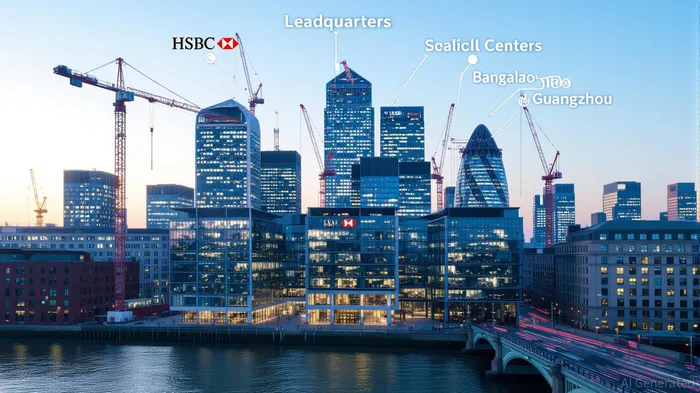
However, this shift is not without operational friction. HSBC faces a projected desk shortfall of 7,700 in London alone when it relocates to its new headquarters in 2026, with similar shortages anticipated in key tech hubs like Bangalore and Guangzhou. The cost of securing additional office space—estimated at $200 million annually—directly challenges the bank's $1.5 billion cost-cutting goals. This tension between strategic priorities and financial discipline raises critical questions: Can the operational benefits of in-person work justify the real estate burden? Or will these costs erode investor confidence in traditional banking's efficiency?
Real Estate Demand: A Double-Edged Sword
HSBC's RTO policy is part of a broader surge in commercial real estate demand, particularly in financial hubs. The bank is already in talks to lease additional floors in London and retain satellite offices previously slated for closure. In India and China, HSBC aims to finalize leases by mid-2025 to meet 2027 deadlines, a timeline complicated by competition from other banks and rising construction costs.
This demand surge mirrors trends in the wider commercial real estate market. Deloitte's 2025 survey of global executives reveals that 60% expect revenue growth to exceed 5% YoY, with 81% prioritizing technology investments to enhance operational efficiency. However, the office sector remains a challenge, with elevated vacancy rates and slower transaction activity. For HSBC, the key will be balancing the need for physical presence with cost-conscious strategies, such as shared workspaces or flexible leasing terms.
Investor Sentiment: Traditional vs. Hybrid Paradigms
Investor confidence in traditional banking models has been mixed. While HSBC's Q1 2025 earnings growth of 11% and a CET1 capital ratio of 14.7% signal resilience, its ESG controversies—such as exiting the Net-Zero Banking Alliance—have raised concerns. Conversely, hybrid work models, which allow 83% of financial services firms to offer location flexibility, remain popular among employees and investors who prioritize cost efficiency and talent retention.
The Deloitte survey highlights this duality: 44% of money managers are bullish on emerging markets, but 14% remain bearish, citing trade tensions and China's property sector risks. For HSBC, the challenge lies in aligning its RTO strategy with investor expectations. The bank's $3 billion share buyback program and 3.5% dividend yield have bolstered short-term confidence, but long-term success will depend on its ability to demonstrate that in-person work drives measurable operational gains—such as improved client satisfaction or faster decision-making—without sacrificing cost discipline.
Strategic Implications for Investors
For investors, HSBC's RTO mandate offers both opportunity and risk. The bank's pivot to in-person work aligns with its broader cost-cutting and regional realignment goals, particularly in high-margin markets like Asia. However, the associated real estate costs could strain margins, especially in a high-interest-rate environment.
Key metrics to monitor include HSBC's cost-income ratio (targeting below 50% by 2026) and its ability to secure office space without derailing restructuring efforts. Additionally, the bank's performance in wealth management and infrastructure financing—segments where in-person collaboration is critical—will be crucial for validating the strategic value of RTO.
Conclusion: Navigating the Post-Pandemic Workforce
HSBC's return-to-office strategy reflects a broader industry reckoning with the post-pandemic workplace. While in-person collaboration remains vital for leadership and client engagement, the financial and operational costs of RTO must be carefully managed. For investors, the key takeaway is that traditional banking models are not obsolete but require strategic adaptation. Those who can balance the benefits of physical presence with cost efficiency—through hybrid models, technology integration, or innovative real estate solutions—will likely outperform in an evolving market.
As HSBC and its peers navigate this transition, investors should prioritize banks that demonstrate agility in balancing operational needs with financial discipline. The future of banking may lie not in a rigid return to the office, but in a nuanced hybrid model that leverages the best of both worlds.





Comentarios
Aún no hay comentarios