
The Post-Oracle Correction: A Strategic Inflection Point for AI-Driven Tech Stocks
The recent slump in Oracle's stock price following its Q2 FY2026 earnings report has crystallized a pivotal moment for AI-driven tech stocks. Investors are no longer content with grand narratives of AI dominance; they now demand proof of capital efficiency and profitability. Oracle's aggressive, debt-fueled expansion into AI infrastructure-raising its fiscal 2026 capital spending forecast to $50 billion-has sparked a broader reckoning with how companies allocate resources in the AI era according to Reuters. This shift marks a strategic inflection point, where the market is recalibrating its expectations for AI investments.
Oracle's Capital-Intensive AI Push and Financial Risks
Oracle's strategy to compete with hyperscalers in the AI cloud space hinges on massive infrastructure spending. While its Infrastructure-as-a-Service (IaaS) revenue grew 52% year-over-year, the company's long-term debt surged 25% to nearly $100 billion, raising red flags about sustainability according to Chronicle. A report by Bloomberg notes that Oracle's free cash flow turned negative in Q2 FY2026, a stark contrast to its historical strength according to Bloomberg. This capital-intensive approach, while ambitious, has left investors questioning whether the company can convert its $523 billion in remaining performance obligations into near-term profits according to market analysis.
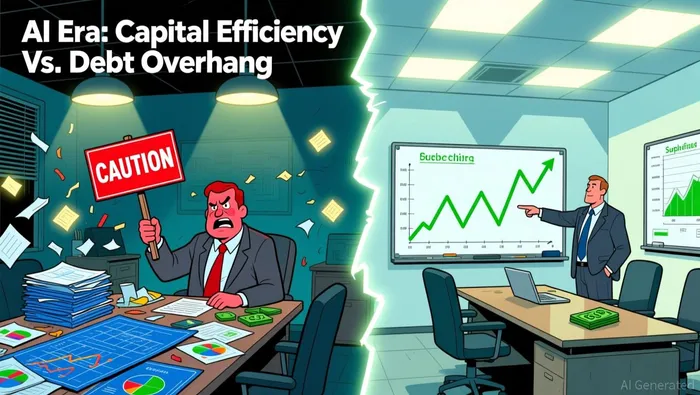 The market's skepticism is evident in Oracle's stock volatility-a 23% plunge in October 2025, its worst monthly drop since 2001, followed by a partial recovery in November according to CNBC. Meanwhile, its 5-year credit default swaps have hit multi-year highs, signaling growing concerns about debt repayment capacity according to CNBC. Oracle's trajectory underscores a critical lesson: in the AI era, scale alone is insufficient without a clear path to profitability.
Broadcom's Profitability and Capital Efficiency as a Benchmark
In stark contrast, Broadcom (AVGO) has emerged as a model of capital efficiency and profitability in the AI sector. Its Q3 FY2025 results revealed a 74% year-over-year surge in AI semiconductor revenue to $8.51 billion, driven by demand for custom AI accelerators and networking chips according to Yahoo Finance. Adjusted EBITDA for the quarter reached $12.22 billion, or 67.8% of revenue, with free cash flow margins at 41.4% according to Yahoo Finance. These metrics highlight Broadcom's ability to monetize the AI boom without the same level of capital overhang.
Broadcom's success lies in its role as a foundational enabler of AI, supplying critical hardware to hyperscalers and enterprises. As Yahoo Finance observes, the company's high-margin, asset-light business model allows it to capitalize on the AI supercycle while maintaining financial discipline according to Yahoo Finance. This divergence from Oracle's debt-laden strategy illustrates the market's growing preference for companies that can deliver both growth and profitability.
The Broader Market Shift: From Narrative to Execution
Oracle's struggles have amplified fears of an AI bubble, prompting investors to scrutinize capital deployment across the sector. A report by Reuters notes that Oracle's gloomy forecasts and soaring spending have dragged down other AI-exposed stocks, intensifying the focus on financial execution according to Reuters. The market is now differentiating between companies that are "enablers" of AI (like Broadcom and Nvidia) and those still in the capital-intensive build-out phase (like Oracle) according to Yahoo Finance.
This shift reflects a maturing investor mindset. As CNBC highlights, the AI narrative is no longer enough; companies must demonstrate how they convert contracts into cash flow. Oracle's $300 billion OpenAI deal, for instance, is a long-term bet that may not alleviate near-term debt concerns according to CNBC. Investors are increasingly prioritizing metrics like free cash flow, debt-to-EBITDA ratios, and return on invested capital to assess AI investments.
Implications for Investors and the Future Outlook
The post-Oracle correction signals a recalibration of risk and reward in the AI sector. For investors, the key takeaway is to favor companies with high capital efficiency and clear monetization strategies. Broadcom's performance underscores the value of asset-light, high-margin models, while Oracle's debt load serves as a cautionary tale about overextending in pursuit of market share.
Looking ahead, the AI sector will likely see further divergence. Companies that can scale infrastructure without sacrificing profitability-by leveraging existing assets or strategic partnerships-will outperform those reliant on debt-fueled expansion. As the market continues to demand execution over hype, the winners in the AI era will be those that balance ambition with financial prudence.







Comentarios
Aún no hay comentarios