
Post-IPO Capital Allocation and Strategic Positioning: The Verisure Case Study
When a high-growth company transitions from private equity ownership to public markets, the post-IPO playbook is often the litmus test for long-term success. Verisure's 2025 IPO-raising €3.6 billion in what became Europe's largest public offering since 2022-offers a masterclass in balancing deleveraging with strategic expansion. For investors, the question isn't just whether Verisure can reduce its debt burden but whether it can do so without sacrificing its aggressive growth trajectory in a competitive sector.
The Deleveraging Priority: A Prudent First Step
Verisure entered the public markets with a net leverage ratio of 5.1x EBITDA, a figure that screamed for immediate action. According to a PitchBook report, over 80% of the IPO proceeds will be allocated to debt reduction, aiming to bring leverage down to 3.0x EBITDA by 2025. This isn't just about aesthetics-it's about financial flexibility. By refinancing high-cost debt and securing lower interest rates through public market access, Verisure is positioning itself to weather macroeconomic headwinds. For context, the security sector's average leverage ratio hovers around 2.5x EBITDA, meaning Verisure will still carry a heavier balance sheet than peers. As CTOL Digital noted, "The trade-off is justified if the capital preserves their ability to outspend competitors on customer acquisition and technology."
Strategic Acquisitions: The ADTADT-- Mexico Gambit
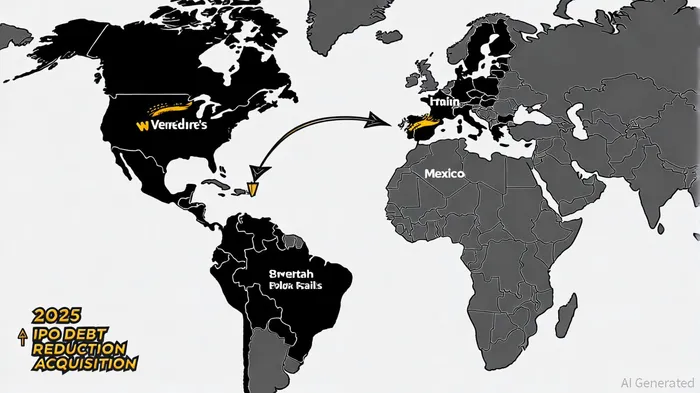
While deleveraging is the immediate priority, Verisure isn't shying away from bold moves. According to a Reuters report, the IPO proceeds will fund its acquisition of ADT Mexico from Johnson Controls, a $1.2 billion deal that cements its foothold in Latin America. This acquisition isn't just about scale-it's about diversifying revenue streams. Mexico's home security market is growing at 8% annually, driven by urbanization and rising crime rates. By snapping up ADT Mexico, Verisure gains 250,000 households under contract, instantly boosting its recurring revenue base. Quartr stated that this move "aligns with Verisure's thesis of leveraging its European playbook in underpenetrated markets."
The Long Game: Balancing Defense and Offense
Critics argue that Verisure's post-IPO strategy leans too heavily on debt reduction, potentially slowing its ability to innovate against DIY security providers like Ring and SimpliSafe. However, management's approach is calculated. By stabilizing its balance sheet, Verisure can afford to invest in AI-driven monitoring systems and expand its 24/7 customer support infrastructure-differentiators in a sector where trust is paramount. A Saxo article highlights that "Verisure's focus on premium, monitored services gives it an edge in markets where DIY solutions lack regulatory traction."
Risks and Rewards: A Cramer-Style Verdict
For investors, Verisure's post-IPO strategy is a mixed bag. On one hand, the aggressive deleveraging reduces downside risk in a rising interest rate environment. On the other, the company's reliance on acquisition-driven growth could strain cash flow if integration falters. The key metric to watch is free cash flow conversion post-2026. If Verisure can achieve 60%+ conversion while maintaining its 10% revenue growth target, the stock could outperform. Conversely, missing these marks-particularly in Mexico-could trigger a re-rating.
In the end, Verisure's 2025 IPO is a case study in pragmatic capital allocation. It's not the flashiest strategy, but in a sector defined by sticky subscriptions and high customer lifetime value, discipline often trumps bravado. As the company navigates its next phase, the real test will be whether it can turn its reduced leverage into a springboard for innovation-not just a Band-Aid for old wounds.
---







Comentarios
Aún no hay comentarios