
Post-FTX Crypto Regulatory and Reputational Risk: Executive Penalties and Their Impact on Market Trust and Innovation
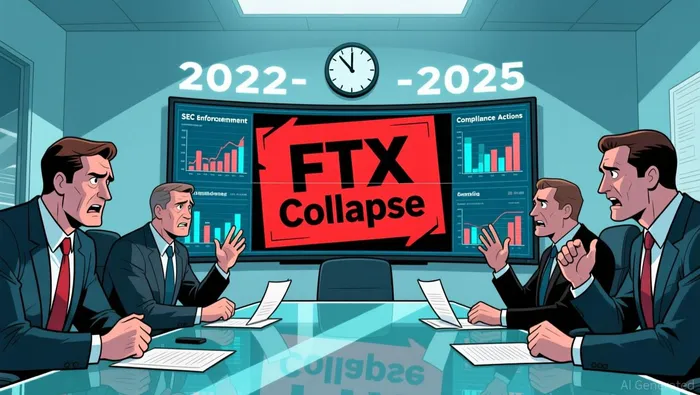
The collapse of FTX in late 2022 marked a watershed moment for the cryptocurrency industry, exposing systemic vulnerabilities in governance, transparency, and regulatory oversight. In the aftermath, regulatory bodies like the U.S. Securities and Exchange Commission (SEC) have imposed stringent penalties on FTX executives, while the broader market has grappled with reputational damage and shifting innovation dynamics. This analysis examines how these regulatory actions and their enforcement have influenced market trust and fintech innovation, drawing on recent data and policy developments.
Regulatory Actions and Executive Penalties
The SEC has taken a firm stance against FTX's leadership, proposing long-term bans on key figures to deter future misconduct. Caroline Ellison, former CEO of Alameda Research, faces a 10-year prohibition from serving as an officer or director of a public company, while Gary Wang and Nishad Singh, former FTX executives, each face eight-year bans. These penalties, coupled with permanent injunctions against securities law violations, underscore the SEC's intent to hold individuals accountable for misleading investors and enabling the misuse of customer funds according to SEC filings. Such measures extend beyond criminal sentencing, effectively sidelining these figures from leadership roles in the financial sector for nearly a decade.
These actions reflect a broader regulatory strategy to restore confidence in crypto markets. By targeting executive accountability, regulators aim to signal that the industry's failures will not be tolerated, thereby reinforcing the importance of corporate governance and compliance. However, critics argue that such bans may inadvertently stifle innovation by deterring talent from entering a sector perceived as high-risk according to industry analysts.
Market Trust and Reputational Risk
The FTX collapse had a profound and lasting impact on market trust, with reputational risks compounding the sector's challenges. According to a report by CoinCover, 40% of consumers now associate cryptocurrency with criminality and fraud, while one in five have become more cynical about the industry according to a CoinCover report. A Bayesian structural time-series analysis further revealed that major cryptocurrencies like SolanaSOL-- and EthereumETH-- experienced sharp price declines following the FTX insolvency, diverging significantly from counterfactual predictions according to a 2024 study.
Regulatory responses have sought to mitigate these risks. The European Union's Markets in Crypto-Assets (MiCA) regulation and initiatives in Singapore and Dubai emphasize transparency and investor protection, aiming to rebuild trust through standardized oversight according to industry reports. Additionally, proof-of-reserves initiatives-where exchanges publicly verify their asset holdings-have gained traction as a tool to restore confidence in crypto custodianship according to market analysis.
Despite these efforts, reputational damage persists. A 2025 report by Fin Integrity highlights that crypto exchanges faced $927.5 million in anti-money laundering (AML)/counter-terrorist financing (CFT) penalties, reflecting systemic weaknesses in compliance frameworks according to a 2025 report. These enforcement actions, while necessary, have also contributed to a narrative of regulatory overreach, deterring institutional participation and amplifying public skepticism according to a Brookings analysis.
Innovation in a Regulated Landscape
The post-FTX regulatory environment has created a nuanced landscape for fintech innovation. On one hand, increased scrutiny has forced companies to prioritize compliance, as seen with Coinbase's strategic shift toward institutional infrastructure and regulatory alignment according to Forbes analysis. On the other, the SEC's pragmatic approach-exemplified by no-action letters for crypto-asset custody and the DePIN (Decentralized Physical Infrastructure Network) token model-has provided a framework for innovation within existing securities laws according to Goodwin Law analysis.
The DePIN model, in particular, represents a departure from traditional investment paradigms. By rewarding participants for services rendered (e.g., data storage, network maintenance), it aligns with regulatory expectations while fostering decentralized infrastructure growth according to Goodwin Law analysis. This suggests that innovation can thrive when it addresses real-world utility rather than speculative investment.
However, regulatory uncertainty remains a hurdle. SEC Commissioner Caroline Crenshaw has cautioned that staff-level no-action relief cannot override statutory definitions, highlighting the need for formal rulemaking according to Goodwin Law analysis. For fintech startups, this duality-between regulatory clarity and ambiguity-presents both challenges and opportunities. Firms that proactively align with evolving standards are likely to gain competitive advantages, while those resisting oversight may face reputational and legal risks.
Conclusion
The FTX collapse and subsequent regulatory actions have reshaped the crypto landscape, with far-reaching implications for market trust and innovation. Executive penalties, while necessary for accountability, have also underscored the sector's vulnerabilities. Meanwhile, reputational risks persist, driven by systemic compliance failures and public skepticism. Yet, the push for regulatory clarity-through frameworks like MiCA and DePIN-offers a path to rebuild trust and foster innovation.
For investors, the key takeaway is that the crypto industry is at a crossroads. Regulatory enforcement will continue to play a critical role in shaping its trajectory, but long-term success will depend on balancing oversight with the flexibility needed for innovation. As the sector evolves, firms that embrace transparency, compliance, and utility-driven models are likely to emerge as leaders in a post-FTX world.







Comentarios
Aún no hay comentarios